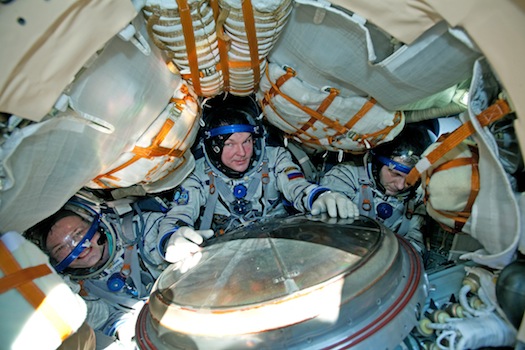
TMA-21 in Mid-Air The Soyuz TMA-21 capsule, here seen in mid-air, landed about 93 miles from Dzhezkazgan, Kazakhstan, a small city smack-dab in the center of the country. Sergei Ilnitsky/AP

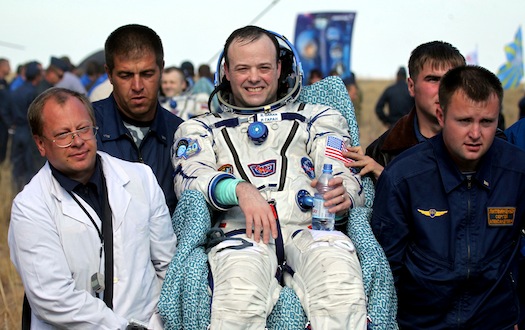
The Russian Soyuz TMA-21 spacecraft, carrying three astronauts (Commander Andrei Borisenko and Alexander Samokutyayev, both Russian, and American Ron Garan) safely landed this morning in Kazakhstan, bringing them home after five months on the International Space Station. The landing, about 94 miles southeast of the smallish Kazakh city Zhezkazgan, wasn't entirely flawless--mission control lost contact with the capsule briefly--but the landing itself was very smooth.


Click to launch a gallery of the capsule's Kazakh landing.

Three astronauts remain on board the ISS: Russian Sergei Volkov, American Michael Fossum, and Japanese Satoshi Furukawa. All three are due to return to Earth on November 22nd, which, as we noted, may leave the ISS unmanned for the first time in a decade, as the preceding launch of three new astronauts has been repeatedly delayed.

[AP]

6 Comments

Pretty sad that we have to car pool.

Live through Wisdom and Faith

At least human spaceflight still exist. A ride is a ride. So long as we can still manage to get there. Besides, these type of operations foster international cooperation. Kind of a small but meaningful step in the right direction.

It's pretty clear already that we need to develop our own ride. But in the mean time we have to get it how we can. Means relying on our neighbors.

When the last 3 astronauts leave the ISS in November and the ISS will be unmanned, I hope they remember to turn off the coffee pot.

wait the amazing part is they can land on land from space.... from what i understood the US can only land astronauts on water successfully unless i am mistaken...

@ kamikazesmiley
The united states is perfectly capable of landing on land. That is what the space shuttle did (before it was scrapped). I'm not so sure if the new system they are designing will though.

Hey @ kamikazesmiley: The Americans can't set Apollo/Gemini style capsules down on dry land because the continental U.S. hasn't enough uninhabited land to do so.The Russians have millions of acres of sparsely populated land to do so.Even if a Soyez crashed through the roof of some sheepherder's hut,they probably wouldn't have to worry about getting sued.


140 years of Popular Science at your fingertips.


Popular Science+ For iPad

Each issue has been completely reimagined for your iPad. See our amazing new vision for magazines that goes far beyond the printed page


Download Our App

Stay up to date on the latest news of the future of science and technology from your iPhone or Android phone with full articles, images and offline viewing


Follow Us On Twitter

Featuring every article from the magazine and website, plus links from around the Web. Also see our PopSci DIY feed


February 2013: How To Build A Hero

Engineers are racing to build robots that can take the place of rescuers. That story, plus a city that storms can't break and how having fun could lead to breakthrough science.

Also! A leech detective, the solution to America's train-crash problems, the world's fastest baby carriage, and more.


Online Content Director: Suzanne LaBarre | Email
Senior Editor: Paul Adams | Email
Associate Editor: Dan Nosowitz | Email

Contributing Writers:
Clay Dillow | Email
Rebecca Boyle | Email
Colin Lecher | Email
Emily Elert | Email

Intern:
Shaunacy Ferro | Email

circ-top-header.gif
circ-cover.gif
bmxmag-ps