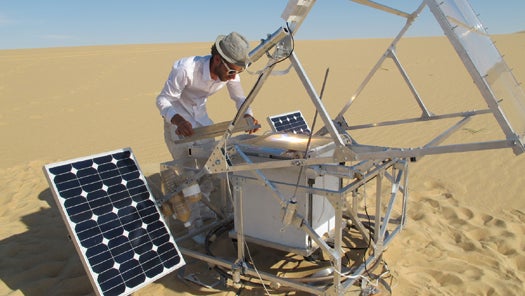
Markus Kayser’s Solar Sinter project takes the desert’s two most abundant resources, sunlight and sand and puts them to work manufacturing glass objects. Kayser loads the sand into a solar-powered 3-D printer where it serves as the raw material for glass. In a process that’s fascinating to watch, concentrated sunlight replaces the laser typically found in 3D printers, melting sand (instead of resin) in patterns to form an abstract sculpture or, more usefully, a bowl.
Kayser tested the Solar Sinter for two weeks in the Sahara desert in May of this year; you can see the results in the video below. The project is currently on display at the Royal College of Arts in London.
[Markus Kayser via Engadget]
Five amazing, clean technologies that will set us free, in this month's energy-focused issue. Also: how to build a better bomb detector, the robotic toys that are raising your children, a human catapult, the world's smallest arcade, and much more.


Online Content Director: Suzanne LaBarre | Email
Senior Editor: Paul Adams | Email
Associate Editor: Dan Nosowitz | Email
Assistant Editor: Colin Lecher | Email
Assistant Editor: Rose Pastore | Email
Contributing Writers:
Rebecca Boyle | Email
Kelsey D. Atherton | Email
Francie Diep | Email
Shaunacy Ferro | Email
Sounded like Pop Rocks when the sand was melting. We will be using tech like this on the moon to build structures. We'll just print them using regolith and the power of the sun!
That's what I call resourcefulness!
awsome
Imagine, if these printers could be made into autonomous robots, they could build us a city in the desert made almost entirely of glass! Of course there'd be metal bits here and there that other robots (or humans) would install, but it'd be a gleaming example of the accomplishments of humanity! And it'd only cost whatever it costs to (1) design (2) engineer (3) maintain the robots, and the aforementioned metal bits. But that's nothing considering you get an entire CITY out of the deal.
Excelente idea puesta en practica. Una muestra más de que todo es utilizable, tanto para bien como para mal. Pero en este caso celebro que sea para algo constructivo. Suerte
A glass house like the house in the movie '13 ghosts' I wouldn't want to share!
Interesting, I could use one of these
the sculptures looked more like sandstone than glass.
For those of you who know about the reprap project, this looks like a variation on the design that uses a much stronger heating mechanism in order to accomplish a similar goal. The reprap project is a project dedicated to producing an inexpensive, self-replicating 3D printer. So far, the clonedel fork of the project has reduced the expense of 3D printing significantly by using molded bootstrap parts for the printer that were imprinted using an original plastic printed set. Reprap uses a similar method, whereby it heats plastic and prints vertical surface layers until a 3D replication of a CAD object results.
This is interesting because I was discussing the idea of being able to power a 3D printing device in a remote location so as to make it universally available to remote areas of the world that are less technologically diversified. This idea seems perhaps more pragmatic in the sense that it is able to use the resources readily at hand, such as sand to make "glass" objects. I like the idea of being able to use such a device on remote locations that require bootstrapping with available resources. Certainly, a lunar environment could be simulated here using the desert model. More pragmatic, perhaps, would be the ability to fuse sand on or silica on a slighly larger scale: instead of encapsulating the fusing device within its own framework, a freely moving robotic device that uses a visual sensing apparati to A) survey and level a site prior to laying the foundation for the model to be constructed, and B) uses a silica gathering device and collection feed to supply itself while printing out the model.
If such robotic device were designed, it would have limitations in the vertical dimension as to how tall of a model it could construct. This limitation could be potentially overcome by lightly fusing its own "scaffolding" which would then more easily be broken apart by some subsequent process, similar to breaking a cast out of a mold. It is possible to conceive of such devices autonomously building small shelters and the like in out of the way places with nothing more than the sun to power them and the necessary time to complete the project at whatever rate is allowed. It would be interesting to see what the time frame for such a construction technique would entail, and likewise, what protective measures, if any, would be required for the circuitry that would power such a device so that it does not over heat. I suppose that this is part of the reason that the sun-shielded "office" was provided, however, for projects that would require the device to be exposed for prolonged periods of time to extreme heat, more protective measures would be required.
Thermal engineering seems to be the main hurdle to get over to make this device useable for any large scale construction in such environments. On the lunar surface, however, because of the lack of atmosphere, heat build up may pose less of a threat to electronics, motors, and servos.
[Standard Noodler Disclaimer: I have been thinking about this for a long time, long before seeing what this clever fellow has done] I have often wondered if solar sintering of dunes would decrease the creep of the deserts onto arable land in North Africa. How much and what part of a dune would most effectively reduce its blowing away? My own guess is that a net pattern across the tops would work well, and that in areas in which the Sahara literally threatens to swallow towns, walls could be built of the dunes themselves...perhaps even with assistance from space. Yup. I am a nerd. Thoughts?
very resourceful! these are the kinds of innovation i enjoy hearing about. :)
er.. i meant that solar sinter project not the sand/glass dike created from space lasers or whatever..
but my thoughts on that would be that the encroachment of the desert over arable land is most likely due to fluctuations in atmospheric temperatures.
so unless you can figure out a way to manipulate the weather then.. no.. i don't think those sand dikes would suffice.
Hey Greymase you stole my icon...
This is a great advancement in green production, granted it's clunky right now, but look back at the first computer, light bulb, led, mouse, etc etc etc. Refining of this design will yield some impressive results.
As far as using this tech on the moon or mars? I don't think that the heat required would be achieved in those locations to support any useful product. But I guess one never really knows. Wonder what the melting temp of lunar sand/dust is...
Playing Devil's Advocate since 1978
"The only constant in the universe is change"
-Heraclitus of Ephesus 535 BC - 475 BC
Hey CodeZero, i could take yur icon and you couldnt do a thing about it!
now what did i tell yall, them terrorist done got themselves a fazer ray
Yep, if you got ten thousand dollars worth of equipment and drag it out into the hot, dusty desert then I suppose you can make something worth ten cents with it.
Being a general contractor, my first thought is how durable and strong is the end material?
While this is great looking for a bit of art, can he make bricks? Are those bricks strong enough to be built into a wall? If so then he has an idea that has someplace to go as a product. If all he can make is pretty objects, then it is merely an art project, not something that will really change the world
The idea, on the surface, seems like a good one. IF the end product is strong and durable enough to be used to make useful things.
I completely agree with Bowyn_Aerrow (nice name, by the way). The end product is glass, after all. You all are saying they should build houses out of the material, but it seems we've forgottenthe old saying "People in glass houses shouldn't throw stones". In this case the saying is literal. what is the second most abundant thing in the desert? Rocks. I give it a week before a house made of glass produces the most comical work of teenage vandalism ever.
Also, glass really isn't that insulated. Hold a glass full of hot coffee and say I'm wrong.
@aarontco & other's sniping from the sidelines: It's so much easier to sneer and criticize, than it is to actually innovate. What have you discovered or built recently (ever)? Anyone, who doesn't see the potential here -- well beyond making "something worth ten cents" -- has a woefully limited imagination.
In terms of desert encroachment, I don't think the bricks would necessarily need to be all that strong...a solid block of glass is quite a bit less fragile than sheet window glass that most people are thinking of.
Anyway, set something up making glass bricks out of sand and either humans or another robot making them into a wall on the order of 5 to 10 feet tall. Desertification occurs because the wind and dryness allows the fertile soil at the edge of a desert to get blown off into the desert.
A low wall or series of walls likely can help slow the process, but would not be a cure-all either.
This kind of stuff fascinates me. I love the different ways people would put something like this together. I see lots of potential for various artistic forms. Others see a tool for colonizing other planets or building in a harsh environment. In a way, machines like this are an art form themselves. Take a look at the Sun Cutter Markus built. Aside from those killer shades, I see the sun cutter and other machines like that as pieces of kinetic art. I don’t think it would be all that expensive to build one either. Some of the more technical components may get kind of pricy but I am sure there is a maker way around it. That looks like a Fresnel lens. I have one in an old rear projection TV. I only held on to it for the lens. Now I have a potential project to put it to use.
thats intellectually stimulating :)