
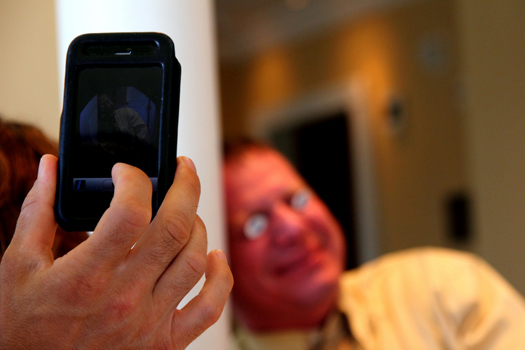
It was only a matter of time, and that time is fast approaching: Google is incubating a mobile app that will use facial recognition technology to identify people and access their personal info via photos snapped with a digital camera or mobile device. Privacy advocates, prepare for war.
For its part, Google is trying to get in front of the privacy argument that is undoubtedly coming (Google is getting pretty good at this by now) by assuring users that they will have to opt into such a service by checking a box. And the search giant is working on added layers of security and privacy to ensure that only those who want to be photographically found will be.
The idea is that Google’s massive search resources could be used to trawl social networks, online photo sharing sites like Flickr and Picasa, and the like to associate an individual’s face with his or her online presence. This, of course, could also include contact info like email addresses and phone numbers. It would at the very least identify a person by name, with which any reasonably tech-savvy person could track down contact information anyhow.The technology, a Google engineer says, already exists and has for some time (though we really already knew that, since Google is not the first to come up with such an app). But the company is sensitive to privacy issues--if not out of genuine concern for its users then for avoiding public backlash--and wants to make sure that when it launches, it launches the right way. As such, Google has not said when it will release the product, or even so much as offered a rough production timeline. But don’t worry about being left out of the loop; when the app does launch, the stranger sitting across the coffee shop will surely email you to to let you know.
Update: A Google rep. dropped us a call to let us know that the news story upon which this blog post is based is "extremely speculative," and that the company has no such application in the pipeline, nor does it have plans to introduce such a facial recognition app to its development pipeline. According to Google, the engineer--director of engineering Hartmut Neven--was speaking to CNN's reporter about hypothetical uses for some of Google's technology, not about existing applications or applications under development.

[CNN]
Five amazing, clean technologies that will set us free, in this month's energy-focused issue. Also: how to build a better bomb detector, the robotic toys that are raising your children, a human catapult, the world's smallest arcade, and much more.


Online Content Director: Suzanne LaBarre | Email
Senior Editor: Paul Adams | Email
Associate Editor: Dan Nosowitz | Email
Assistant Editor: Colin Lecher | Email
Assistant Editor: Rose Pastore | Email
Contributing Writers:
Kelsey D. Atherton | Email
Francie Diep | Email
Shaunacy Ferro | Email
Wow, it took them long enough- How long will it take, I wonder, for them to be able to access the gigantic store of faces inside Facebook? I think that in a few years we able to wear a pair of augmented-reality glasses that recognizes almost everyone around you by name+ tells you information about them (so you can know the name of your grocery store clerk by name and creep them out!). Go future!
Wow is nothing safe anymore? seriously. Everything that has to do with personal info is all over the internet. And they are still deciding to come out with new ways to find info about people.
38KKK
*D Ace Lee*
\m/(>.<)\m/
Rewatch the minority report in a decade, it will look like a completely realistic movie.
except precogs probably still won't exist...
Fundamentally I think it will be a good thing. It will cause people to act more responsibly in a public setting.
People who act rudely will not be screened by anonymity any longer. And someone who defrauds others, can be treated accordingly by civil society. That will make sociopaths lives much more difficult, as they will be recognized by strangers and treated accordingly for their actions.
@barnz - In some ways, I agree, in others I do not.
For one, it is true that people will begin to act differently while knowing they could be watched. Hence the purpose of dummy (or real) cameras located in gas-stations and super-markets. However, if such a system expanded to the point where there is NO privacy, then you will ultimately need a system where observers who police every action will need observers to police their actions.
Such a problem exists already in our justice system where corruption is often times just one layer above - that being those enforcing the laws. If a system was in place where Group A monitored Groups B and C, and in turn Group B monitored Groups A and C, and in turn Group C monitored Groups A and B, certainly this check-and-balance system solves some of the problems... however I can only imagine the expense and paranoia that would create. It also means that under the right conditions, someone could influence two of them to target a 3rd group.
I also picture in my head the scenario of the sitcom where person A exposes (by mistake) the dark secret of person B to person C... in turn, as revenge person B, reveals the dark secret of person A (ect...) and next thing you know EVERYONE is mad at EVERYONE and no one wins. Then we all laugh and say "that could never happen in real life". But can it?