
We may earn revenue from the products available on this page and participate in affiliate programs. Learn more ›
Microsoft’s Applied Sciences Group recently displayed some very advanced 3-D technology, that solves a major problem with 3-D: the glasses. 3-D without glasses has been around for awhile, but it has always had some limitations. One of the largest and most troubling limitations is that it only works for one viewer, and that viewer must keep their eyes within a specific area.
The displays do this by using lenses or filters that divide the image between the viewer’s eyes creating a 3-D effect without relying on glasses that use active or passive means to only show specific images to each eye.
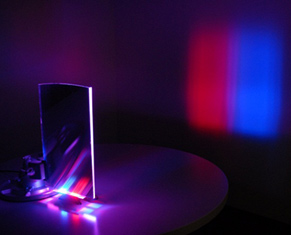
Microsoft’s new display relies on a wedge-shaped lens that doubles as the screen. It uses motion tracking to track up to four viewers and display a 3-D image to each of them. The motion tracking is vital to displaying 3-D without glasses, as this form of 3-D is impossible to achieve without knowing the viewer’s head position. As we stated before, this can be done without head tracking but it only works for one viewer and that person must keep their head in a very specific position or the 3-D effect will be lost. With the motion tracking ability the display can focus the 3-D effect in real-time on the viewer by detecting and constantly updating their position. Nintendo is using this tehcnology combined with a parallax filter in their new handheld gaming device they announced at E3, the eagerly awaited 3DS.
The real breakthrough with this Microsoft display is the ability to track and display 3-D to four viewers at once. Currently the technology is limited to a 20 degree viewing angle, though the researchers feel they will be able to get it up to at least 40 degrees. In the case of LCD and LED screens you’ll experience picture degradation at angles wider than this anyway, so it’s not such a big deal.
3D without glasses is the holy grail of 3D TV so we will be sure to keep an eye on further developments of this technology.
This article originally appeared on 3DTVBuyingGuide.com.
