
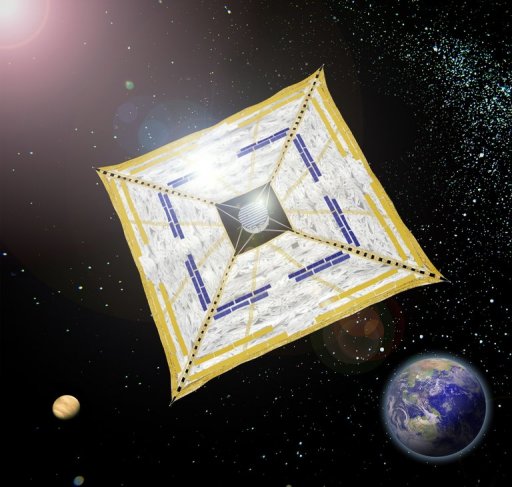
Space Sailing This rendering provided by JAXA depicts what Ikaros might look like cruising the cosmos with its sail unfurled. JAXA

After lots of talk and testing, Japanese researchers are ready to go space sailing. Japan Aerospace Exploration Agency (JAXA) announced its intention to launch its first "space yacht" propelled by solar sails into the heavens on May 18. Ikaros -- the Interplanetary Kite-craft Accelerated by Radiation of the Sun -- will cruise through the solar system powered by solar particles that bounce of its giant, ultra-thin sails.

Ikaros -- which aside from being a somewhat clumsy acronym is also an allusion to the Greek mythological character who flew too close to the sun -- marks the first time a space craft will enter deep space towed by solar sails, which provide a fuel-free means to explore the solar system provided the craft is near enough the sun to catch a particle powered breeze. Several prototype space sails have been unfurled in orbit by various agencies including NASA, but as far as long-term propulsion is concerned the Ikaros mission is solar sailing's coming out party.

Ikaros's 46-foot flexible sails are thinner than a human hair and equipped with thin-film solar cells that will generate power for the craft, which mission controllers on the ground will steer by making adjustments to the angle at which incoming radiation strikes the sails. Such technological strides haven't come cheap; JAXA has already poured $16 million into the vehicle, and there's no guarantee this maiden voyage beyond orbit will succeed.

But given Japan's space aspirations, gambling on Ikaros's technology is but a small step. JAXA's ambitions are pretty aggressive in the near term in stark contrast to the U.S.'s long-term space exploration approach recently detailed by President Obama. The same rocket that carries Ikaros will send Japan's first satellite to Venus as well, and JAXA plans to land a wheeled exploration robot on the surface of the moon by 2015, adding a moon base inhabited by several wheeled robots by 2020. The country plans to spend at least 2 billion dollars on its lunar ambitions over the next decade.

[PhysOrg]

13 Comments

I know you only have so much space for these articles, but you left out an important component of the IKAROS: it's photon propulsion engine. The article gives the impression of an un-manned skooner, drifting along. It's not just out there floating haplessly. It's more like a sailboat with a little propeller attached making it a sort of hybrid. I think that's an interesting addition the Japanese put on there.

several problems i might consider: micrometeroids will tear through the sail.

light has no mass so theoreticall and practically it cant push the craft, so i surmize its powered by solar wind: charged particls of electrons, protons, Hydrogen bonds and whatever has enough mass to make any difference in speed at all.

thats it i guess. although solar cells to power an electric propulsion system would work.

I liked project Orion better, if used correctly ( taking off in space rather than on earth :( )

@ extramechiton: It is true that photons of light have no mass, but they do carry momentum. When a photon bounces off an object, there is a momentum transfer that gives the object a nudge. Whenever a charged particle (like an electron) accelerates it emits photons, and conversely whenever a photon hits a particle, the particle gets an acceleration.

Energy E=hv (v is frequency, h is planck's constant)

Momentum P=h/y (y is wavelength, since I don't think I can insert a lambda in this text box)

I like that idea. Japan is great.

For a more effective and cost efficient way of space exploration by humans, I still prefer powerful means of propulsion such as aneutronic nuclear fusion.
www.youtube.com/watch?v=ng0NNRor_iQ
www.crossfirefusor.com/nuclear-fusion-reactor/overview.html

momentum= mass*velocity

im trying to picture this.... a teency weency ball of something... idk what a photon is since i think light is a wave... that has no mass but contains a velocity of 300 kilometers/second and theres an infinite amount of these lighty thingys collide with an object over 9x10^100000000000000000000000000000000000000000000000000000000000000000000 its mass (theoretically idk how heavy the craft is) and in space there is no weight due to 0 gravity... im losing myself.

> can just see the future ;won't just have america's cup yachting, there will be solar cup yacht race, 1st marker bouy the moon,2nd marker bouy venus,3rd marker bouy mercury,finish line earth;& not just windsurfing or landyachts; going to have solarsurfing(already they go skysurfing from thousands of feet) & solarkite surfing;
> or surfing the tail of comet as it goes around the sun, that would be xtreme sports.

The photons that bounce off the sail transfer momentum and in the process undergo a Doppler shift to a lower frequency. Now if we could only find a way back...tacking is going to take a while!

Robert M. Smith, MD, PhD

What about E=mc2? m=mass.

if light waves come from every where the craft will move in the opposite direction the most light waves are coming from.

if light waves come from every where the craft will move in the opposite direction the most light waves are coming from.


138 years of Popular Science at your fingertips.

Innovation Challenges


Popular Science+ For iPad

Each issue has been completely reimagined for your iPad. See our amazing new vision for magazines that goes far beyond the printed page


Download Our App

Stay up to date on the latest news of the future of science and technology from your iPhone or Android phone with full articles, images and offline viewing


Follow Us On Twitter

Featuring every article from the magazine and website, plus links from around the Web. Also see our PopSci DIY feed


February 2012: The Future of Fun

Science is reinventing play, from extreme sports to gamification to ridiculous roller coasters to the playgrounds of tomorrow, and this issue is chock full of fun. Also, on a less fun note: Did global warming destroy my hometown?


circ-top-header.gif
circ-cover.gif