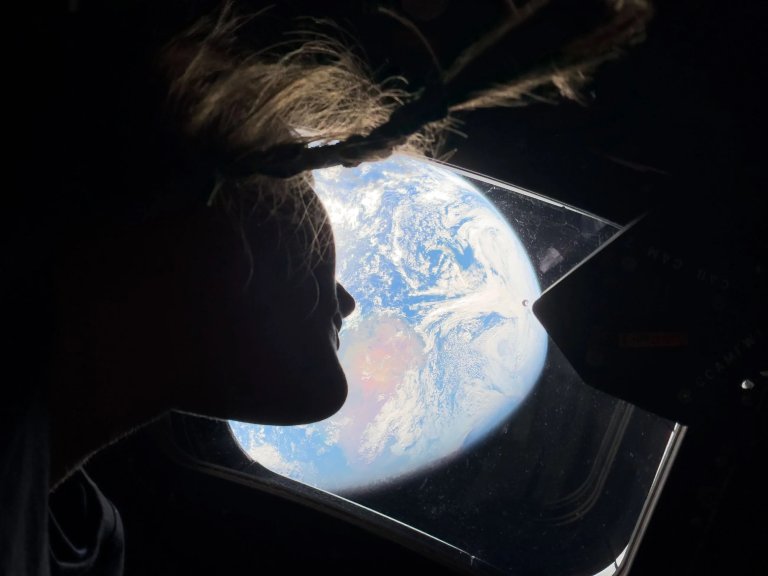
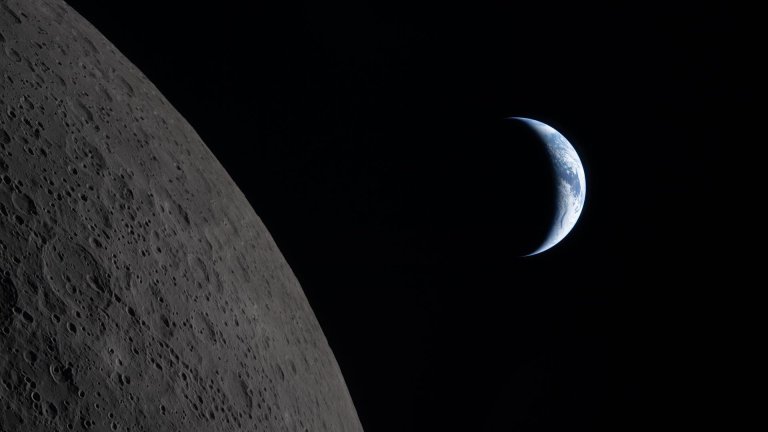
What does the past look like from 200 miles up? A new generation of archaeologists has found that the history of civilization may look far clearer from the top of the atmosphere than it does from the bottom of a dig

On High The temple of Angkor Wat from above—the surrounding ruins hold untouched archaeological treasure. NASA; Stephen Studd/Getty

If it weren’t for the landmines, Lingapura would be a great place to dig. For part of the 10th century, this pocket of northwestern Cambodia was the capital of the famed Angkorian empire, a sprawling city studded with homes, irrigation channels, and more than 1,000 temples crowned with stone lingam, or phalluses. But ever since Pol Pot and the Khmer Rouge dotted Cambodia with millions of landmines in the 1970s, Lingapura’s ruins have sat mostly untouched.

For Damian Evans and Bill Saturno, now surveying Lingapura from atop a crumbling 1,000-year-old tower, the mines don’t really matter. Evans and Saturno are among a growing group of archaeologists who use radar, satellite imagery and other advanced technologies to uncover the mysteries surrounding ancient civilizations. This young vanguard of scholars explores not only regions where violence rules out groundwork, but also sites previously invisible from the ground: the ocean floor, dense jungle, even buried cities. They are transforming archaeology from a gritty, hands-on profession into an office job—what NASA terms, in program-funding documents, “space archaeology.” In doing so, they’re unearthing whole civilizations and rewriting history books: reshaping, in a few short years, the study of our preindustrial past.

Here in Cambodia, the new archaeology has changed the history of a civilization. The low-key Evans, a director of the University of Sydney’s Greater Angkor Project at just 32 years old, has already mapped northern Angkor, another heavily landmined area, from a computer screen in Australia. He has used radar and satellite images to chart its vast network of canals and reservoirs, proving that Angkor was once the largest city in the world, a metropolis consuming an area about the size of present-day Los Angeles. His work also underpins a radical new explanation of why, in the 15th century, the Angkor civilization died out, a finding that holds grave undertones for the megacities of the 21st century.

Now Evans has set out to map nearby Lingapura. The first stop in his mission is this tower, the closest approximation he can get to the vantage point of a satellite. When humans construct a house, field or temple, they alter the surrounding plants and trees—either deliberately, through farming or grooming the forest, or unintentionally, by enriching the soil with meal scraps and organic waste. This process creates vegetative trails that can linger for centuries. The team’s goal today is to discover what kinds of vegetation grow at Lingapura’s settlements and nowhere else—the space archaeologist’s equivalent of the X that marks the spot.

Page 1 of 7 1234567next ›last »
Want to learn more about breakthroughs in electronics, medicine, nanotech, and more?
Subscribe to Popular Science and enter to win $5,000!

8 Comments

The linga is a representation of the god Shiva.
Its is the form of an egg, not a phallus.
The egg represents the universe in its seedling stage before the 'Big Bang'.
If you had eyes you would appreciate this egg shape.
Note there is not stalk attached to it so there is no way you can see a phallus in it, unless you are a moron.
It is half-articulate fools like you that insult ancient cultures.
If you want to be worthy of the title of scientist, get the whole picture and present it, rather than fragments glued together incorrectly.

Aside from that the article is nice.

Meh. Much more interesting if it WERE a phallus. An EGG? How emasculating. Pshh... shancre is a vedic fanboy.

EGG what?!>@?#
oh shancre oh shancre..u should have first confirmed b4 writing that comment...should have saved some embarrassments

Didn't they use something like this to locate the ancient temple underneath the antartctic ice, where the humans were lured by the Predators?

There are no "vedic fanboys" who pretend that the lingam is anything but a phallus. In fact, the representation of Shiva in iconic form is that of a phallus penetrating a yoni, aka vagina.

So much for eggs.

I think that particular pantheon has an imbalance in the arm to yoni ratio.

العاب البنات
العاب باربي
<
افلام
منتديات
العاب طبخ

great

Whatever the abstract meaning of the lingam in classical Indian texts, this is largely irrelevant here, where the salient issues are: 1) what the object meant to the people of the culture in question; and 2) how scholars of that culture interpret the meaning.

Almost all of the ancient Khmer would have been utterly unaware of the formal meanings of things in the Indian tradition, 'cosmic eggs' or otherwise. In the Khmer traditon, linga are frequently carved with decorations showing, in elaborate and unmistakable detail, the physical characteristics of the male penis. They do indeed have a shaft, and are never even remotely egg-shaped. The Khmer-language name for the Shaivite temples that house them is 'prasat leung', which literally means 'penis temple'. I could go on (or you could just google it). It is perfectly reasonable therefore for scholars to interpret them, on one level, as phallic symbols.

The article is therefore bang on correct, and the original poster, shancre, has demonstrated for us irrefutably the moronism of which he incorrectly and hilariously accuses the article's author and subject. Nice work!


Download Our iPhone App

Stay up to date on the latest news of the future of science and technology from your iPhone with full articles, images and offline viewing


Follow Us On Twitter

Featuring every article from the magazine and website, plus links from around the Web. Also see our PopSci DIY feed


Become a Fan On Facebook

Share links with friends, comment on stories and more


December 2009: Best of What's New

In our December issue, Popular Science names the 100 best innovations of the year: bombproof wallpaper, self-parking cars, the fastest helicopter, and 97 more. Plus inventor profiles and videos.

Check out the best of what's new here.

Popular Science Photo Pool


Share your photos in the Pop Sci pool at www.flickr.com!
tags_sprite.png
POP_embeddedForm_cover_May09.jpg