
Engineers find that ivy uses nanoparticles to climb walls

Ivy Nanoparticles American Chemical Society

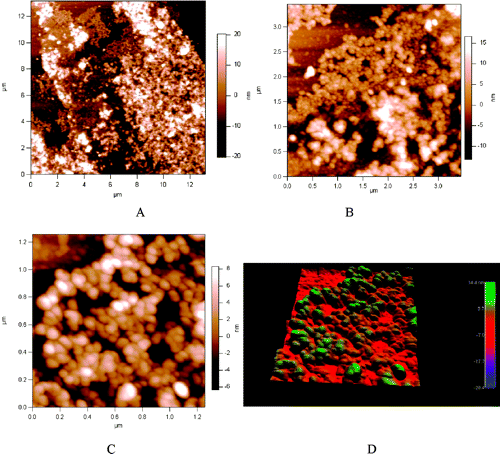
It's about time someone recognized ivy's ability to stick to walls, especially with geckos getting all the headlines lately. You had to figure that at some point a few scientists were going to sit down and start figuring out how to transfer ivy's sticky technique to man-made materials. Now researchers from the University of Tennessee and Agilent Labs have determined that ivy actually secretes tiny nanoparticles to bind to surfaces.

The scientists found that ivy most likely sticks to surfaces through hydrogen bonding. Also, the material secreted is initially in a gel-like state—then it dries and hardens, and that section of the ivy becomes firmly attached.

Now the idea is to study the secretion mechanism in more detail, and explore potential engineering applications. Medgadget suggests that sutures and surgical adhesives are two possibilities. The research is described in a paper published in Nano Letters.

Want to learn more about breakthroughs in electronics, medicine, nanotech, and more?
Subscribe to Popular Science and enter to win $5,000!

1 Comment

Does the hydrogen bond gel do harm to the structures that it bonds to??

This would be something important to find out BEFORE you go ahead and use it in buildings, as you suggest.


Download Our iPhone App

Stay up to date on the latest news of the future of science and technology from your iPhone with full articles, images and offline viewing


Follow Us On Twitter

Featuring every article from the magazine and website, plus links from around the Web. Also see our PopSci DIY feed


Become a Fan On Facebook

Share links with friends, comment on stories and more


November 2009: Astronaut 3.0

Inside NASA's astronaut bootcamp and the grueling new training regimen for deep space. Plus, ten young geniuses shaking up science today, one writer's quest to analyze every man-made chemical in her body and more.

Check out the issue's full contents online here

Popular Science Photo Pool


Share your photos in the Pop Sci pool at www.flickr.com!
tags_sprite.png
POP_embeddedForm_cover_May09.jpg