People don’t usually become scientists expecting fame, glory or to have a line of sneakers named after them. But we at Popular Science believe that scientists are the true celebrities of our time. Their contributions enhance our lives and stretch our imaginations. For the fourth year running, we conducted a rigorous search to identify some of the most dynamic, promising young researchers at institutions around North America.
We sought nominations from university department heads, the organizations that award prizes for scientific merit, and the editors of prestigious journals. We were looking for people who are just starting to get noticed for work that is pushing their fields in new directions. This year’s crop of Brilliant 10 winners are investigating such matters as the nature of black holes, the mechanisms that enable human cells to sense their surroundings, and the creatures that inhabit deep-sea volcanoes-oh yes, and the bizarre mating rituals of venomous spiders. We chose them based on their stellar credentials. When we met them, we weren’t disappointed. You won’t be either.
Amy Barger
University of Wisconsinâ€Madison
She probes black holes to fathom the early days of our universe.
If you can see a star with your naked eye, Amy Barger probably isn’t interested in it. What gets her going are the faraway objects invisible to anything but the most powerful instruments. I’m just really fascinated by what’s going on at the edge,” she says. The farther out, the better.”
By the mid-1990s, researchers figured they had most of the universe’s history tied up. The early universe was speckled with a few intensely bright objects called quasars, whose cores are thought to contain black holes billions of times as massive as the sun. These supermassive” black holes gulped down the surrounding dust and gas, heating it and making it blast light at all frequencies. Measurements indicated that black hole activity peaked around 11 billion years ago, three billion years after the big bang.
But these conclusions were based primarily on visible light. Barger was among the first crop of scientists to monitor multiple wavelengths by combining data from many telescopes. As a just-
minted Ph.D. working at the University of Hawaii, she was awarded time on SCUBA, a far-infrared camera, and discovered a previously unknown population of quasars. Next Barger, 34, led a team that surveyed a small section of sky using NASA’s orbiting Chandra X-Ray Observatory. Only x-rays would reveal certain dust-enshrouded black holes.
The team matched those objects to visible galaxies, painstakingly extracting each one’s redshift, a measure of its distance. The lower the redshift, the more recent the black hole activity. I suddenly realized the average redshift was astonishingly low. â€Whoa, what’s going on?’ ” Barger recalls thinking. Her conclusion: Active black holes abound in relatively nearby galaxies, which means that they were active much more recently than previously thought. And although the newly discovered black holes are weaker than quasars, their combined glow actually outshines their older counterparts.
The discovery raises fresh uncertainties. Why are nearby black holes so plentiful? How does their activity relate to star formation? These are just the sort of questions Barger likes. I want to see how things within the universe evolve,” she says. Ultimately, it leads to us.”
-JR Minkel
Sebastian Thrun
Stanford University
He’s making a car so smart it drives itself. Someday we may all travel that way.
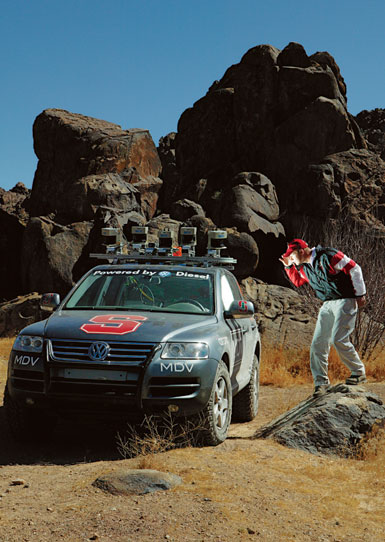
Sebastian Thrun isn’t watching the road when his driverless Volkswagen SUV veers off-course and heads for a 50-foot precipice. He’s in the backseat looking at a laptop that’s tracking the car’s brain, which consists of seven Pentium processors. When he feels the car swerve abruptly to the left, Thrun looks up, pushes aside a bundle of cables blocking his view, and realizes that his car is about to pull a Thelma and Louise.
Thrun, 38, director of the Stanford Artificial Intelligence Laboratory, is field-testing what he hopes will be the world’s first fully autonomous car. Outfitted with lasers, radar, cameras, GPS and, most important, Thrun’s breakthrough road-finding and obstacle-recognition software, it will compete in the second annual DARPA Grand Challenge robotic-vehicle race, to be held in the Southwestern desert on October 8. But it’s not the $2-million purse that motivates Thrun. An unwavering optimist, he envisions robot cars traveling our nation’s highways, cars that drive better than humans, causing fewer fatal accidents.
Optimism will come in handy. The most successful entrant in last year’s race completed just 7.4 miles of the 175-mile course. Despite vast gains in computing power, intelligence still eludes robots. Model-based robots can’t simulate real-world complexity, while reactive robots lack the ability to plan ahead. In 1998, while programming a tour-guide robot to navigate a crowded museum, Thrun had a Zen-like revelation: “A key prerequisite of true intelligence is knowledge of one’s own ignorance,” he thought. Given the inherent unpredictability of the world, robots, like humans, will always make mistakes.
So Thrun pioneered what’s known as probabilistic robotics. He programs his machines to adjust their responses to incoming data based on the probability that the data are correct. In last year’s DARPA race, many derailments occurred when a ‘bot’s sensors provided faulty information, causing it to, for example, mistake a tumbleweed for a rock and stop in its tracks. Thrun’s car didn’t go off the cliff mentioned above, because its software ignored the bad GPS data (which it judged to have a significant probability of error) and responded instead to the more accurate laser readings. (If the car hadn’t made the right choice, Thrun or a colleague would have hit two giant red buttons next to the wheel to disable the AI.)
By early July, Thrun’s car had navigated 88 miles of last year’s route. It would have logged more, but the pace car got a flat tire after its (human) driver failed to avoid a bump in the road.
-Rena Marie Pacella
Doug James
Carnegie Mellon University
His programming prowess yields the fastest, most accurate collisions ever simulated.
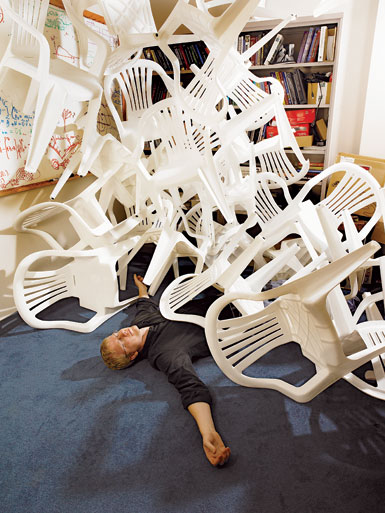
A waterfall of plastic lawn chairs. A stampede of horses and elephants through chess pieces. A hail of fish smacking a bridge. These animations, created in hours instead of months, are the surreal handicraft of Doug James. “Everything I do has to have lots of cheap collisions,” he says. James, 33, has created tools that simulate collisions more convincingly and faster than ever before. James hopes to enable programmers to manipulate 1,000 objects in the same amount of time it now takes to handle just one or two. That fluency could usher in novel applications that were formerly impractical, such as real-time virtual surgery; it should also enable more-realistic special effects in films and computer games, such as animated battles that look and sound natural.
When James started working on collisions in 2002, algorithms for simulating flexible objects were painfully intricate. The software divided each object’s surface into many little triangles. When two objects touched, the program calculated the effects of the impact by determining the new locations of all the triangles. But James observed that the physics of collisions can be relatively simple. Bend a lawn chair, and only a small part of it moves. It shouldn’t be necessary to model the entire object to create a realistic animation, he reasoned: “There should be an easier way to do things.”
He capitalized on that hunch, using clever mathematics to describe colliding, flexible objects so that only the parts that touch require detailed calculations. By the old method, making a realistic deluge of 3,600 lawn chairs would take two months. James did it in 10 hours. Pixar, maker of the animated films Toy Story and The Incredibles, has given James some research money.
Moving almost as quickly as his animations, James is working on many new projects. He wants to simulate more-violent collisions and collisions that occur between complex objects such as animals. All of it has to be fast, fast, fast. “Speed up these fundamental things,” he says, “and the sky’s the limit.”
-JR Minkel
Nathan Wolfe
Johns Hopkins University
He combs tropical africa to find the newest diseases, before they find us.
Most scientists who study emerging viruses toil in labs. Nathan Wolfe befriends hunters in rural Cameroon, convincing them to dab blood samples from their prey onto bits of filter paper-and to offer up samples of their own blood as well. To learn how hunters are exposed to disease, he sometimes accompanies them on days-long treks, sloshing through streams to follow as they pursue wild animals through the jungle. “It can be difficult to keep up. They move quickly,” he says.
Wolfe realized that hunters could help him track virus origins while he was in Uganda as a grad student watching chimpanzees pursue monkeys for food. The chimps were exposed to the blood of their prey through injuries and ingestion, which could explain why chimp SIV-the progenitor of pandemic HIV-is a hybrid of two monkey viruses: The chimps contracted it from two different species of monkey. Since human viruses such as HIV and Ebola originated from human-animal contact, Wolfe wondered whether African hunters, who expose themselves with every slip of the knife, might inadvertently trigger new outbreaks.
To investigate, he and his team traversed Cameroon’s back roads by Jeep and on foot, collecting blood from hunters and their prey. Lab analysis of viral DNA extracted from the hunters’ blood samples confirmed his hypothesis: Multiple nonhuman viruses were present, including a number of previously undiscovered viruses from the same family as HIV. One of these, HTLV-3, has a known counterpart in nonhuman primates, and Wolfe’s team thinks another, HTLV-4, probably has a simian analogue too. Not all viruses have epidemic potential. But one that has a high mutation rate could spread quickly, first infecting members of a hunter’s family, then people in nearby towns and beyond. “Nathan’s work has important implications for predicting where emerging diseases could occur,” says Don Burke, one of Wolfe’s Johns Hopkins colleagues.
Wolfe, 35, plans to analyze body fluids from more local people to compare the hunters’ infection rates with those of nonhunters, to better assess the transmission risk that primate hunting poses. He is also developing clinics in Cameroon for AIDS-vaccine testing. But eliminating new diseases from the get-go is his ultimate goal. “Health organizations spend so much money dealing with epidemics,” he says. “It would be better to prevent them from occurring in the first place.”
-Elizabeth Svoboda
Alexis Templeton
University of Colorado at Boulder
She explores red-hot undersea volcanoes to study weird metal-munching bacteria
Alexis Templeton slams the refrigerator door, enclosing herself in a 50-degree cocoon, then extracts a test tube from its Styrofoam cooler. “Look closely,” she says. As she holds the tube up to the light, a few solid granules the color of a rusty nail slide into view. “The amazing thing about these bacteria is that they’re able to survive just by oxidizing iron,” she says.
They may be microscopic, but the creatures in Templeton’s lab are tough. They thrive in environments once thought inhospitable to life, such as the scorching vents of undersea volcanoes. Unrelenting opportunists, they extract energy from iron and basalt rather than carbon. Templeton, 34, got her first glimpse of the role these bacteria play in the ocean while she was investigating submerged volcanoes near Hawaii. When she saw the unusual chemical signatures that mineral samples from the volcanoes produced, she suspected that living things were responsible. Inspired, she decided to investigate how bacteria were affecting the geology and chemistry of their surroundings-and to assess whether their activity was helping sustain critical undersea food chains. “I want to find out how they extract what they need to live, and how that process affects ocean dynamics,” she says.
Templeton’s quest often takes her nearly a mile beneath the ocean’s surface, crammed into a five-foot-wide submersible with several other researchers. “You’re all curled up on these little benches,” she says. “Outside, it’s an orange rust-covered world.” Much of the life down there subsists on solidified lava, an iron- and manganese-rich compound known as volcanic glass. By directing x-rays at glass samples and reading the energy profiles that return, Templeton can determine which bacteria are present and how their metabolism might be changing the glass. She has discovered more than 40 new species of metal- and mineral-dependent bacteria; last year she won the first Rosalind Franklin Award for Young Investigators.
Templeton hopes to broaden notions of where life is possible. Mars’s red color, for instance, is the result of iron-rich rocks, which could have harbored metal-dependent creatures. “For the longest time I wanted to be an astronaut,” she says, “but I’d never want to be away from family and friends that long.” Her current gig lets her stay grounded while studying life-forms that border on the
extraterrestrial.
-Elizabeth Svoboda
Hope Jahren
Johns Hopkins University
She extracts secrets from ancient trees that shed light on global warming
Hope Jahren slips a crumbly hunk of tobacco-colored wood from a Ziploc bag. “Looks like driftwood from the beach,” she says. But her delicate grip says otherwise-it’s actually a precious 45-million-year-old fossil of the redwood-like Metasequoia tree. This specimen and others chilling in Jahren’s lab are clues to a major puzzle: How did a lush forest once flourish a snowball’s toss from the North Pole?
At 36, Jahren is already considered a master at prying loose secrets about the Earth’s climatic history by scrutinizing the carbon, oxygen and hydrogen inside plants. Her skill at this technique-known as stable isotope analysis-is yielding insights into the Eocene epoch, a potentially instructive period from 57 million to 36 million years ago when a global heat wave melted most of the planet’s ice cover. It’s also earning her kudos. In December, Jahren will pocket the American Geophysical Union’s prestigious Macelwane medal, making her one of only four researchers-and the only woman-to snag both this and the other coveted prize for young earth scientists, the Donath award.
Jahren’s work has taken her from the rain forests of Puerto Rico to Axel Heiberg Island, 700 miles from the North Pole. Today Axel is a glacier-glazed landscape. During the Eocene, however, the island was a veritable Eden, crawling with crocodile-like beasts and forested with Metasequoia and deciduous conifers. Incredibly, mummified branches, cones and pollen remain. In 2003 Jahren’s analysis of these fossils revealed that the conditions on Axel during the Eocene were a result of more moisture in the air.
That finding is especially relevant today, because the role of water vapor in global warming is fiercely debated. “It’s the wild card in the whole greenhouse story,” notes University of Michigan geochemist Philip Meyers. As the global thermostat rises, it causes more water to evaporate. Some models predict that added humidity will counteract the heating effects of greenhouse gases; others predict that it could amplify the gases’ warming effect.
Jahren prefers to leave the global-warming debate to others. She’s too caught up with yet another Axel enigma: How did such a forest survive without sunlight for three months a year? “It’s equivalent to discovering ancient humans who could live underwater,” she says.
-Michael Stroh
Maryam Mirzakhani
Princeton University
She finds new ways to describe arcane geometric objects.
One of Maryam Mirzakhani’s favorite movies is Dogville, a stark look at Depression-era America. “There are no walls and no sets. You have to fill a lot in for yourself,” she says. Mirzakhani’s taste in films reflects the open-ended nature of her research, which involves pinning down the characteristics of unusual geometric forms. “There are times when I feel like I’m in a big forest and don’t know where I’m going,” she says. “But then somehow I come to the top of a hill and can see everything more clearly. When that happens, it’s really exciting.”
Mirzakhani, 28, grew up in Iran. After winning the International Math Olympiad twice in high school, she attended the Sharif University of Technology in Tehran. In 1999, at Harvard University, she tackled a problem that had stymied many a mathematician: calculating the volumes of moduli spaces of curves-geometric objects whose points each represent a different hyperbolic surface. Some hyperbolic surfaces are oddly shaped, like doughnuts or amoebas. Mathematicians had been trying to calculate the volume of all possible variants of these forms. Mirzakhani found a new way, using a strategy that involved drawing a series of loops on the surface of the shapes and calculating their lengths.
Few practical applications now exist for Mirzakhani’s research, but if the universe turns out to be governed by hyperbolic geometry, her work would help define its precise shape and volume. “Maryam is great at finding new connections,” says James Carlson, president of the Clay Mathematics Institute. “She can rapidly move from a simple example to a complete proof of a deep and comprehensive theory.”
-Elizabeth Svoboda
Maydianne Andrade
** University of Toronto at Scarborough**
She scrutinizes cannibalistic spiders to understand the twisted net of sexual selection.
Life sucks if you’re a male Australian redback spider. Latrodectus hasselti isn’t the only animal to engage in postconnubial cannibalism (a practice in which females eat the males immediately after mating), but it may be the only species in which the male offers himself voluntarily as a snack. This so-called “sacrificial somersault” occurs when the male inserts one of his sperm-transfer organs into the female, then pivots in a forward “handstand” so that his body hangs over the female’s jaws. While he’s transferring sperm, the female, who by the way is 200 times as large as he is, chomps on his rear end. If he’s lucky, he’ll survive for a second mating. If not, well, he won’t be around to care.
The scientific champion of these S&M arthropods is biologist Maydianne Andrade, 35. Andrade first encountered the redback-whose lethal bite gives it as infamous a reputation in Australia as the black widow enjoys here in North America-when her grad-school adviser asked her to go to Perth to study them. Because redbacks are nocturnal, she spent much of her time bicycling to study sites at 2 in the morning and sitting for hours under webs with a poisonous spider inches from her face. (Her parents worried so much about her safety that she didn’t have the heart to tell them how often she had to dodge drunk guys wandering the early-morning streets after the bars had closed.) In the sort of scientific coup most biologists merely dream of, Andrade, while still a grad student, made a discovery so unusual that the prestigious journal Science published the research. Her finding: Although suicide does not seem the best way to spread one’s genes around, redback males that get eaten by their partners actually mate much longer-and hence father more spiderlings-than their uncannibalized brethren.
Andrade’s further research has proved that the spiders’ mating rituals are even more complicated than they appear. Females sometimes preemptively eat obstreperous males before they finish mating. Males, for their part, develop a constriction in their abdomen during courtship that allows them to survive the first mating long enough to try for a second. Andrade is now attempting to develop a DNA library for the redback. Currently it’s impossible to test the paternity of spiderlings-and thus Andrade’s latest theories of mate choice and genetic control-via DNA, because the molecular tools don’t exist.
Unlike her test subjects, Andrade and her own mate, husband Andrew Mason, cooperate quite well (they have adjoining labs; Mason studies the bioacoustics of parasitic flies and wolf spiders). Observing redbacks may seem an obscure choice of occupation, but the spider’s life cycle has wider implications, as mate choice and sperm competition occur in almost every animal species. By analyzing suicide, cannibalism and other perverse behaviors, Andrade says, “you can test the limits of behavior at the extremes.”
-Martha Harbison
Kevin Eggan
Harvard University
Armed with superior mouse-cloning skills, he is now tackling human disease.
When Kevin Eggan went from mouse cloning to human-embryonic-stem-cell research, his working conditions took a dive. An unlisted phone number, uncertain funding, and the remote chance of physical harm from a rogue protester are now part of the territory, and his lab is hidden behind an unmarked door. But Eggan, 31, isn’t deterred by the political maelstrom that surrounds his chosen field. In fact, the brutally high stakes drew him in. The idea that his knack for solving tricky cloning problems could help cure diseases like Parkinson’s, Alzheimer’s and diabetes was too seductive a prospect to ignore. “It just evolved into a palpable feeling that this thing, which had been an intellectual pursuit, really had a chance to help people,” he says.
Eggan began grad school at MIT in 1998, months after the birth of Dolly, the first cloned mammal. He immediately set out to master the delicate art of cloning, before the technique was fully understood. “Kevin doesn’t waste his time trying to do trivial things,” says Alan Colman, one of Dolly’s creators and the CEO of ES Cell International in Singapore. Slipping the DNA from an adult cell into an egg that has had its own genetic material removed, then coaxing it into a living thing, requires the crazed intensity of a watchmaker operating on a clock the width of a human hair. “I locked myself in a windowless room with a microscope for a year and worked at it every day,” Eggan says.
Last year Eggan accomplished an extreme act of cloning, using one of the most specialized cell types in the body, an olfactory sensory neuron. After marking the neurons with a fluorescent protein, he produced live mice in which every cell was a resplendent green-proof that even the most specialized cell can be reprogrammed as the basis for a new cloned animal.
Now Eggan plans to create human embryos from cells donated by people with Parkinson’s. Stem cells gleaned from those embryos will help him reveal the cellular mechanisms of the disease. Some religious groups oppose the research because extracting the stem cells kills a five-day-old embryo, an act they equate with taking a life. But Eggan is confident that political opposition to his work will subside as people better understand the benefits. There is no moral consensus on when life begins, he observes, “but there is a moral, religious and philosophical consensus around the world to help sick people.”
-Laurie Goldman
John Crocker
University of pennsylvania
He prods cells under his microscope to determine what makes them tick.
John Crocker has spent much of his career probing, as he likes to put it, “gooey, snotty stuff”-known in the trade as soft condensed matter. It may sound disgusting, until you realize that Crocker doesn’t study just any snotty stuff. He studies the most important snotty stuff there is: living cells.
Specifically, Crocker is trying to understand the ability of these squishy blobs to sense and respond to their surroundings. “We tend to think of cells as bags of chemicals,” he says. “But they have a much more complex sensory apparatus than we give them credit for.” In 2000 Crocker devised a measurement technique that is helping him and others investigate the mystery. The advance, says Harvard physicist David Weitz, “has revolutionized the whole field.”
Scientists have only recently begun to appreciate how responsive cells are to outside forces. Muscle cells in the uterus trigger labor when stretched by a growing fetus. Gravity-sensitive osteoblasts in the skeleton crank out bone when you gain weight. But how do cells convert physical sensations into chemical signals? Experts suspect that the secret lies within the intricate protein scaffolding that props up the cell’s interior, the cytoskeleton.
That’s where Crocker’s protocol comes in. He puts living cells under a microscope rigged to a high-speed video camera and tracks hundreds of micron-size fat particles as they flit around inside. It’s touchy work; a heavy footstep can throw off the readings. But tracking particles within cells is considered the most accurate noninvasive way to see how the cytoskeleton deforms under stress.
Crocker, 37, says his research is yielding “some really big hints” that certain struts in the cytoskeleton serve as a signaling mechanism by popping free in response to external force. His findings could influence fields as disparate as tissue engineering and cancer detection. And Crocker, who began his career slaving over obscure subatomic particles, says it’s refreshing to tackle a problem with real-world relevance: “Not necessarily something you can explain on a bumper sticker. But I don’t want to be off in a cloud.”
-Michael Stroh