
Needles that don't hurt.

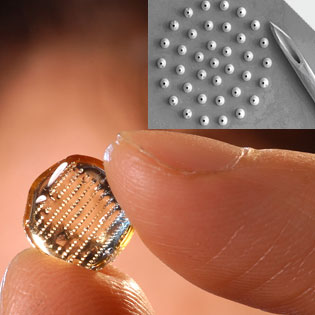
by From top: courtesy Shawn Davis; courtesy Gary Meek Georgia Tech researcher Mark Prausnitz holds an array of 400 microneedles designed to punch tiny holes in the outer layer of the skin. Inset: a ring of microneedles, each with a 75-micron-wide tip, next to a typical hypodermic, which is six times as wide. From top: courtesy Shawn Davis; courtesy Gary Meek

The next time you roll up your sleeve for a painful hypodermic jab, take heart: Researchers at the Georgia Institute of Technology may soon deliver an ouchless alternative, called microneedles. These near-invisible pokers, made from silicon, metal, glass or biodegradable polymers, are as much as 500 times smaller than an ordinary hypodermic -- too minute to irritate nerve endings, says Mark Prausnitz, lead investigator for Georgia Tech's microneedle research program.


An array of 400 embedded in an adhesive patch could gently puncture the skin, making it permeable to extended-release medication such as insulin, which contains protein molecules too large to slip by skin cells unassisted. Or, attached to a syringe, a single microneedle could deliver drugs directly to cancer cells. Though licensing deals are already in the works, the technology must still be cleared by the FDA. Expect your painless shot within the next five years.

Want to learn more about breakthroughs in electronics, medicine, nanotech, and more?
Subscribe to Popular Science today, for less than $1 per issue!

0 Comments


138 years of Popular Science at your fingertips.

Innovation Challenges


Popular Science+ For iPad

Each issue has been completely reimagined for your iPad. See our amazing new vision for magazines that goes far beyond the printed page


Download Our App

Stay up to date on the latest news of the future of science and technology from your iPhone or Android phone with full articles, images and offline viewing


Follow Us On Twitter

Featuring every article from the magazine and website, plus links from around the Web. Also see our PopSci DIY feed


February 2012: The Future of Fun

Science is reinventing play, from extreme sports to gamification to ridiculous roller coasters to the playgrounds of tomorrow, and this issue is chock full of fun. Also, on a less fun note: Did global warming destroy my hometown?


circ-top-header.gif
circ-cover.gif