
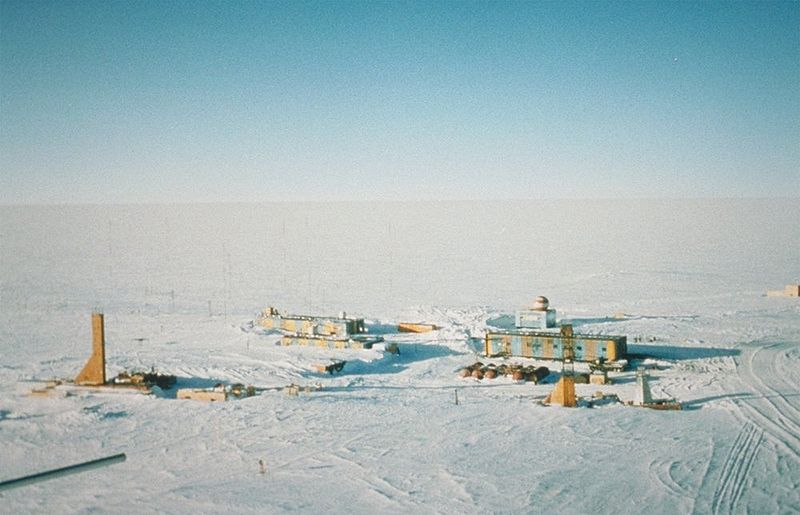
That heretofore unknown variety of life found deep below the frozen surface of Lake Vostok in Antarctica? Yeah...about that...

Lake Vostok Drilling Site Wikimedia Commons

We've been following the Antarctic drilling projects for a while now; there have been three major projects to drill holes in some of the coldest and most remote lakes on the planet to see what's underneath all the ice. The reason we're so interested in these hard-to-study lakes is for their relation to other worlds, specifically Europa and Enceladus, the frozen moons of Jupiter and Saturn, respectively. And last week, the Russians, who have been drilling into Lake Vostok, the coldest and deepest lake of them all, announced that they had in fact found a new type of bacteria, seemingly unrelated to all known organisms on the planet.

That announcement came on the heels of the American discovery of microbes in Lake Vida, and seemed to usher in a pattern--were there creatures in many more of these frozen lakes?

Except, well, no. This weekend, Vladimir Korolyov, the head of the Russian genetics laboratory at Saint Petersburg Institute of Nuclear Physics, admitted to Interfax (a news agency catering to Russia, China, and surrounding areas) that the bacteria they had found were nothing but contaminants. This wasn't completely unexpected, given earlier reports. Says Korolyov: "We found certain specimen, although not many. All of them were contaminants... That is why we cannot say that previously-unknown life was found."

Welp.

[via io9]

8 Comments

I bet if they drilled a hole in the halls of congress they will not find any life forms there either...

Ron Bennett

WoW, spam posted first?!

..............................

I wonder if the contaminated life found, will corrupt the sterile environment and kill off any other not-yet-discovered life in the same enviorment?

rlb2,
Or all they will find in the halls of congress is 'corrupt life', which is well established!

How could contaminants be confused with "previously unknown lifeforms"? Wouldn't contaminants be easy to identify or at least be similar to all known forms of life?

The problem is modern science. These so-called "scientists" come up with some theory, then try and force the data to fit. So instead of instantly realizing that the microbes were contaminants, they decided they had a new life form, and likely didn't even run it against the databanks. Real scientists come up with a theory and see if it's true, they have open minds and don't try and force the data to fit their preconceived ideas. Unfortunately they are nearly an extinct species, along with honest politicians.

they abandoned this project, because they unleashed "The Thing"

This likely would not be as big of a deal if there wasn’t so many people watching over there shoulders and hanging on there every word. I can't help but wonder if the press isn’t helping make these guys look bad. Or if they are doing it all on their own.

@arathorn867

I think your discounting all of 'modern science' based on one scientific report is a little premature. Especially since the 'discovery' is being recanted so swiftly, essentially showing that the facts won out - as is the design of the scientific process.

One might also note that most of the scientific community had been critical of the Russian procedure at Vostok as the method they used to seal the drilling hole was not felt to sufficiently protect from contamination. Seems the scientific community was right on that one.

One might also point out that the original claim to finding new life came so shortly after the American discovery at Lake Vida. So indeed perhaps there is some political motivation to trying to make the 'data fit the theory', as you mentioned, but I wouldn't put that on the whole scientific community.

Lastly one has to point out the ever-present misuse of the term theory. I think what you're referring to is hypothesis. The formulation of a 'theory' in science comes much later in the scientific method, and the word is thrown around much to much by the media, politicians, and web commenters.


July 2013: The Future Of Flight

The incredible innovations, like drone swarms and perpetual flight, bringing aviation into the world of tomorrow. Plus: today's greatest sci-fi writers predict the future, the science behind the summer's biggest blockbusters, a Doctor Who-themed DIY 'bot, the organs you can do without, and much more.


Online Content Director: Suzanne LaBarre | Email
Senior Editor: Paul Adams | Email
Associate Editor: Dan Nosowitz | Email
Assistant Editor: Colin Lecher | Email
Assistant Editor: Rose Pastore | Email

Contributing Writers:

Kelsey D. Atherton | Email
Francie Diep | Email
Shaunacy Ferro | Email

circ-top-header.gif
circ-cover.gif
