
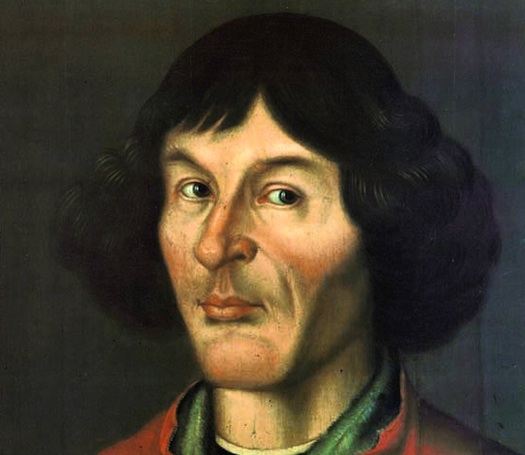
It's Nicolaus Copernicus's 540th birthday today. He is widely considered the father of modern astronomy and is best known for arguing that the Earth revolves around the sun--a controversial stance until the mid-17th century. Before he found his calling in heliocentrism, however, Copernicus was a versatile scholar who studied several unrelated fields, including church law and medicine. And while it's implanted in our heads that the Catholic Church skewered anyone who espoused heliocentrism, Copernicus actually had a fine relationship with the Church. At the beginning of his career, he was elected canon, a position just below bishop. He dialed down his church work before pursuing astronomy, and afterward found both supporters and detractors in the Church.
Sound surprising? Here are eight more surprising facts from Copernicus's long life (70 years) and career:
He never earned a bachelor's degree.
He went to a lot of college, but there's no record of him ever earning a bachelor's degree. He attended the University of Cracow, the University of Bologna and the University of Padua. At the time, men didn't need to get a bachelor's for a church career or to study for a higher degree, so Copernicus's career path wasn't unusual, according to the Stanford Encyclopedia of Philosophy.
He practiced medicine. Without a medical degree.
Copernicus's father died when he was about 11, so his uncle, a bishop, took him and his three siblings under his protection. When the uncle became elderly and fell ill, Copernicus acted as his physician. Copernicus was also a physician for the bishop who succeeded his uncle and for members of his church chapter. He never received a medical degree.
He was an economist. Sort of.
Before he got into astronomy, he wrote essays about stabilizing the value of currency that "were consulted by the leaders of both Prussia and Poland," according to the Stanford Encyclopedia of Philosophy.
He didn't actually think the earth revolves around the sun.
In his theory, the Earth and planets revolved around a center that was near, but wasn't exactly, the sun. The Christian Science Monitor outlines his other important axioms.
Give some of the other guys credit, too.
Copernicus wasn't the first to think that perhaps not everything in the sky revolved around the Earth. Pythagoreans thought the Earth revolved around a central fire that wasn't the sun, while ancient Greek astronomer Aristarchus of Samos proposed the Earth rotated 360 degrees a day and orbited the sun.
Copernicus was less hated than you think.
Not all signs pointed to disaster for heliocentrism and the medieval Catholic Church. Copernicus sent manuscripts about his theory to other astronomers and scholars, a few of whom mentioned that his ideas seemed to conflict with the Bible, but most of whom encouraged him.
No, really.
Georg Joachim Rheticus, a mathematics professor, published and circulated an introduction to Copernicus' heliocentric ideas to little reaction. That's why Copernicus decided to publish his seminal "On the Revolutions," which posited that the Earth revolved around a point near the sun.
Copernicus was much luckier than Galileo.
Copernicus died soon after publishing his ideas formally. Decades later, Galileo would be brought before the Inquisition and placed under house arrest for doing math to prove Copernicanism, but during his own life, Copernicus had both admirers and detractors of his theory.
Our thanks especially to the Stanford Encyclopedia of Philosophy for a great online biography of Copernicus.
Five amazing, clean technologies that will set us free, in this month's energy-focused issue. Also: how to build a better bomb detector, the robotic toys that are raising your children, a human catapult, the world's smallest arcade, and much more.


Online Content Director: Suzanne LaBarre | Email
Senior Editor: Paul Adams | Email
Associate Editor: Dan Nosowitz | Email
Assistant Editor: Colin Lecher | Email
Assistant Editor: Rose Pastore | Email
Contributing Writers:
Rebecca Boyle | Email
Kelsey D. Atherton | Email
Francie Diep | Email
Shaunacy Ferro | Email
Celebrate Copernicus' life by questioning a prevailing paradigm today....I suggest evolution.
Try applying the scientific method to evolution....it won't seem so appealing anymore....well appealing outside the realm of SciFi. I think it is fun there.
@Bagpipes100
If you have a theory to compete with evolution and want to celebrate the life of Nicolaus Copernicus, why not formally submit it to the scientific community so the world can benefit from your genius.
@Bagpipes100 - I'm curious as to why you think this is needed.
@ColtonCM - It's because Bagpipes is a troll who tries to use every article as a means to spread misinformation and deny evolution and climate change or simply bash scientists. It's really pathetic actually.
[SARCASM]
IM NOT A MONKEY!
[/SARCASM]
@Bagpipes, forget if you have a theory, if you even have a scientific hypothesis it will be reviewed...
Evolution theory is not sci-fi and is extremely relied upon and tested/trusted to explain the way life has changed through out earths history.
The main idea behind evolution is much simpler to understand than heliocentrism. Which makes me question the intelligence of those who seemingly don't understand it.
Before DNA nobody knew of the mechanism by which creatures/creations could change from one form to another. Though it was obvious that each could reproduce its own kind.
DNA shows us that all life is much, much, much more similar than even the original theory of evolution predicted, even down to an unimaginable scale.
Thank "god" we no longer have to ask permission to think from some religious zealot. Although every time science makes a discovery they either ridicule it or try to claim they knew it all along. (Four corners of the Earth my azz. Earth is spherical geniuses! No corners!)
A pathetic bunch they are.
FYI
Evolution has still failed to explain how one critter could change into another.
We've observed small little changes, but no large scale changes.
Irreducible complexity along with the whole ID paradigm are already being researched and put forth. Evolution has failed time and time again to show the least bit of credibility. Statistics has shown time and time again that the improbability of so many small changes coming together in any meaningful time frame to go from one kind of animal to the next is nigh unto impossible.
You guys think that you aren't needing to ask for premission to think anymore? You're priests don't wear big white hats, they wear white coats.
Think through the scientific method yourself and how to set up an experiment for verifying evolution on a large scale using the scientific method. Don't just trust the men in the white coats at their word. Think for yourself.
There is still no definitive proof that "the earth revolves around the sun". The space of our universe is infinite, and all perception of motion through this space is relative. Without knowing a fixed point of reference, there is no way to establish the absolute universal motion of the earth or sun. Thus it is theoretically possible that the earth is indeed the center of the universe, about which the motion of all heavenly bodies occurs.