
I first heard about nuclear diving while I was getting my hair cut in downtown Manhattan. My stylist seemed out of place in an East Village salon, so I asked her where she lived. Brooklyn? Queens? Uptown?
“Upstate,” she answered. “I commute two hours each way a few times a week.”
I asked her why, and she stopped cutting.
“Well, my husband has kind of a weird job,” she said. “He’d rather not live around other people.”
I sat up in the chair. “What does he do?”
“He’s a nuclear diver.”
“A what?”
“A diver who works in radiated water at nuclear power plants.”
I turned around to look at her. “Near the reactors?”
“The reactors, fuel pools, pretty much anywhere he’s needed.”
“And is he . . . OK? I mean . . .”
“Is it safe? Well, he says it is. They monitor his dosage levels and all that. Sometimes they’re too high, and he’s not allowed to dive. That’s why we live out in the middle of nowhere. Obviously, I’d rather he didn’t do it. Who wants a glowing husband?” She laughed, a bit sadly.
I told her I was a writer and asked if I could meet him. She said probably not. Most divers don’t like talking about their work, and their bosses discourage the ones who do. “I think it all comes down to the radiation,” she said. “It spooks people. It spooks me! Not that the rest of the job is a picnic. The non-contaminated diving they do—around the huge intake pipes that bring water into the plants—is even more dangerous. Sometimes they get sucked in.” Her husband had survived the day-to-day hazards of his job, she said, but I wondered about the long-term effects. “Has he ever gotten sick?”
“You’d have to ask him.”
“But you said he won’t talk to me.”
She put her scissors down. “He gets chest pains.”
“From the radiation?”
“He says probably not, but what else could it be from? He’s still young.”
She wrote down her husband’s e-mail address, and I tried over the course of the next few weeks to get him to talk to me. He wrote back eventually, but only to say that he was busy servicing a reactor in California. Maybe he’d get in touch when he had more time. By then I was hooked, though. What kind of person knowingly dives in contaminated water? I spent months sending queries to divers I found online, but none of them would talk either. Then came the Fukushima disaster, which changed the nuclear-energy landscape almost overnight. On a hunch, I started contacting plant operators rather than individual divers. An article about the hazards (and heroics) of nuclear diving might not be a plant manager’s idea of great publicity, but it sure beat images of helicopters dumping seawater on crippled Japanese reactors. Someone at the D.C. Cook nuclear power plant in Bridgman, Michigan, agreed. More than a year after that East Village haircut, I was invited to see a dive in person.

“I got thyroid cancer a few years ago. I quit diving, but then came back. I missed it. Besides, who knows if the cancer was related? These guys were diving in the same water as me, and they’re all just fine.”Word seemed to get around. I heard back from one of the divers that I had e-mailed previously. If I agreed not to use names, he and two of his co-workers would talk to me.
I met them for lunch at a diner outside Chicago. They looked like hockey players: young, tough, athletic. They talked about where they dove and what they did, and after a while, the conversation turned to radiation. Each had spent years diving in contaminated water, and I asked if anyone had experienced health problems. It seemed like a stupid question, looking at them.
“I got thyroid cancer a few years ago,” one of them said, between bites of his burger.
“From the job?” I asked.
“I don’t know. It was weird. I was 28 years old, in perfect shape. I had no family history or anything.”
“So what did you do?”
“I quit diving, but then came back.”
“Why?”
“I missed it. Besides, who knows if the cancer was related? These guys were diving in the same water as me,” he said, nodding at his co-workers, “and they’re all just fine.”
* * *
As a cold-war kid who grew up in the long shadows of Three Mile Island and Chernobyl, I retain a healthy fear of nuclear power. What other source of energy is so readily associated with Armageddon? Add to this our post-9/11 fear of terrorism, and the landscape darkens further. My apartment in Manhattan is 40 miles south of Indian Point, a nuclear power plant that sits on a fault line and has a history of groundwater leaks and minor explosions. Almost all of the New York metropolitan area’s 19 million residents live within Indian Point’s “Emergency Planning Zone.” One of the hijacked 9/11 planes flew almost directly over the plant.
Hundreds of cities have their own version of Indian Point somewhere out in the gloaming, and millions of Americans live with the jittery bargain these plants present. Indian Point, for instance, supplies New York City with up to 30 percent of its electricity, and no realistic energy alternatives have yet been put forth if the plant were to be shut down. It remains true that nuclear power is the cleanest and safest form of energy currently in wide use in the U.S. Of course, the same was true in Japan until last year.
Making the bargain even more complex is the fact that construction on every one of the country’s 65 working nuclear plants began before 1978. In the years that followed, tough economic times, a burgeoning environmental movement and the near-catastrophic meltdown at Three Mile Island in Pennsylvania combined to bring an end to the permitting and financing of new plants. The nuclear-energy industry limped along for most of the next three decades, supplying only about 20 percent of the nation’s power. But as fossil fuels fell increasingly out of favor and nuclear energy gained support in Europe and parts of Asia, George W. Bush and then Barack Obama began speaking of nuclear power as a crucial component of any new national energy policy. At the same time, bipartisan support for nuclear energy was steadily rising among both the public and members of Congress. Even many environmentalists were coming to see nuclear power as a necessary, if unwieldy, weapon in the battle against global warming. In February 2010, Obama announced guarantees of more than $8 billion in loans for the construction of two new reactors in Georgia, the first commitment of its kind in more than 35 years.
Then, last March, a tsunami hit Japan’s Fukushima Daiichi nuclear power plant, leading to a disastrous series of reactor meltdowns. The consequences were immediate. Germany vowed to phase out nuclear power, and other countries spoke of following suit. In the U.S., the nuclear-energy renaissance was left suspended in time. But even as its future remains uncertain, nuclear energy remains an indisputable part of our present. And as our power plants continue aging with no viable replacements, the challenges facing the nuclear industry will only continue to grow. So will the potential for another disaster. The threat of radiation poisoning hangs over everyone who works at or lives near a nuclear plant, but no one more than the divers, who literally swim in the stuff.
* * *
It was still dark out when I drove up to the entrance of D.C. Cook. I’d been hoping for something dramatic—low lit reactor buildings emitting ominous steam—but all I could see was a sturdy guardhouse, and beyond it a two-lane road disappearing into the woods. After a few phone calls and a thorough inspection of my rental car, the well-armed security guards allowed me to pass. I drove slowly around a bend, and there they were, the two domed reactor buildings, stone gray and featureless. They were smaller than I’d pictured them, but just as unsettling. I parked carefully (I’d read in a divers forum that security booted any car that so much as touched a white line) and made my way to the building that housed the diving team.
My host, Kyra Richter, was waiting for me at the front door. She had been a nuclear diver for more than seven years, a pioneer in an overwhelmingly male field, but now worked in plant operations supervising the diving program. She was petite, with long dark hair in a ponytail, and she was in a hurry. As she quickly explained the plan for the day, I did my best to keep up. Nuclear divers, she said, perform three different kinds of dives: non-radioactive “mudwork” in the lakes or rivers that supply water to the plant, and, inside the plant, both non-radioactive and radioactive dives. Today the divers would be out on Lake Michigan, cleaning intake pipes.
“In a boat?” I asked.
“Of course in a boat. Is that a problem?”
“No,” I said, unconvincingly. I was worried about getting seasick, but Richter, perhaps charitably, misread my distress. “You’re upset that we’re not contaminated-water diving,” she said. “Well, mud diving is far more dangerous.”
“That’s what I’ve heard,” I said.
She grabbed her coat, and we walked to her car, which was parked perfectly. A stiff breeze had come up with the sun, and Richter paused to assess its strength. “Of course, we may not go,” she said. “We can only dive if it’s calm. You can’t tether divers properly if the boat’s bobbing up and down.”
As she drove, she explained that lake diving at D.C. Cook takes place in and around the complex system of pipes, pumps and screens that draws more than 1.5 million gallons of water into and out of the plant’s condensers every minute. The pipes extend a quarter of a mile into Lake Michigan and require constant maintenance. And beyond the normal hazards of welding and cutting at the bottom of a muddy lake—”it can be like looking through coffee”—lie the dangers of the intake structures themselves.
“We probably could have gone for a little while, but we don’t chance things like that. We don’t chance anything.”I could find no definitive statistics concerning nuclear diving injuries and deaths, but as I studied news accounts and individual incident reports, it became clear that most diving accidents involved intake work. In 2004, at Point Beach Nuclear Plant in Wisconsin, a diver became trapped when one of his lines got sucked into an intake pipe. The plant immediately turned off its circulating water pumps—which in turn shut down the reactor—so the diver wouldn’t be sucked into the pipe as well. Powering down a reactor too quickly can damage the nuclear core, but in this case everything worked out: The plant went undamaged, and the diver escaped. Other divers have been less fortunate. In 1986 an untethered diver performing intake inspections at Crystal River Nuclear Plant, on Florida’s Gulf Coast, failed to surface. The dive team sent a (tethered) rescue diver to find him. But a few minutes after entering the water, the second diver’s tether went taut and he became unresponsive. The team quickly pulled him up, and his unconscious body was almost to the surface when the tether line broke. The rescue diver sank again from view. As with the Point Beach incident, the intake systems were immediately shut down, but it was too late. Both divers were dead. While the rescue diver’s body was recovered quickly, it took workers almost two hours to locate the first diver. His body had been sucked almost all the way into the plant itself.
Richter, I knew, had been heavily involved in the effort to improve safety, and she’d had some success. In 2009, after years of advocating for the creation of industry-wide regulations, she was offered her current job at Cook. Now she acts as a liaison between plant operators and the dive teams, and the communication lapses that contributed to many of the previous incidents had all but disappeared. There hasn’t been a diving accident at Cook since she became supervisor.
When we arrived at the docks in nearby Benton Harbor, several divers were milling around beside the 52-foot dive boat. They were dressed casually—jeans, T-shirts, work boots—and were, on the whole, younger then I’d expected. None of them were smiling. “Looks like a blow day,” Richter said, shaking her head. “Which means no dice.”
Click here to view this article on a single page, or continue to page two below.

Keith Kinsella, the brawny, clean-cut dive-team supervisor (and captain of the boat), was the only one onboard. He too looked downcast. Richter was right—the dive had been canceled. I peered out at the water. I was surprised; it didn’t look that rough. But safety came first. The divers would get paid for two hours of work and try again tomorrow. “We probably could have gone for a little while,” Kinsella said, “but we don’t chance things like that. We don’t chance anything.”
Keith Kinsella did not begin his diving career thinking that he would work at nuclear power plants. None of the divers I spoke with did. Some were ex-military; others began as oil-rig workers, amateur scuba divers, even competitive swimmers. Kinsella grew up in West Virginia, listening to stories about his uncle, a commercial diver who had helped clean up the massive Exxon Valdez spill in Alaska’s Prince William Sound. “I happened to have a conversation with him in a pretty transitional period of my life,” Kinsella told me. “I thought it was cool, and decided that’s what I was going to go off and try.” In 1990, a year after graduating from high school, he enrolled in a diving academy.
Commercial divers perform a wide variety of tasks. Some repair ship hulls and restore piers, inspect bridges and fortify dams. The more adventurous—and those willing to travel for extended periods—take oil-rig jobs. And a select few take on even more challenging work: hazmat diving (in chemicals and sewage), saturation diving (at extreme depths), search-and-rescue diving, and, of course, nuclear diving.
“My instructors showed me photos of nuke jobs. And I thought, Nuke! I want to go that way. I knew offshore wasn’t the best place for me, as a woman. So I started looking for work.”Kinsella graduated as a certified underwater welder and was hired by a major dive company. That’s when he heard about nuclear work. It sounded darkly glamorous. The claustrophobic steel maze of a power plant was a long way from the expanses of Alaska, but he didn’t care. As contract divers, Kinsella and his new colleagues moved from town to town like ballplayers on a never-ending road trip. A month at a reactor outage in Alabama. A weeklong fuel-rod job in Wisconsin. A two-day inspection of a pump bay in Georgia. Kinsella took to the work immediately. The pay was poor—as little as $12 an hour—and as a contractor, he was paid only when there was work (despite sporadic attempts at organizing, nuclear divers have no national union). Talented divers were looked after, though, and Kinsella stood out. He never turned down a job, no matter how difficult the work or contaminated the water. (The divers I spoke with said they make about $20 an hour, which added up to somewhere between $20,000 and $60,000 a year, depending on workload and seniority. On contaminated dives, they get an extra $10 per day.)
After several years of traveling for work, Kinsella found himself diving almost exclusively at D.C. Cook. And he wasn’t the only one. Southwestern Michigan is a hub for nuclear divers. A dozen plants are within a half-day’s drive, making the area a convenient home base, but it is Cook itself that attracts many. Because of the plant’s large cooling system, it has been able to contract a full-time team of divers, which Kinsella now supervises.
On the dive boat’s bridge, I asked him what would happen if the weather stayed bad. Would his team get paid? “Money definitely becomes an issue,” he said.
* * *
Since we had time, Richter agreed to take me on a tour of the plant. It took well over an hour to get me through all the checkpoints, puffer machines and metal detectors. Finally inside, we walked through a maze of hallways toward the turbine building. The walls were covered with safety-themed reminders (“All Injuries Are Preventable!”) and lists of directives that became more forceful the farther we went. Nuclear plants may be the most earnest places in America. People speak clearly and say what they mean. At the same time, they’re incredibly friendly; everyone we passed smiled and said hello. Everyone we passed was also wearing a dosimeter. I was not. I took this to mean we would not be visiting what nuclear workers call “the hot side,” the area around the reactors and spent fuel pool, where potential dosage levels are highest. No one, I realized, had mentioned radiation at all. The few times I’d brought it up—to Richter, to Kinsella—I’d been waved off, as if it was beside the point.

Richter was more forthcoming on the subject of diving. She took her first lesson in 1993, while she was living in the Philippines. “My instructors were retired North Sea divers,” she said, “so I was hearing all these stories. I was fascinated. I wanted to do that. But I was just a girl.” She moved to Cozumel, Mexico, where she led tourist diving excursions and explored underwater caves and then went to commercial diving school in Seattle and graduated at the top of her class. Like Kinsella, she was intrigued by plant work. “They started showing me photos of welding and nuke jobs. And I thought, Nuke! I want to go that way. I knew offshore wasn’t the best place for me, as a woman. So I started looking for work.” Richter quickly became a sought-after coating specialist, applying paint and other protectants to underwater surfaces, and she spent several years diving in nuclear plants around the U.S. and in Japan.
“I’ve done some penetration dives, and once in a while, a feeling of eeriness will come over you, like ‘Boy, if something went wrong, it would really be bad right now.’ “We came to a staging area, where I was given a hard hat, safety glasses, earplugs and steel tips for my decidedly non-steel-tipped boots. When I was ready, Richter opened a door and we entered the plant proper. We were met with a blast of hot air and a roar that made communication nearly impossible. Which was fine; it was more of a take-it-all-in moment anyway. The inner workings of the plant were a wonder, and the sheer size and complexity of the undertaking, the miles of exposed condensers, coolers, generators, pipes, pumps, tanks and turbines would have launched me into a reverie on the nature of man and the large forces he endeavors to control—but Richter was already moving me along.
We stopped at the screen house, where water from the intake pipes flows into the plant. Richter pointed out half a dozen manhole-size openings in the floor. Divers climbed through them to access the screens and pump bays that trapped system-clogging debris and marine life, including Lake Michigan’s ubiquitous zebra mussels. Much of the work down below involved penetration diving with no opportunity for an immediate ascent to open air. “I’ve done some penetration dives,” Andrea Grove, the only other woman on the D.C. Cook crew, told me, “and once in a while, a feeling of eeriness will come over you, like ‘Boy, if something went wrong, it would really be bad right now.'”
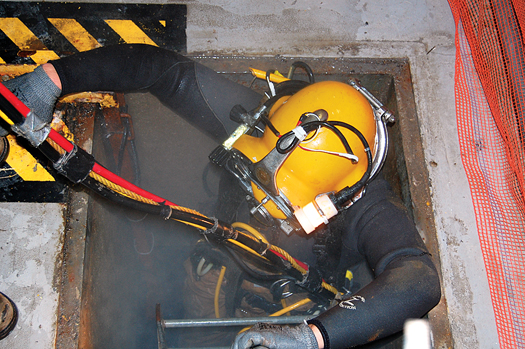
Something did go wrong here in 2003. A young diver descending into the screen house’s discharge vault became disoriented and, when he touched down, began walking in the wrong direction. An emergency intake valve that should have been closed was not, and the diver, overcome by the water flow, was sucked through it. He lost consciousness yet was quickly intercepted by other divers, who brought him to the surface. He recovered quickly, but the dive team was determined not to repeat the episode. They instituted new safety procedures, including detailed flow assessments, additional diver experience requirements, and mandatory pre- and post-dive briefings. Richter now personally oversees the “tagging out” of every valve or switch that might, if mistakenly turned on, put a diver in peril.
That was also the year of the famous fish invasion. Seeking warm spawning water, millions of tiny alewives got past Cook’s initial screens and clogged the internal intake systems, requiring both reactors to be shut down. The absurd, almost Simpsons-esque incident could have been catastrophic—the plant activated its emergency plan—but the reactors quickly stabilized. Divers were sent down to assess the situation and, later, helped spearhead the month-long cleanup. After an investigation, the Nuclear Regulatory Commission found Cook’s operations team at fault for not being adequately prepared, an admonishment that helped fuel (along with the diving incident and a transformer fire that led to the temporary shutdown of Unit 1 earlier in 2003) a perception that Cook was a troubled plant. But a change in management marked the beginning of a significant turnaround, and the plant has earned high industry safety ratings for five years running.
As we walked back toward the entrance, Richter recited a series of other recent improvements, to the plant and the team. But something obvious was being left unsaid. D.C. Cook was getting old—39 years and counting. Much of the interior had the sterile, olive-green look of an early NASA mission-control room. With little new plant construction on the American horizon, keeping Cook and other plants running smoothly is becoming more crucial and more difficult. Since so many vital parts of nuclear-energy production take place underwater, it follows that divers will play an increasingly central role in the ongoing life of the plants. I mentioned this to Richter as we stepped outside. Now you’re starting to get it, she said.
The following afternoon was another blow day on the lake, so Richter finally agreed to take me to the hot side. After being guided through an even lengthier than usual process of security briefings and screenings, I was at last given a dosimeter. We walked through a thick door and into the “radiologically controlled area” of the plant. I’d been advised not to bring my camera—it could become contaminated—and that idea alone had me checking my dosimeter from the moment we entered. There was no change, but the air felt different, heavier. I mentioned this, calmly, to Richter. She said it was my imagination.
I was still radiation-free when we reached the giant auxiliary building that housed the spent fuel pool. I walked up as close as I dared and gazed down at the storage racks far below. They emitted an unsettling blue glow. A dozen people went carefully about their tasks; this wasn’t a place where mistakes could be made. We walked over to the 44-foot-deep transfer canal, where technicians moved highly radiated spent fuel from the reactors to the pool by way of a remotely controlled underwater cart. Divers were occasionally lowered into the canal, Richter said, to repair the cart or the cables it moves along. I gazed into the foreboding chasm. It looked like the last place on Earth.
Back in her office, I asked Richter again about living with the threat of radiation. Again, she brushed the question aside. The topic was so all-encompassing as to be unexplainable. Ask a diver, and they’ll say contaminated-water work is the safest kind of diving they do. Try fixing a giant intake valve in zero visibility or penetration diving underneath a condenser. What divers don’t say (at least on the record) is that they think about radiation all the time. They keep track of their dose levels the way most people watch their weight. And just as people are hard-pressed to say no to food, divers find it difficult to turn down a job, no matter how dangerous.
Nuclear plants are regulated by at least five different government agencies, but their own rules regarding acceptable dosage levels are always the most stringent. Each plant employs ALARA technicians (the acronym stands for “As Low As Reasonably Achievable”) to plan and monitor all activity on the hot side. Radioactivity as it relates to humans is measured in millirems of exposure. Most nuclear plants set their maximum allowable dose level at 2,000 mrem (per person, per year), although the federal government allows up to 5,000 mrem of exposure per year. (By comparison, a standard chest x-ray is about 10 mrem, and a year of exposure to environmental radiation from the soil and cosmic rays is 300 mrem.) But those numbers can be tricky. Occasionally, if a diver approaches the plant’s maximum dose level before finishing a dive, he or she can be granted an extension, allowing the level to be raised. “Our plant management—our radiation protection and senior managers—will get together and discuss the merits of a person going over,” says Ray Vannoy, a senior Cook ALARA technician. “Sometimes they can bring in another diver so they can split the dose rather than give it all to one person.” Ultimately, of course, the diver in the water must approve the extension. They almost always do.

The teams plan and perform contaminated-water dives with such obsessive attention to detail that accidents are extremely rare, especially where sudden or unplanned exposure to radiation is concerned. The far greater danger is time. No one knows for sure how the small but consistent levels of exposure affect the human body over the course of months, years, decades. The divers at Cook have, through unwavering professionalism, gone a long way toward eliminating the immediate dangers that have plagued their work, but the long-term threats still remain.
* * *
I managed to leave the plant without ever seeing a diver in radiated water. In any water. Richter knew I was disappointed, so she invited me back for a reactor outage that was scheduled to take place a few weeks later. During an outage, the reactor is shut down so it can be refueled, which also allows for all kinds of crucial inspections and repairs. The plant hires 1,100 temporary workers, more than doubling the full-time workforce. It’s also the busiest time of year for the divers. There might even be a nuclear dive, she said.
When I arrived, the divers, whom I’d last seen lounging by the docks, were working at two sites. The first team was replacing a giant discharge valve (more than seven feet in diameter), which required a tricky two-man penetration dive through a series of tunnels and pools 20 feet below the turbine building. The other group was cleaning the debris-strewn intake screens. The divers took turns going down, never more than two in the water at a time. When they emerged, exhausted and often covered with tiny maggot-like water bugs, they looked their supervisor in the eyes and verbally stated their condition. They were always fine. Richter moved back and forth between the two dive sites, making sure everything ran smoothly. The outage clock was ticking away.
Neither dive involved contaminated water. But Richter told me there had been a nuclear dive just two days before I arrived. In fact, it was Kinsella who had been the diver. “I would have told you to come out for it, but there was no time,” Richter said. “It was high-priority.”
“An emergency?”
“We don’t use that word,” Richter said.
I pieced the dive together as best I could. There had been plenty of witnesses, after all, other divers and plant workers. It was the kind of thing you watched if you could, and never forgot. It had started in the lead-up to the refueling, when a worker noticed a problem in the transfer canal I had seen on my last visit. The fuel cart’s steel cables were showing wear and needed to be replaced. Since a plant can lose more than $1 million a day when a reactor is offline, the job had to be done quickly so the outage could start on time. That left two options: drain the canal or use a diver. Working in radioactive water would be dangerous for the diver, but emptying the canal could expose a much larger number of workers to contamination (water acts as a radiation shield). The plant managers decided to use a diver. Kinsella volunteered.
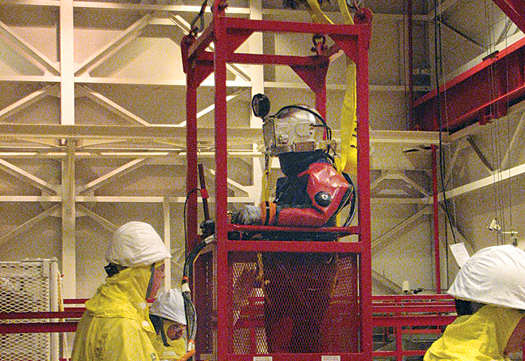
As a crowd of workers looked on, Kinsella stepped carefully into a crane-mounted steel “man basket” and prepared to descend into the heavily radiated water. He was wearing a lightweight vulcanized rubber drysuit—to which several radiation-detecting dosimeters had been attached—and a round copper diving helmet that somehow looked both antiquated and strangely futuristic. The rest of the dive team were dressed in white protective scrubs. Some attended to Kinsella, while others, including Richter, took their station at a temporary control center near the canal opening.
Kinsella stood stock still as the man basket began moving. He was holding a radiation probe. Once underwater, he would wave it in front of him, as if groping for a light switch in the dark. A few feet away, a designated tether man let out the lines that would keep Kinsella connected to the world—a communications line, a dosimeter line, an air line, a “pneumo line” that indicates depth, and a strength member (to keep all the other, more fragile lines from snapping). All of these lines were taped together into a single umbilical cord. Kinsella slipped into the placid water, and the unspooling line quickly became the crowd’s only visible evidence of the diver’s progress beneath them.
When he was chest-deep in the water below, Kinsella stepped out of the cage and carefully descended the remaining distance to the bottom of the chasm, waving the probe in the direction of his movement. Back up top, a technician tracked data from the probe and from other dosimeters. Radioactive particles travel in detectable clusters, and divers are often warned by radio to shift an arm or a leg to avoid a sudden dose.
On this day, Kinsella reached the bottom without incident. He set to work replacing the cables by unbolting, and then sending topside, the block they were attached to. The water was 91 degrees. He was wearing only protective scrubs beneath his dry suit, but it didn’t matter; he was soon drenched in sweat. When he was finished, though, the cart had fresh cables. The outage—and the all-important fuel transfer—could begin. Kinsella had received 16 mrem of dosage. It wasn’t a lot, but there would be other dives.
David Goodwillie is the author, most recently, of the novel American Subversive.
