
CMS Collision Event A typical candidate event including two high-energy photons whose energy (depicted by dashed yellow lines and red towers) is measured in the CMS electromagnetic calorimeter. The yellow lines are the measured tracks of other particles produced in the collision. CMS/CERN

Physicists at CERN may have caught the first whiffs of the elusive Higgs boson, researchers announced this morning, but more numbers must be crunched before anyone will claim its discovery. Bumps in signals at the Large Hadron Collider are not surefire proof of the so-called god particle, at least not yet — but at the very least they’re enough to keep faith in our modern theories of physics.

Two detectors have been sifting the detritus from ultra-high-energy proton collisions at the LHC, and so far they have seen “tantalizing hints” of the Higgs, physicists said at a news conference. The particle weighs about 125 to 126 giga-electronvolts, according to evidence from the Atlas and CMS detectors, respectively. That’s about 125 times heavier than a proton.

If it exists at all, it must weigh between 117 to 127 GeV, according to the new measurements. That relatively narrow band is the result of previous LHC (and Tevatron) experiments that already ruled out other suspected sizes.

“As of today what we see is consistent either with a background fluctuation or with the presence of the boson,” said Guido Tonelli, spokesman for the CMS experiment. “Refined analyses and additional data delivered in 2012 by this magnificent machine will definitely give an answer.”

Atlas spokeswoman Fabiola Gianotti also demurred — “This excess may be due to a fluctuation, but it could also be something more interesting. We cannot conclude anything at this stage,” she said. “We will not need to wait long for enough data and can look forward to resolving this puzzle in 2012.”

The world over, physicists (and those with physics envy) watched online and in university conference rooms in heady anticipation. Tuesday’s announcement was widely expected to bring news of a Higgs discovery, and while neither the Atlas nor CMS teams were claiming such a breakthrough, they haven’t not seen it, either.

The Atlas results suggest a Higgs particle weighing 125 to 126 GeV, at a confidence level of 3.6 standard deviations, or 3.6σ. The CMS team saw potential around 124 GeV, with a confidence level of 2.6σ. In particle physics, a true discovery calls for a five-sigma confidence level, so we’re not quite there yet. A three-sigma result is good enough to say a particle may exist.
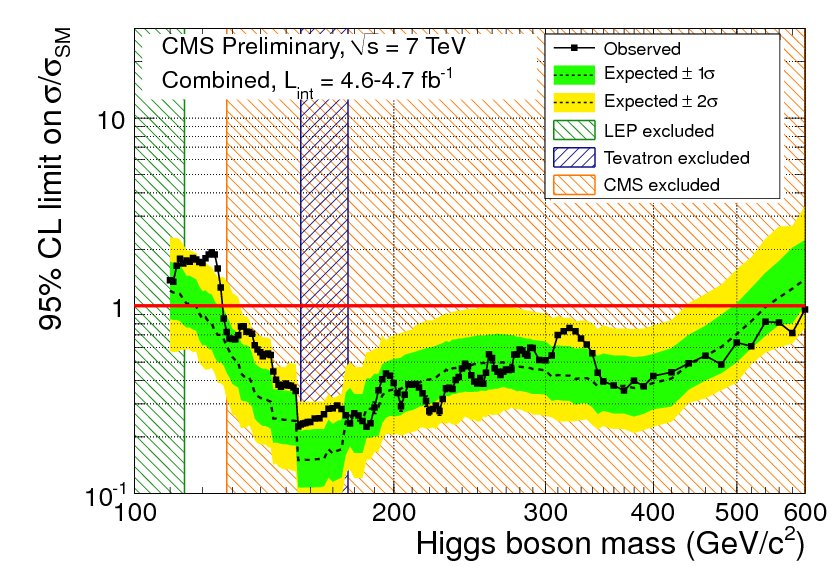
Higgs Mass Possibilities: Exclusion limit on the mass of the Higgs boson at 95% confidence level (below red line). The analysis is based on proton-proton collision data collected by CMS in 2010 and 2011. The hatched bands show the mass regions previously excluded by CERN's Large Electron Positron collider, Fermilab's Tevatron, and now by CMS. The dashed line and the green and yellow bands show the average expected CMS sensitivity corresponding to the actual amount of data analysed.  CMS/CERN

Or, as Guardian blogger John Butterworth awesomely explains it:

A physicist saw an enigma
And called to his mum "Flying pig, ma!"
She said "Flying pigs?
Next thing you'll see the Higgs!"
He said "Nah, not ‘til it's five sigma!"

At the LHC, high-energy collisions between protons shatter the particles into their constituent parts, and at really high energies, physicists expect to see the Higgs boson emerge from the mess. The suspected smidgen of energy is thought to endow all other particles with mass, hence its importance. It is also the only particle yet to be observed in the entire standard model of particles and forces — so not finding it at all would be really interesting, too.

CERN managers had already decided to keep the LHC running through 2012 to improve their odds of finding the Higgs. More data is being generated all the time, so the Atlas and CMS teams are optimistic for a true five-sigma result sometime next year.

We have seen previous rumors of a Higgs sighting before, but nothing as promising as Tuesday's announcement. On top of the statistical significance (for Atlas, at least), it's crucial that two different detectors have seen something intriguing, and in roughly the same mass-energy range, as the NYT points out.

One of the most amazing things about today’s announcement is the possible new pathway it opens. If the Higgs is indeed between 117 and 127 GeV, that’s actually pretty little, in relative terms. At one point physicists thought it could weigh as much as 600 GeV. If it’s small, as these results suggest, that means it must come with another particle to stabilize it. So no matter what we learn with more data, one thing is certain — even more discoveries are yet to come.

12 Comments

Very kind of Higgs to be there to bail out the credibility of LHC and its secure funding. But at 2.3 ~ 1.9 Sigma? So the yes/no is still held in the clutches of the funding strategy. But surely put your champagne away in the deep freezer! Also, the strategy has to be excellent otherwise they too shall see the funds drying up like it happened with Fermilab. I as an amateur researcher fully agree with Professor Hawking. The reasons for mass and gravity are totally different than Higgs. For example, faster than light Neutrinoes and Higgs both cannot coexist -- either one has to be wrong. It's DCE research and superluminal speed which has the potential of breaking current scientific barriers, rather than finding a nebulous statistical dual peak for a Higgs, which well could be due to many other anomalies, one that LHC could not decipher is that of the UFOs.

awesome possum

One thing Ive been wondering for a while is that when we find the higgs, then what? Does all that accomplish is verify our models? Or would it enable some sort of exotic technology if we could manipulate it. What sorts or applications would be possible once we can manipulate it?

------------------
www.solidlightlabs.com - blurring the lines of virtual reality

even though the planet wasnt all round... they were close enough...

i think it is the same thing right now with Higgs Bs... ^^
its awesome to get closer to the truth

---
bored? lets go mine the stars... ^^

i find it kind of odd that we have to wait till 2012........

_________________
The people of the world only divide into two kinds, One sort with brains who hold no religion, The other with religion and no brain.

- Abu-al-Ala al-Marri

JediMindset,
You do not have to wait until 2012. The time is now; let the Anunnaki speak to you, rise up and live! The Anunnaki bodies have been wiped out from earth, but their spirits are all about us. Every now and then posses a human and do a walk about. Call to them JediMindset. Allow your mind and soul to be one with them and show you the way to planet Nibiru. You too can be part of the Mayan spiritually or Sumerians, perhaps the Egyptians too.

We know the Anunnaki are amongst us; aliens walk about on earth now. No need to wait for 2012. Take a walk about, pray to them, call to them, journey now!;)

...........................

Meanwhile, back at the ranch. I side with Professor Hawking. He is a smarty!

@anadish

I'm inclined to agree with you. The existence of a Higgs boson would only prove every theorist that has come to pass right. It might bring us closer to the facts of the universe but it would not help us beyond scientific barriers inhibiting us. Plus, it's highly irregular.

Humanity is neither enlightened or advanced enough to be anywhere close to being right about the universe. As such it would make more sense if this search ended up negative or conclusively inconclusive for discovery of something they were not looking for (not the god particle).

On the other hand, the several instances in which neutrinos (and other subatomic particles) have been observed (astronomically or otherwise) traveling at superluminal velocities are usually pushed aside as optical illusions or calculation errors. If fact discovers the universal speed limit is not c then a few peaces of the Grand Unified Theory of Physics will break down. While this takes our species IQ down a few notches, it opens the possibilities of the things we dream about that others put towards being impossible because of heavy faith in using theory to suit facts instead of the other way around.

@anadish

Well, not every theorist. Just the ones we work under with current scientific knowledge. I think the biggest fear with being wrong is having to work hard on developing new theory to account for the discredited ones. We've become somewhat of a lazy race.

@GeeWillikers,

what you say is true. i wish to join my cosmic spiritual companions/brothers in there odyssey into the universe. peace be onto you.

_________________
The people of the world only divide into two kinds, One sort with brains who hold no religion, The other with religion and no brain.

- Abu-al-Ala al-Marri

My question is... If it cost millions of dollars to execute and record the particle smashing and to get a glimmer of the Higgs Boson, what's the pay-off?

To confirm a theory?... or do we actually get closer to the biggest puzzle of all; how to travel practically to another star?

So, if we confirm it exists what is the theoretical use of this particle? What can we do with it if we can isolate it and manipulate it? Does it help us move faster than light, create anti-gravity, or create a worm-hole?

Anyone smarter than I is welcome to answer.

The atom-like structure of baryons described within the Everlasting Theory leads to following masses: 105 GeV, 118 GeV and 140 GeV. For very high energies, great part of the orbits is destroyed so we should observe the weak signals only. In the high-energy regime there dominate the phenomena which take place on the Schwarzschild surface for the strong interactions. For this surface, we obtain 127-128 GeV. We can see that there should be the three small maximums/peaks for the first three masses and one a little higher for in approximation 127-128 GeV.
The obtained theoretical results are consistent with the latest LHC-experiment data (published in December 13, 2011).
We can see that the data lead to the atom-like structure of baryons. The Higgs boson(s) is not in existence.

It seems as if this particle has to be real with all of the close calls I've heard. I think they should continue the funding much longer as this particle really seems to be on the brink of discovery!


138 years of Popular Science at your fingertips.

Innovation Challenges


Popular Science+ For iPad

Each issue has been completely reimagined for your iPad. See our amazing new vision for magazines that goes far beyond the printed page


Download Our App

Stay up to date on the latest news of the future of science and technology from your iPhone or Android phone with full articles, images and offline viewing


Follow Us On Twitter

Featuring every article from the magazine and website, plus links from around the Web. Also see our PopSci DIY feed


March 2012: The Future of Medicine

A 10,000-rpm, no-pulse heart is completely revolutionizing how we think about transplants. Plus: rapid-response virus hunters, a shocking cure for migraines, the world's youngest person to have achieved nuclear fusion (in his parents' garage!), and much more.


circ-top-header.gif
circ-cover.gif
bmxmag-ps