
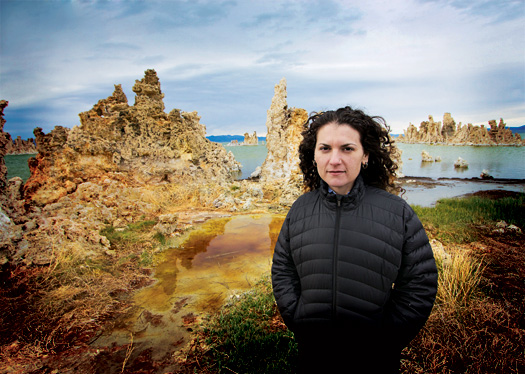
This should have been Felisa Wolfe-Simon’s moment in the sun. But as the television crew takes positions, the 34-year-old scientist glances at the gray, churned-up lake behind her and gathers her collar around her neck. On cue, she begins her explanation of this lake’s unique chemistry, her voice rising in volume and pitch above the wind.
She’s halfway through the take when the gulls arrive. They swoop and swirl above the shoreline in a swarm, calling in harsh, jeering tones that drown out her carefully chosen words. As the sound technician pulls off her headphones in frustration, the director Oliver Twinch halts the taping and ventures a smile in Wolfe-Simon’s direction. “How about we try that one again?” he says.
“I think we’ll have to move,” Wolfe-Simon says, peering down toward her boots. “I’m sinking in the mud.”
It is this mud, and the peculiar microbes in it, that have stuck Wolfe-Simon in the middle of one of the most extraordinary scientific disputes in recent memory. Last December, at a highly publicized NASA press briefing, Wolfe-Simon announced that her research team had isolated bacteria from Mono Lake, on the edge of California’s Eastern Sierra mountain range, that could subsist on arsenic in place of phosphorus, one of the elements considered essential for all life.
The research, financed mostly by NASA and published initially in the online edition of Science, jolted the scientific community. If confirmed, scientists said, the discovery would mean that this high mountain lake hosts a form of life distinct from all others known on Earth. It would open up the possibility of a shadow biosphere, composed of organisms that can survive using means that long-accepted rules of biochemistry cannot explain. And it would give Mono Lake, rather than Mars or one of Jupiter’s moons, the distinction of being the first place in our solar system where “alien” life was discovered.
This should have been Felisa Wolfe-Simon’s moment in the sun.But within days, researchers began to question Wolfe-Simon’s methodology and conclusions. Many of them cast aside traditions of measured commentary in peer reviewed periodicals and voiced their criticism directly on blogs and Twitter. Then, as the conflict spilled into the mainstream, the scientific community witnessed something few would have predicted: meaningful public engagement over a serious scientific issue. For several days, at least, a good many watercooler conversations revolved around the metabolic capabilities of a Gammaproteobacterium.
Among academics, the debate devolved into something more vitriolic and personal. One researcher questioned whether Wolfe-Simon and her team were “bad scientists.” Another called her work “science fiction.” One blog post bore the title “Is Felisa Wolfe-Simon an Alien?”
In early June, a few days before going to Mono Lake, Wolfe-Simon and I met at a café in Palo Alto. Standing just over five feet tall, she has curly brown hair and wears a tiny diamond stud in her nose. She ordered an espresso at the counter, sat down, and pulled a digital audio recorder from her bag.
“Mind if I tape this?” she asked.
Wolfe-Simon had spent much of the previous six months avoiding the media, insisting that she and her colleagues needed to focus on their formal “technical response” to the criticisms leveled against them. The months we’d spent negotiating this face-to-face interview had featured several last-minute cancellations, including one issued when I was on the plane out to meet her. She told me she had been misquoted and misunderstood by both her scientific peers and reporters who focused heavily on the doubts raised about her work, while disregarding its strengths. Hence the recorder. “Now I understand what’s going on,” she told me, “when you see ‘So-and-so’s office has been contacted, but they will have no comment.’ “
Wolfe-Simon has learned to be cautious in her dealings with the media—she has learned that it can be dangerous to reveal too much of herself—but she does have comment. The daughter of trumpet players, she earned two bachelor’s degrees from Oberlin College, one in oboe performance and one in biology (with a chemistry minor). When she talks about the process of science, she talks about rigor, the need to build in yourself the tools necessary to answer the questions you ask. She talks about endless repetition. “When musicians go up there and it looks like they’re having fun,” she says, “what you’re seeing are the long hours in the practice room.” She says this in a way that suggests that to her it’s the long hours that are fun, or at least deeply satisfying. “Science isn’t easy,” she says. “But there’s a joy and synergy in coming to a deeper understanding of the nature around you.”

After graduating from Oberlin, she earned a Ph.D. in oceanography from Rutgers University. She studied algae and phytoplankton to better understand how organisms evolved to use metals, such as iron and manganese, for biological functions. During a postdoctoral fellowship in which she split her time between Arizona State and Harvard universities, Wolfe-Simon began to describe herself as a geobiochemist and to edge her research into the growing field of astrobiology, which involves the study of the origin, evolution, distribution and future of life in the universe. “I could see that you can be smart in science, but it will only get you to a certain point,” she says. “The really smart scientists were the ones asking the best questions, the very big, very simple questions.”
For Wolfe-Simon, the question was, How flexible is life? Every known living thing on Earth shares certain chemical and biological characteristics: They all ingest some form of energy, use it, and release it in a different form. They all use the same 20 amino acids to build the proteins that enable that activity, and they all use DNA and RNA molecules to store genetic information. And as far as scientists have found, they all require six elements—carbon, hydrogen, nitrogen, oxygen, phosphorus and sulfur—to survive. Within those constraints, though, are many variations. For instance, our blood contains iron—that’s why it’s red—to ferry oxygen around, but blue-blooded crustaceans use copper. Most living things use oxygen to burn sugar for energy, but some, including many bacteria, use nitrogen or sulfur.
Still, no organism has been discovered that can survive without phosphorus. The phosphate ion maintains the structure of DNA and RNA, combines with lipids to make cell membranes, and conveys energy through the molecule adenosine triphosphate.
Arsenic, directly beneath phosphorus on the periodic table, is so similar to its neighbor that cells often mistake it for phosphorus—with fatal results. In 2009, Wolfe-Simon co-authored a paper in the International Journal of Astrobiology hypothesizing that “ancient biochemical systems . . . could have utilized arsenate in the equivalent biological role as phosphate. Organisms utilizing such ‘weird life’ biochemical pathways may have supported a ‘shadow biosphere’ at the time of the origin and early evolution of life on Earth or on other planets. Such organisms may even persist on Earth today, undetected, in unusual niches.”
“They carried out science by press release. They are now hypocritical if they say that the only response should be in the scientific literature.”Wolfe-Simon’s knee-high boots crunch along Mono Lake’s salt-crusted shore, making the only sound in what is certainly a very unusual place. Snowy peaks and volcanic hills line the horizon and funnel mineral-rich water down from the high country and into the lake, which has no natural outlet. As the water evaporates, the minerals become increasingly concentrated, giving the lake its elevated levels of alkalinity and, in certain coves, high levels of arsenic. In some places, tufas, crinkled spires of calcium carbonate, rise from the water.
Wolfe-Simon says that “otherworldly” is the word that came to mind when she first visited the lake in 2009 on a grant from NASA’s Astrobiology Institute. She was there with several other researchers, including Ronald Oremland, a senior scientist with the U.S. Geological Survey in Menlo Park who has studied the biogeochemistry of Mono Lake for 30 years. The two had met at a conference in 2006. “She was always persistent,” Oremland says. “She kept on talking about arsenic substituting for phosphorus. Every two years, her argument became a little more complicated and a little more compelling. Finally, I said, ‘Look, I don’t think this is going to work, but it might. Come on out to the lake—what have we got to lose?’ “
Now, for the first time since last summer, Wolfe-Simon has returned, not to do fieldwork but to pretend to do it for the benefit of a two-part Nova television documentary that will air this fall when NASA launches its Mars Science Laboratory, a mission to determine the habitability of the Red Planet and to search for chemical signatures of life. The video crew has flown in from London for what will turn out to be a one-day shoot.
At Wolfe-Simon’s invitation, I had arranged to come along. I was intrigued by the prospect of seeing the media and entertainment side of NASA at work, but when the space agency learned of the invitation, it promptly retracted it. I came anyway, figuring that I shouldn’t need permission to attend a taxpayer-funded shoot on public property.
Wolfe-Simon has spent much of the morning arguing with the video crew—about the schedule, the placement of props, and how far she’ll wade into the lake. As she crouches to retrieve a collection tube from the water, she looks like she’d rather be anywhere else.
A few days earlier, her life seemed to be calming down. Then Science republished her paper in its print edition, followed by eight “technical comments” that formally raised many of the criticisms circulating in the blogosphere, and capped off by her research team’s defense. Wolfe-Simon found herself besieged again by a new round of criticisms and interview requests from media outlets in half a dozen time zones.
With the camera following her movements, she takes a sample over to a microscope and loads a slide. On Twinch’s instructions, she peers into the eyepiece. “Now let’s have you do a bit of knob-twiddling,” he says, “and let’s have you look up so we can see your eyes.” She scowls. “Can we just hurry it up?” she says.
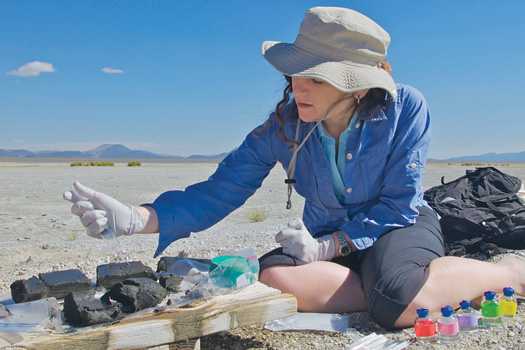
Shortly after her first visit to Mono Lake, Wolfe-Simon joined Oremland’s lab. There, she took the samples from the lake and added the sediment to a series of test tubes. She mixed vitamins, sugars and salts into sterile water to mimic the mineral composition of Mono Lake. Those were the controls.
To some of the samples, she added arsenic but left out phosphorus. To a different batch, she added phosphorus but left out arsenic. Then she watched the samples for signs of growth. Nothing grew in the control tubes that lacked phosphorus and arsenic, but one bacterium, a strain of Halomonadaceae, seemed to grow in the arsenic environment. (It also grew in the phosphorus one.) After isolating the microbe, Wolfe-Simon and her colleagues needed to give it a name. Joking around late one night, they settled on GFAJ-1—short for “get Felisa a job.”
Wolfe-Simon started boosting the arsenic, wondering how much the bacteria could tolerate. As she steadily brought the level up, ultimately to 500,000 times the limit for EPA-regulated drinking water, she began wearing a second pair of gloves. She says that every day she entered the lab, she expected to find the bacteria dead. But it continued to grow.
Thinking that the results might be an error, the team repeated the experiment multiple times. “We were pretty self-critical the entire time,” she says. But after six trials, GFAJ-1 seemed clearly able to survive and reproduce using arsenic instead of phosphorus. The question was: how?
To find out whether, and in what way, GFAJ-1 was incorporating arsenic into its biochemical machinery, Wolfe-Simon would need collaborators outside her field. Among the first colleagues she contacted was Samuel Webb, a beam-line scientist at the Stanford Synchrotron Radiation Lightsource. Located in the SLAC National Accelerator Laboratory in Palo Alto, the synchrotron can be used to determine the molecular structure of a sample. The device circulates electrons in a vacuum at nearly light speed until ejecting them into one of 30 experimental stations, producing the high-intensity x-rays needed to elucidate molecular structures.
A few days before the shoot at Mono Lake, Wolfe-Simon gave me a tour of the place. We entered the huge, circular building that encloses the synchrotron’s 768-foot acceleration ring and made our way toward the instrument hutch where Webb bombards biological and medical samples with x-rays. As we traced the ring halfway around the building, Wolfe-Simon told me, “This is what we did when we were up late waiting for results.”
To take full advantage of their allotted beam time, Wolfe-Simon and Webb worked in stints of up to 72 hours, setting up experiments and then sealing the leadlined door and directing the narrow beam of x-rays at the GFAJ-1 cells. Webb used two tests, x-ray fluorescence imaging and extended x-ray absorption fine structure (EXAFS) imaging, to determine the location and chemical structure of arsenic in the GFAJ-1 cells.
“I had thought we’d see some free arsenic in the cells,” Webb would tell me later, “but the data were showing that the arsenic was being chemically bound in the cells in a way that’s consistent with the role you’d expect phosphorus to play. It’s not a golden bullet that absolutely proves it’s in the DNA, but it’s definitely some very interesting chemistry that’s different than anything we’ve ever seen. It certainly looks like arsenic is capable of performing phosphorus’s job in the cell.”
Wolfe-Simon also took GFAJ-1 to Lawrence Livermore National Laboratory, Arizona State University and Duquesne University. She and the paper’s 11 co-authors used inductively coupled plasma mass spectrometry to confirm that arsenic was inside bacterial cells, rather than just a contaminant fixed to the exterior of the cells. They used radioactive labeling to determine that arsenic existed within the protein, lipid, nucleic acid and metabolite fractions of the cells.
“At that point,” Oremland says, “we were getting out of the doubting stage.” With encouragement from her collaborators, Wolfe-Simon wrote up the results and submitted the paper to Science. “I would have loved to have had an additional two or three experiments,” she says. “But we had six lines of evidence that this microbe was doing something new. It seemed to be a story that held together. It seemed like something we should tell our friends about.”
On November 29, NASA’s media team posted an enigmatic announcement: The agency would hold a news conference at 2 p.m. the following Thursday, “to discuss an astrobiology finding that will impact the search for evidence of extraterrestrial life.” (“For just a few days,” science writer Carl Zimmer later wrote on the Web magazine Slate, “a lot of us wondered if NASA had discovered aliens.”) Although NASA awards about $50 million annually in astrobiology grants—many of which have produced newsworthy results—it has shied away from big announcements about extraterrestrial life since 1996.
That year, the space agency issued a press release announcing that scientists had identified features consistent with extraterrestrial life in a Martian meteorite. By the time David McKay, the lead researcher, reported his findings at a news conference a few days later, the media had already made up its mind. Though McKay never claimed absolute certainty that the meteorite had contained living microbes, news outlets ran with the proof-of-extraterrestrial-life story.
As quickly as McKay’s work was lauded (President Clinton even praised the results on the White House lawn) the scientific community began tearing into it, citing contamination issues and the fact that no microbes as small as McKay’s reported microfossil had previously been found. “The media had trouble getting their arms around the story and seeing what was really there,” McKay told me. “They jumped on every sensational criticism of our story, and what people are left with is that ‘life on Mars’ has been disproved—even though a lot of what supposedly disproved our story has itself been disproved.” Since then, NASA has taken a measured approach to its astrobiology announcements—at least until it learned about Wolfe-Simon’s paper.
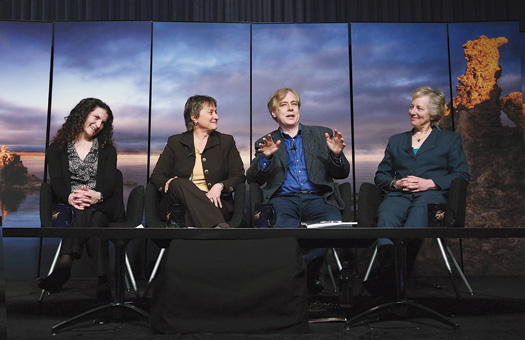
By the time Wolfe-Simon took her seat at NASA’s news conference on December 2, science-related websites had been abuzz for four days. General interest outlets such as Gawker and Fox News had joined the speculation as well, running headlines and segments about the discovery of “alien life.”
Although NASA brought chemist Steven Benner, who heads the Foundation for Applied Molecular Evolution, to offer a skeptical counterpoint (“I’m the curmudgeon chemist,” he said at the conference, “brought in to throw wet blankets on things and dampen some of the enthusiasm”), his perspective was largely drowned out by the prevailing hype.
“I can’t bring myself to watch the conference again.””[It’s] not life as we know it,” said Mary Voytek, director of NASA’s astrobiology program, who said at the conference that science textbooks might now have to be rewritten. She called the discovery “a huge deal” and compared it with the Star Trek episode in which the Enterprise crew finds Horta, an alien life-form that they can’t detect with tricorders because it’s based on silicon rather than carbon. Later that day, Edward Weiler, NASA’s associate administrator for the Science Mission Directorate, said, “The definition of life has just expanded.”
Wolfe-Simon’s performance came off as both patronizing and overly dramatic. She seemed more concerned with defining her discovery’s place in history than offering a clear-headed explanation of the paper’s findings. “We’ve cracked open the door to what’s possible for life elsewhere in the universe,” she said. “What else might we find?”
“I can’t bring myself to watch [the conference] again,” says Oremland, who didn’t attend. “There was a tone of arrogance, and they seemed carried away, feeding the desire to make something more of it. There were mixed messages. An entirely new microorganism? Wrong. Thriving on arsenic? No—it managed to make do. An example of hidden life-forms? We have no proof.”
As Oremland correctly notes, the paper was actually quite understated and conservatively written. But reporters mirrored the oversimplified urgency of NASA’s press conference; “alien life discovered on Earth” was the dominant theme. Soon Wolfe-Simon began to crop up in stories that seemed more related to celebrity than science. Time magazine selected her as one of its Time 100, an annual list of “the most influential people in the world.” Glamour interviewed her for a “5-Minute Mentor” column titled “This Rising Star’s Four Rules for You.” She says her inbox swelled by hundreds of e-mails every couple of hours.
Meanwhile, the initial tide of astonishment quickly turned to skepticism, with academics claiming that the paper had overreached. Some, including Benner, didn’t believe that the team had found an exception to one of the fundamental rules of life on Earth. “Their hypothesis would, if true, set aside nearly a century of chemical data concerning arsenate and phosphate molecules,” he wrote in one of the responses published in Science. He and other chemists objected that the arsenic linkages purportedly holding the DNA of GFAJ-1 together would quickly fall apart in water. Also, critics said, arsenic in the cytoplasm would be reduced to arsenite, which wouldn’t be able to substitute for phosphorus.
Other researchers suggested that mineral salts in the bacterial cultures could have contributed enough phosphorus to meet the needs of GFAJ-1—although Wolfe-Simon counters that in her control batches, similarly minute levels of phosphorus couldn’t fuel the microbe’s growth or even sustain its life.
Rosie Redfield, a microbiologist at the University of British Columbia, led the criticism, with her blog, RRResearch, becoming a clearinghouse for challenges to the paper. Redfield called the research “a shabby trick,” with “lots of flim-flam, but very little reliable information.” She said, “I was shocked at how bad the science was. If this data was presented by Ph.D. students at their committee meeting, I’d send them back to the bench to do more cleanup and controls.” Redfield was also the one to publish the “Is Felisa Wolfe-Simon an Alien?” post, which was an anonymous undergraduate essay that satirically suggested that Wolfe-Simon wrote a deeply flawed paper to discredit more serious research into the existence of alien beings like herself.
Redfield’s technical criticisms—that trace phosphorus in the culture media could have fueled GFAJ’s growth, and that Wolfe-Simon had inadequately purified the DNA—degenerated into speculation about the motivations of Wolfe-Simon and her co-authors, as well as those of NASA and Science. “I don’t know whether the authors are just bad scientists,” she wrote, “or whether they’re unscrupulously pushing NASA’s ‘There’s life in outer space!’ agenda.”

Overwhelmed with questions from the media, Wolfe-Simon went underground. Guided by NASA’s PR team, she and Oremland and the paper’s other co-authors began citing NASA spokesperson Dwayne Brown’s position that the authors would not be responding to individual criticisms. The agency, Brown said, didn’t feel it appropriate to debate science using the media and bloggers. Discourse should occur in scientific publications.
“I wasn’t hiding, but I didn’t want to get involved in a Jerry Springer situation, with people throwing chairs,” Oremland says. “There are hundreds of blogs some viable and some off the wall, and they all want an immediate response. To try to engage in scientific commentary that way seems like a descent into madness.”
Microbiologist Jonathan Eisen of the University of California at Davis called the lack of response “absurd” and told Carl Zimmer from Slate, “They carried out science by press release and press conference. They are now hypocritical if they say that the only response should be in the scientific literature.”
In a short article that appeared in Science in late December, Wolfe-Simon asked for time and patience, writing that she wanted “to be able to have that discourse in the scientific community, as a record.” But her appearances in Time and Glamour only seemed to fuel the indignation. (Here’s science writer Ed Yong’s response to the latter in a post on Discover magazine’s website: “Felisa Wolfe-Simon wouldn’t discuss her arsenic-life findings with the press, but she’s happy to share keys to success with Glamour. Wikipedia has this to say on glamour: ‘Glamour originally was a magical-occult spell . . . Today, glamour is the impression of attraction or fascination that a particularly luxurious or elegant appearance creates, an impression which is better than the reality.’ Mm-hmm.”) In March, Wolfe-Simon spoke at the glamorous annual thought-leader summit known as the TED Conference, touting the transformative potential of her findings but neglecting to mention her critics, a performance that also didn’t sit well in certain circles.
With Science‘s June publication of the formal critiques and technical response, the debate moved briefly from the blogs back to the scientific literature. The eight criticisms focused mostly on the possibility of contamination and on whether arsenate compounds would be stable enough to survive in the cells.
Redfield presented calculations that supported her assertions that trace amounts of phosphorus in the mineral salts in the culture media would be enough to fuel GFAJ-1’s growth. In their response, Wolfe-Simon and her co-authors wrote that background phosphorus levels weren’t high enough to create all the necessary biomolecules required for growth. Addressing the stability question, Wolfe-Simon cited two new papers by other researchers, each of which suggested that DNA with arsenic could indeed retain its phosphorus-based structure.
To corroborate her results, Wolfe-Simon is collaborating with researchers who plan to subject the microbes to mass spectrometry, nuclear magnetic resonance spectroscopy and genomic sequencing. She says she has also been encouraging independent studies. Oremland has fulfilled about 10 of the more than 40 requests he has received for samples.
“I’m not a NASA employee, and I’m not a vehicle for their ideas. They have their own agenda. I’m a pawn at best”One sample went to Redfield, who has, characteristically, posted regular blog updates throughout the experimental process—most notably an installment on August 2 entitled “First evidence refuting Wolfe-Simon et al.’s results.” She replicated Wolfe-Simon’s experiment using a medium that contained trace amounts of phosphorus similar to what GFAJ-1 would have encountered in Wolfe-Simon’s arsenic sample—but without the arsenic. “The sample grew just fine,” Redfield says. “I went into this with a very strong expectation that the arsenic results would not be reproducible, so I wasn’t surprised by the findings. I assume the things I see, other researchers will too.” Of course, it’s worth noting that these are preliminary results, not yet submitted for journal publication or subjected to rigorous peer review.
“The results of our study were interpreted in ways that we had not intended,” Wolfe-Simon tells me in a phone conversation a few weeks after the shoot at Mono Lake. “GFAJ-1 is not ‘weird life,’ nor do we ever state that. It is not alien or anything like that—again, nothing we ever say. Our paper shows compelling data that suggest that GFAJ-1 can use arsenic in a similar way to phosphate in its major biomolecules.”
One reason for the confusion, she says, could be the explanatory video NASA produced for the press conference, which shows all the DNA’s phosphorus atoms being replaced by arsenic. “It clearly says ‘artist’s interpretation,’ ” she says, “but maybe that doesn’t work for biology. With astronomy, people seem to be comfortable looking at cartoons and not holding the scientists accountable for those purple planets. But with biology, it’s looked at as data.”
But in focusing on this one small feature of the press conference, Wolfe-Simon is casting culpability onto too narrow a target. She’s neglecting to notice that the entire affair was rife with oversimplification and unearned celebration. Add in the “extraterrestrial life” press release and the four-day media embargo and it’s clear that Wolfe-Simon was, like McKay before her, inadvertently set up to fail by pressures at NASA that have little to do with science.
Because NASA is dependent for funding on Congress, and therefore its constituents, it needs to project an ongoing sense of relevance. But the agency also needs to maintain its scientific credibility. The controversy over GFAJ-1 demonstrates the risks inherent when a scientific institution assumes a media role. NASA’s publicity blitz created expectations that weren’t matched by the paper’s data, and this vastly amplified the criticism that followed.
Dwayne Brown, the NASA spokesman, has said that the agency is comfortable with how it handled the affair, particularly the use of the term “extraterrestrial life.” In a story posted on the Embargo Watch blog, he said, “It’s easy to play Monday morning quarterback. However, the statement was accurate. The real issue is that the reporting world has changed because of the Internet/bloggers/social media, etc. A ‘buzz’ term like ET will have anyone with a computer putting out anything they want or feel. NASA didn’t hype anything—others did.”
Brown, too, appears to be willfully ignoring some of the facts. NASA’s media team did hype the arsenic-life findings—through the timing and wording of the press release, through the tone of the news conference, and through a follow-up tweet that claimed that the discovery “will change how we search for life elsewhere in the Universe.” Furthermore, many of the bloggers who he dismisses as “anyone with a computer” were in fact distinguished researchers and members of established media organizations. (Brown did not respond to several requests for comment from Popular Science.)
Wolfe-Simon was at first reluctant to criticize the agency that writes her checks. But by July, her anger was beginning to show. “I’m not a NASA employee, and I’m not a vehicle for their ideas,” she told me. “They have their own agenda, which I have nothing to do with. I’m a pawn at best.”
While NASA deserves some blame for the arsenic life affair, scientists have also criticized Science. “Where were the peer reviewers, who should have seen the most obvious problems?” asks Michael Eisen, an evolutionary biologist at the University of California at Berkeley (and brother of Jonathan Eisen). Yet there’s no indication that the paper’s reviewers were asleep at the switch. As is usual, the reviewers requested more research before accepting the paper. In line with their request, Wolfe-Simon and her co-publishers used high-resolution secondary ion mass spectrometry to confirm that the isolated DNA contained arsenic.
Bruce Alberts, the editor in chief of Science, wrote in a statement accompanying the print edition that “the fact that the paper received so much feedback suggests to us that science is proceeding as it should.” Later, though, he conceded that, in hindsight, he would have done things differently. “When we receive papers like this one that involve a set of specialized techniques from different laboratories,” he wrote in an e-mail, “we need to create a process to ensure that the reviewers who provide their feedback to us on the manuscript are sufficient—in aggregate—to deal with all of its many different aspects.”
No matter how the peer-review process is amended, the arsenic-life affair laid bare the challenges of scientific discourse in a new media age. The productive collision of ideas and personalities and opinions has long been refereed and filtered by science journals. If that process has made science seem, from a distance, civilized and rational, it has also made it slow and undemocratic. It can take months for a response to be published, if it is published at all. Now scientists are taking the review process into their own hands, creating a fluid communal verdict that’s both immediate and infinitely open to revision. Theoretically, at least, peer-review-by-blog has the potential to move science forward faster, humanize it, and communicate it more openly. But it also risks upending a system that provides a credible scientific record and an impartial forum for rigorous, professional and civil scientific debate.
“I still think science is the coolest thing on Earth,” Wolfe-Simon tells me when we meet the morning after the video shoot in a coffee shop overlooking Mono Lake in Lee Vining. “But it’s quite possible that my career is over.”
In June, Science reported that Wolfe-Simon had left Oremland’s USGS laboratory to look for a location with better molecular and genetic research facilities. “Actually,” Wolfe-Simon says, “I didn’t leave out of choice. Ron basically evicted me from the group. It was a political decision on his part that I don’t understand, and I didn’t see it coming.” Although she received a NASA fellowship in 2010 that provides support through 2013, she is still seeking a new home for her work.
I find it hard not to feel sympathy for her. In a matter of weeks she was catapulted to fame, then singled out and assaulted with professional and personal criticism, some of which resulted from missteps beyond her control. Wolfe-Simon is an early-career researcher in a field dominated by older men. Few scientists, no matter how established, would have the skills to navigate the situation that she found herself in. What made the level of criticism so extraordinary is that the paper, in itself, is not so flawed that it should not have been published. The argument was compelling, the conclusions were measured, the data was thorough, and the paper made it through the same peer-review process as other articles in Science.
Some who initially blasted Wolfe-Simon have since changed their mind. Blogger Alan Townsend, who directs the environmental studies program at the University of Colorado, says he was guilty of rash judgment, and that his preliminary opinions—expressed in writing and conversations with his colleagues—contributed to a response from the scientific community that was “often unprofessional, and at times became downright shameful.” He says, “Absent major ethical violations, no junior scientist full of passion for an idea deserves crucifixion for a professional failure or two. If a paper is flawed, it should be dismissed. The scientist should not.”
Even Redfield has struck a more conciliatory tone. In an e-mail to Wolfe-Simon following her initial critical burst, she wrote, “What matters in science isn’t whether we make mistakes (we all do) but how we handle them, and I think you’re handling the situation well.”
In Lee Vining, Wolfe-Simon and I settle into seats by a window, and again she pulls out her tape recorder. “This whole thing has been so strange,” she says. ” ‘Challenging’ doesn’t fully encompass the experience I’ve had in the past six months.”
It will take a few years to better answer the questions surrounding GFAJ-1. In the meantime, Benner—who says he would be “more than astonished” if arsenic replaces phosphorus in any genetically relevant molecule in GFAJ-1—says Wolfe-Simon’s hypothesis is ultimately useful if it motivates people to look in new places and ask bigger questions.
Wolfe-Simon says the paper’s publicity attracted new collaborators who she wouldn’t have otherwise met, some of whom are already analyzing GFAJ-1. And her fame has played out in surprising ways. Recently, her husband, Jonathan, an engineer, was speaking with a colleague who asked if he happened to be married to Felisa Wolfe-Simon. When he said yes, the colleague said, “My seven-year-old daughter dressed up as Felisa for her school’s science day!” The girl wore a sun hat, with her pants rolled up and flip-flops on her feet, dressed for a day wading the waters of Mono Lake in search of bacteria.
“As difficult as things have been in the past months for me personally,” Wolfe-Simon says, finishing her espresso, “if my work can make this little girl have that kind of inspiration, then maybe it’s all good.” She gazes out the window, at the flat, gray lake. “Then again, considering what’s happened, maybe now she’s thinking it’s not such a good idea after all. Maybe she should go into marketing.”
As the interview winds down, I ask Wolfe-Simon if she has any children of her own. She says she doesn’t but that she has a young niece she spends a lot of time doting on. “I know there will come a day,” she says, “when she will ask me two questions: Are we alone?And how did we get here? These are things that humans have been asking for a long time. And right now, we don’t know the answers.”
