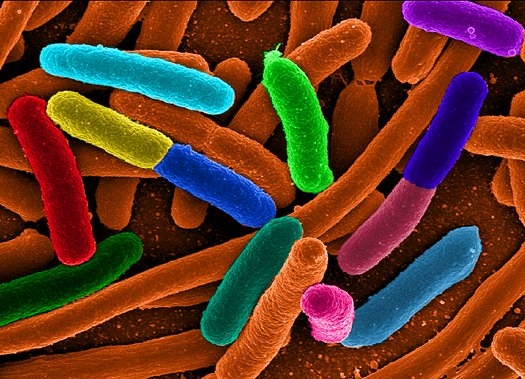
It’s an innovation fit for a Cold War spy novel: a means to transmit secret messages via microbe. Dubbed steganography by printed arrays of microbes (yup: SPAM), the technique involves encoding messages in the colors of glowing bacteria, which can be later unlocked with antibiotics.
That’s not to say this is the first time a secret or hidden message has been encoded into a living molecule. But the method is quite simple, requiring no gene sequencing equipment, microscopes, or other scarce and expensive laboratory gear to extract the coded message. Some simple LEDs and a smartphone would suffice, allowing the recipient to receive the printed microbes through the mail and quickly and easily unlock the message.
It works like so: The team took seven strains of common Escherichia coli bacteria and engineered each to glow a different color under the right light via fluorescent proteins. The bacteria are then grown in pre-selected sequences of paired dots, with each pair representing a letter or other symbol like a numeric digit. These pairs can then be imprinted on a sheet of nitrocellulose and sent through the post like any other piece of paper.
At the other end, the recipient simply has to regrow the bacteria (which isn’t difficult) and place it under the right kind of light or expose it to antibiotics to make it glow, revealing the coded message. Moreover, the bacteria can be further engineered to only express their colors after specific periods of time, or to self-destruct after a certain period in proper Hollywood spy style. They can also be tailored to respond differently to different antibiotics, revealing the true message only when a certain kind of antibiotic–known by the intended recipient–is used.
The drawbacks: there are only a limited number of antibiotics in the world, so it wouldn’t be difficult to brute force a coded message by using all available antibiotics to reveal the true message. But this doesn’t bother the researchers behind the development, as they are less concerned with the cloak and dagger applications of their technology anyhow. They’re more interested in developing new ways to watermark genetically modified organisms with “biological barcodes” to protect intellectual property and make the world safer for modified life.