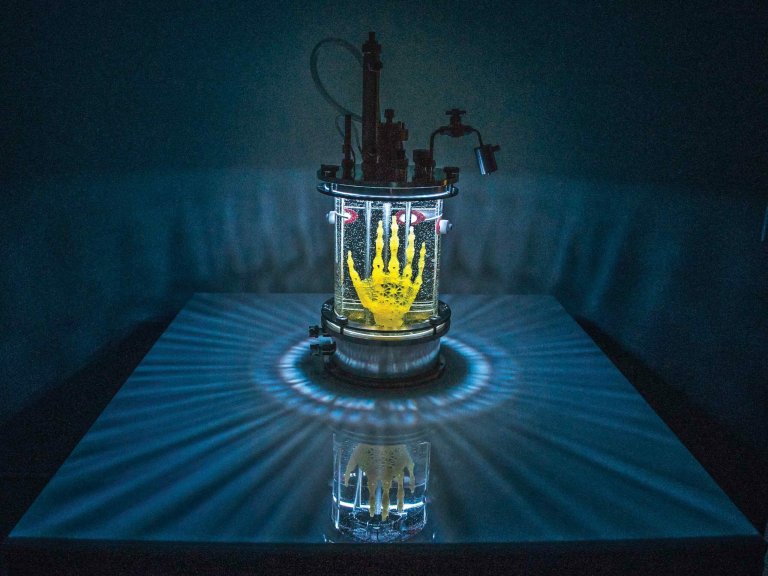
Can be used to study brain function, or just to look cool

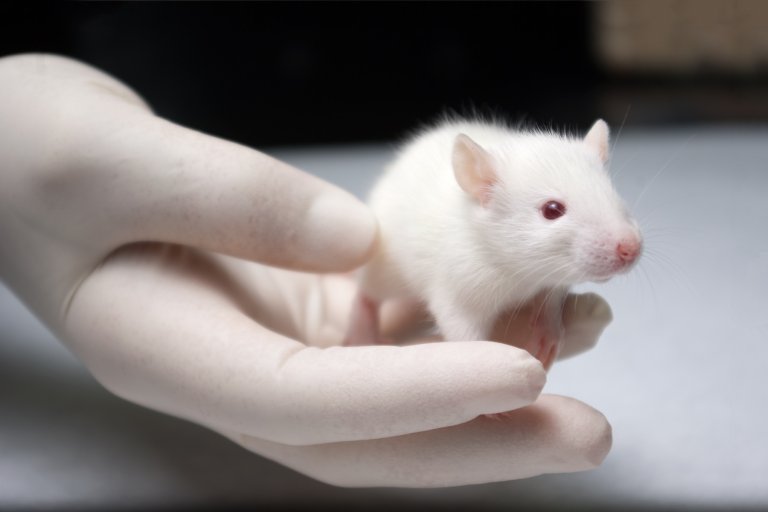
Mouse Embryos This photo shows two mouse embryos. The clear one at right has been rendered transparent by a new chemical reagent developed by Japanese researchers. RIKEN

All the new breakthroughs in microscopy we’ve seen recently are designed to help scientists see deeper, inside individual cells and into the depths of the brain. Of course, this would be easier to do if there wasn’t a bunch of other tissue blocking the cells you want to see. Japanese researchers have a new solution: Make it all transparent.

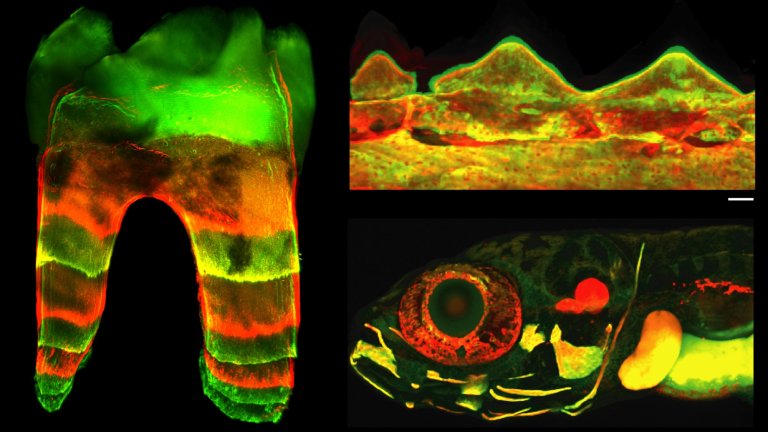
A new chemical reagent makes the brain see-through, allowing fluorescent tags to light up neurons and blood vessels deep inside. This enables 3-D images of entire structures, without having to cut anything away or divide anything into smaller sections.

It doesn’t work on living tissue, at least not yet — researchers at RIKEN, Japan’s major research institute, are investigating another, milder reagent that could allow them to study live tissue in this way.

The reagent, called Scale, has specific clarifying properties that do not alter the overall shape or proportion of the sample being washed, according to a news release from RIKEN. First you would have to genetically modify the sample by adding fluorescent proteins to tag certain cells. While it turns the tissue transparent, the Scale method also prevents decreasing the intensity of those fluorescent signals. So once the tissue is washed with Scale, researchers can see the fluorescent proteins flashing.

The fluorescent tags have made it possible to visualize brain regions at a depth of several millimeters, far better than before, and to reconstruct neural networks, RIKEN says. Atsushi Miyawaki and his team at the RIKEN Brain Science Institute have already used it to study neuronal networks among the cerebral cortex, hippocampus and white matter of mouse brains.

It can work on several other tissues besides the brain, the researchers say — they plan to try Scale on the heart, muscles and kidneys, and on tissues from primate and human biopsy samples. The work was published this week in Nature Neuroscience.

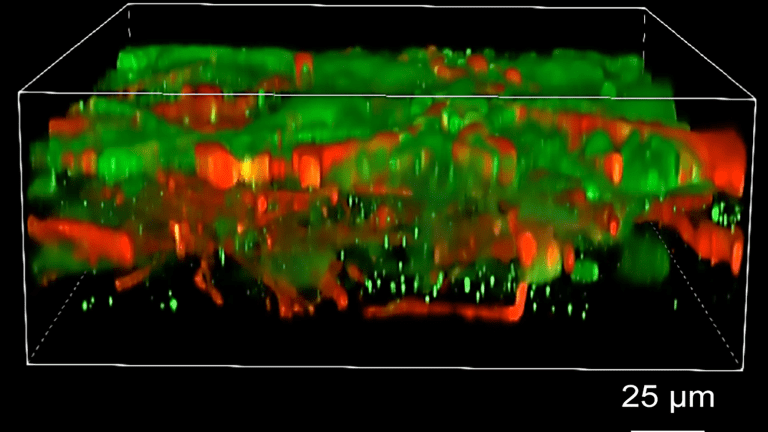
Nuclei in the Brain: This image shows nuclei of proliferating neural stem cells (green) and blood vessels (red) tunneling into the transparent hippocampus. The green signal comes from a fluorescent marker.  RIKEN

19 Comments

CREEPY!

hollow man?

a new form of invisibility

My question: Is where did they find that baby Cthulhu to test it on?

they are mouse embryo's before any one gets to excited. I am actually shocked we do not have a god disciples on here preaching yet lol uh oh!! let the FLOOD GATES BE OPENED AND WE ALL BE DAMNED!!!!! I want to be invisible!! As long as I can shut it off...endless fun endless

@MaxwellMudd

Where ever they find lab rats.

Minni looking at Mickey as says “I love you Mickey! “ Mickey ask Minnie, “Why do you love me so much"? Minnie replies: “Well, it’s you’re so honest, just so transparent to me." Oh, TRUE LOVE, it's so magical! Sigh! xoxo

Doesn't work on living tissue yet? Heh, thats ok. baby steps...

That's pretty cool.

@Wolff:

In the meantime- if you ever find yourself with a body to dispose of...

Are they going to allow a clear mouse to come to full gestation and be born? Maybe these will be super smart mice and read other mice minds; you know, they be clear-voyant. lol!

Hey, cover those organs young man!

I pray these mice as they grow up and mature, do not have hate and racial wars. The aliens came to earth and modified our ape DNA, we are all really aliens on planet earth. Can't we all get along and give peace a chance!

I can't imaging how this rat will look like if grown up.. LOL

While clearly a significant discovery, this also has great potential for misuse.
Please see my analysis here:
http://iheardacouplethings.blogspot.com/2011/09/threat-of-transparency.html

@. Tweakman, why yes it is, lol.

If I remember correctly, this was described in the original "The Invisible Man" by H. G. Wells. The title character says that to become invisible, he first injected himself with a chemical that turned his tissues transparent, then used some kind of sci-fi radiation to alter the refractive index of his tissues to that of air.

Looks like step 1 was Scale.

I would like a copy of their paper :)
This method beats GFP in so many ways (other than, most likely, expense...)


138 years of Popular Science at your fingertips.


Popular Science+ For iPad

Each issue has been completely reimagined for your iPad. See our amazing new vision for magazines that goes far beyond the printed page


Download Our App

Stay up to date on the latest news of the future of science and technology from your iPhone or Android phone with full articles, images and offline viewing


Follow Us On Twitter

Featuring every article from the magazine and website, plus links from around the Web. Also see our PopSci DIY feed


March 2012: The Future of Medicine

A 10,000-rpm, no-pulse heart is completely revolutionizing how we think about transplants. Plus: rapid-response virus hunters, a shocking cure for migraines, the world's youngest person to have achieved nuclear fusion (in his parents' garage!), and much more.


circ-top-header.gif
circ-cover.gif
bmxmag-ps