
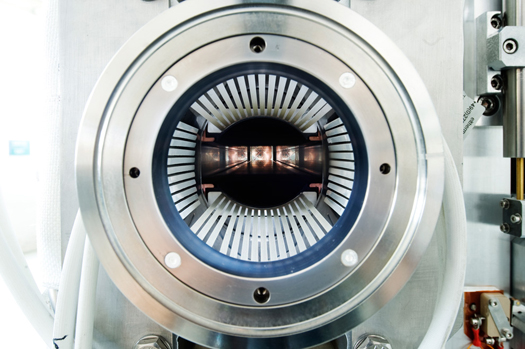
A Collimeter at the LHC The collimation system protects the LHC against damage due to beam loss. Claudia Marcelloni, CERN

Like all good marathons, the race to find the Higgs boson at the Large Hadron Collider began with much fanfare but has now left spectators with little to do but wait until someone nears the finish line (at which point things will become very exciting again). But there’s reason to think LHC researchers at may have the finish line in sight: Scientists and administrators there are seriously considering extending the LHC’s current research run by an extra year through the end of 2012.

While 2012 may still seem a long way away, CERN’s willingness to extend the current research period suggests scientists really do believe they can crack the Higgs code in the next 24 months – and do without cranking the experiment up to full power. The LHC was scheduled to run until the end of 2011, at which point it would be shut down for a year for maintenance and a serious upgrade that would allow the particle accelerator to smash particles at its full potential strength of 14 TeV (teraelectronvolts). Right now the LHC is smashing particles at half that energy.

But given the data they’ve collected so far, researchers at the LHC’s major experiments think they’re quite close to finding the Higgs boson, the elusive – and as-yet theoretical – particle that endows all other particles with mass. The Higgs’ existence is necessary to the Standard Model of particle physics, so its discovery (or disproving) would contribute massively to physicists’ understanding of the universe.

But with other particle accelerators like Fermilab’s Tevatron working feverishly to beat the LHC to a Higgs discovery, researchers at CERN want to keep searching for it through 2012. Then again, maybe CERN’s administrators are bowing to good old-fashioned peer pressure. Said Sergio Bertolucci, CERN's director for research and computing, via the Journal Nature’s Web site: “If we stop the machine with 3,000 people apiece in the experiments waiting for data, there is no way we could get home at night without having slashed tyres on our cars.”

The plan to extend the LHC’s research period will officially be decided in January, but slashed tires or no it appears right now that the world’s largest science experiment will get an extra year of Higgs hunting in 2012.

[Nature]

14 Comments

I still don't exactly understand what the Higgs Boson is. I've been looking online and am still confused.

Does anyone else see the number of typos in these articles?

:(

This is awesome news! As long as it doesn't break again. I'd love to see it at full power, but if they think they might be able to see results at half power, then by all means fire it up! I'm curious as to what data we are not seeing that would sway them to risk machine failure by pressing on rather than moving forwards with the repairs and upgrades. Very interesting, yet perplexing.

Sorry but this article`s intro is a bit misleading. The LHC already made some exiting discoveries if you have actually been following the machine. It`s also extending the gaps in knowledge on many other fields and other then Higgs with new and more accurate data produced. There is much the LHC can discover and a lot of knowledge the LHC can improve on. Even though the Higgs is one of the top reasons the LHC was build it is getting disproportionate amounts of attention compared to the other research LHC is doing.

Funny coincidence end of 2012.

It's theorized to give particles mass...

Couldn't they conjure the Higgs boson from a vacuum. Reference to "Making Something From Nothing: Researchers Find That Matter Can Be Conjured from a Vacuum"

Why do they call it the "god" particle?

@ xalar: I think the term "god particle" came about because finding the Higgs could unify quantum theories with gravitational theories, thus leading to a "theory of everything" that explains all the forces of nature (electromagnetic, strong and weak nuclear, plus gravity).

As far as conjuring from vacuum: that technique uses lasers that cannot produce enough power density to make a Higgs. (Apparently the Higgs is a rather massive beast).

I wonder if the CERN folks are worried that Fermilab might beat them to the Higgs if they shut down for the upgrade. Personally I think the sooner they get to full power the better, but perhaps they feel the competition close behind them.

The problem with CERN's LHC is one of amplitude. Earth's ability to manage energy has been hurt by global warming so that rather than excess, typically heat, related energy being able to radiate out away from planet to outer space, to release it from the earth, heat and related energies are in effect, trapped under the thick insulating blanket that pollution driven global warming has created. Consequently, effect is like a pipe that has too much fluid being pushed through it- hence the blowouts at weak points in Earth's crust by way of sinkholes appearing in recent years in Guatemala and Germany, as a result of literally an underground explosions brought about by huge volumes of energy released into Earth's crust by way of CERN's activities, that the Earth is unable to properly adsorb and manage by way of normal activities. Earth cannot manage the extra energy load so as with a lightning bolt, energy released from CERN's activities is literally just running through the Earth's crust and deeper, related layers closer to the core, and then blowing out at the surface at weak points.

The sad part about this is that CERN apparently is just a bunch of people who all they care about is saying what people need to hear so they can get their projects approved- and then sticking countries like Guatemala and Germany with the consequences of what amounts to CERN’s greed. Next thing you know, one of these days we shall see blowouts in things like oil fields where drilling is occurring, and that includes hitting utility centers in major cities and blowing those out, leaving those cities messed up for some time to come after that. If CERN's LHC gets cranked up to full power it is almost certain to blow out things like California, and Hawaii, so what started out as nice places to live, and we will all be able to watch places such as these fall into the sea. Then, as CERN continues with its activities, and more underground explosions occur, life as we know it will come to an end as the oil supply is disrupted so we no longer have the fuel we need to transport food to be able to get access to it to eat it and although we will have water, it will be polluted and not drinkable, because the machines that are needed to clean it will be unable to run. So no water and no food.

@ jme0598: Ya know, I had and undoubtedly still have illusions, questions, malformed ideas, and still also great fears about these types of machines. It's likely that I'll spend many more hours of digging through the stuff I can understand and that far greater amount of material that I might not ever be able to decrypt just to get a handle on the possible true natures and functions of them. These people have dedicated many years of direct hands on controlled study in multiple post-doctorate levels of their current qualifications just to be considered for invitation to monitor and record the findings and questions of more highly skilled and knowledgeable people. While I do consider this particular facility from a fairly questioning base layman's viewpoint quite a bit, I also try to understand the actual capabilities of the base components from the basic sciences they are designed to exhibit here in this single effort of all of them. With my limited college and workplace experience and limited level of capable study that actually apply to this facility; I am pretty sure that the Earth's crust, and denser mantle, and far denser molten and turning core, and that core's magnetic field would be easily capable of absorbing the 7,000,000,000,000 electron volts that they are throwing. Because what they are throwing with this collection of devices are also contained with magnetic fields. I think that if the fields fail their risk goes up greatly, but this system is designed to learn both through failure as well as success.

I suspect a far greater effect of all of these devices that are currently in various stages of operation at various times around the planet that my weird kind of mind might want to know more about is what about overall net gain through all of the loops created as all of those devices run their cycle at different places on the planet? If these devices were designed and placed and cycled and fired in an effort designed to alter our planet's orbit? If it were even possible; just what would the configuration and sizes of machines be? It would seem to me that it could be possible, but that's about as far as I can get with this in just my head with my twisted way of looking at stuff.

If it could be done then it would be a top containment limit we would be working against with our field science and whatever we'd use as anchoring material.

obviously it would be a big electric loop, that as our earth's irregularity is better determined, combined with our rotation would be able to be refined gradually in facility placement and fired for as great a duration possible each day as our overall tech capability were improved and an ever more refined remaining gaps to fill with loop facilities. then, once some reasonable number were placed, we would then be able to do a coordinated longitudinal firing with ever longer loops, generating more and more speed each day, or less if the desire was to slow. obviously this would be a very gradual effect, but as long as the facilities providing the actual anchor points were kept in good repair; and new facilities added in likewise overall placement, couldn't we call it Planetship Earth, in DEED? If true, I need a job.

@ jme0598: if my crap is possible, you could be right. if that were the case, we'd have a VERY good reason to sacrifice Guatemala. and then mine the hole. then I'd need a job even more, and I'd pick electromagnetic fanblade installer. it would give me a chance to get on with the metallurgy or any of the machine operator jobs. making our field anchors would be a good series of parts to do too. I'd have already worked on the install of one by then. yeah, definitely fanblade installer to start. This concept has to be possible. It's just an enhancement of the big damaged gyroscope we live on. This time; Gimme a job.

hell, you gimme 20 years and I'll have the damaged gyroscope we live on fixed if ya want. If this is what I think, you better gimme a job cause I got things that people do want to know, but I have no idea what to do with em.


140 years of Popular Science at your fingertips.


Popular Science+ For iPad

Each issue has been completely reimagined for your iPad. See our amazing new vision for magazines that goes far beyond the printed page


Download Our App

Stay up to date on the latest news of the future of science and technology from your iPhone or Android phone with full articles, images and offline viewing


Follow Us On Twitter

Featuring every article from the magazine and website, plus links from around the Web. Also see our PopSci DIY feed


February 2013: How To Build A Hero

Engineers are racing to build robots that can take the place of rescuers. That story, plus a city that storms can't break and how having fun could lead to breakthrough science.

Also! A leech detective, the solution to America's train-crash problems, the world's fastest baby carriage, and more.


Online Content Director: Suzanne LaBarre | Email
Senior Editor: Paul Adams | Email
Associate Editor: Dan Nosowitz | Email

Contributing Writers:
Clay Dillow | Email
Rebecca Boyle | Email
Colin Lecher | Email
Emily Elert | Email

Intern:
Shaunacy Ferro | Email

circ-top-header.gif
circ-cover.gif
bmxmag-ps