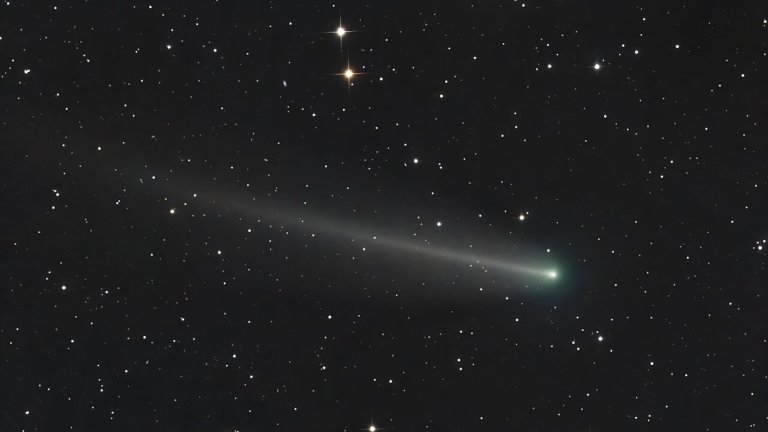
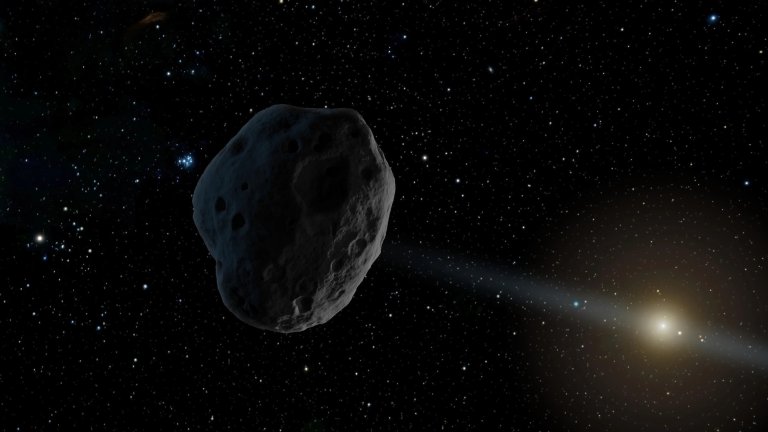
Our solar system's 'hood may get a bit rougher sometime during the next 1.5 million years. An astronomer has given an 86 percent chance for a neighboring star to smash into the frozen Oort Cloud surrounding the outskirts of the solar system, and may scatter some comets toward Earth, Technology Review reports.
That's not the only close encounter for our sun, according to Vadim Bobylev at the Pulkovo Astronomical Observatory in St. Petersburg, Russia. He combined data from several databases of stars and found at least nine more stars that have already swung past the sun or will do so in the future.
The data on Gliese 710, an orange dwarf star, comes from position and velocity measurements of about 100,000 stars in the Hipparcos Catalogue published in 1997. Updates for the Hipparcos data in 2007 allowed Bobylev to calculate the likelihood that Gliese 710 might smash into our solar system.
A hail of comets sweeping toward Earth from that collision could pose a problem, given the relatively pathetic investment in detecting incoming space threats. The loose chunks of ice debris within a comet's gaseous body might also prove more of a nightmare than solid asteroids, and scientists still don't know exactly how to deal with the rockier cousins.If Bobylev's prediction holds and Earth escapes unscathed, it will catch a bit of a breather barring the oddball asteroid, solar storm or human-engineered disaster. That should give enough time to figure out a plan for the inevitable Andromeda galaxy collision in 4.5 billion years.
[via Technology Review]
The incredible innovations, like drone swarms and perpetual flight, bringing aviation into the world of tomorrow. Plus: today's greatest sci-fi writers predict the future, the science behind the summer's biggest blockbusters, a Doctor Who-themed DIY 'bot, the organs you can do without, and much more.


Online Content Director: Suzanne LaBarre | Email
Senior Editor: Paul Adams | Email
Associate Editor: Dan Nosowitz | Email
Assistant Editor: Colin Lecher | Email
Assistant Editor: Rose Pastore | Email
Contributing Writers:
Kelsey D. Atherton | Email
Francie Diep | Email
Shaunacy Ferro | Email
Anyone know where I can get a 1.5 million year home mortgage? (Excellent FICO, 90% loan to value)
Hey, if they backtracked the orbits of stars that have come close in the past (as the article suggested), I wonder if they can estimate the time on a particular candidate star to the Chicxulub event that wiped out the dinosaurs?
What is the purpose of life after all : just to die?
@ wowlife
the sun's expansion would result in lessening gravity, actually, and the earth wouldn't be vaporized; it would move to 1.7 AU. But all life will have died off in 1.2 _Billion_ years or so due to the heating of the sun. The way I see it, this far into the future, humanity will have: a. Died out b. advanced enough to deal with this c. technologically regressed or d. left this planet long ago.
@Dustin2127
Well, said, I think, A or B are more likely.
@wowlfie @Dustin2127 Good points. Earth might as well pick its poison based on closer scenarios ... although I think there's possibly even more pressing worries. I was being a bit flippant in the blog post.
well that's about 20,833.3333 life times from now, so who really cares, can you spend your time and effort in more recent future events?
Personally, I thik its the one we DONT see coming that we will have to worry about!
Zeo
www.fbi-logfiles.int.tc
@wowlife
Read the article again. Pretty sure 1.5 [M]illion is well before 1.2 [B]illion.
I only clicked on this article to say that the title is beyond stupid. K Thanks...
that does it.
I'm getting a smoke detector.
Well, I think in 1.5 millon of years we wil not live here, we'll be extinguished! In that amount of time we have a chance of:
Be killed by a asteroid.
Be killed by a comet.
Be killed by a weak earth field and a coronal mass ejection.
Be killed by a massive earthquake due the yellowstone volcano.
Be killed by a massive oceanic methane gas released to the atmosphere.
Be killed by a ourselves.
Come on!
people are so paranoid about neos. and this one isnt anywhere near earth!
lets just leave it for the scientists 1.5 million years from now to figure out.
o.o myfn
as apposed to mya (million years ago.
@ divideatimpera
No our purpose in not just to die it's make babies before we die.
1.5 million years from now?
Crap! There's still so much I want to do!
When that day comes...Paul Moller's clone will still be 1 year away from getting his flying car to hover.
"When that day comes...Paul Moller's clone will still be 1 year away from getting his flying car to hover."
LOL, dude have mercy, i like the man's spirit and his car, if i had the funding and that unshaken/unmoved/ un-deniable sales smile i would also try and make a flying car
HAA HEHE !!, you can't deny that you like his car and that you want one though.
Divideatimpera asks, "What is the purpose of life after all : just to die?"
No, there is no purpose. You have but one chance to live!
Enjoy the experience and do good for others!!
I have to agree with kgettys's logic hes got a point you have only one chance to live make the best of it,about those 1.5 mil years, well i wont be here to see whats gonna happen,lets leave the future and think about the present its more important at this time.
These subjects always bring up the existentialist in me. It seems as humans we are always trying to grasp on to something that has more meaning. We don't like to look at the facts about our existence on this planet - its finite. Life on this planet WILL end! It's just a matter of time. Not much time on a cosmic scale. Belief in an afterlife is the only hope of any meaning to our existence. Whether that is true or not is unverifiable. No-one has been back from the dead to tell us about it. Near death maybe. That doesn't count unfortunately.
The other hope is that we will colonize some other planet. That's a bit far fetched as well. There has to already be life to support life. No sign of that - so far. The take away - don't sweat death - its waiting for us all. If we make it through this life and die of "natural causes" we may be one of the "lucky" ones. What makes someone "lucky" vs. "unlucky" is the topic of another discussion. Preview to that discussion - I have no idea - and neither does anyone else, although there will be many who will share their opinion with you. You can find them in your friendly local place of worship.
I am with podboq,
This article really IS beyond stupid.
Why are we talking about "pathetic investment in detecting incoming space threats" over a threat 1.5 million years in the future?
Why is Popular Science diminishing itself and us, by publishing this Rubbish?
PBO
@wowlfie, do your homework: 1 billion is 1000 smaller than 1 million so the author is corect and you are really really wrong
Oompa loompa, doopa dee doo...
I've got another riddle for you...
Life is way to stuborn to die off, and by that time we will have colonized many other planets. Its 2010 and they are already talking about staying on the moon. Just imagine in a hundred years how advanced our technology is going to be. Just track the technological advancement from the early 20th century till now.
So is it flying toward us or are we flying toward it? Anybody else see that bad 1951 movie, When Worlds Collide? I think we should try to find planet Zyra orbiting Gliese 710. In the meantime compile a list of hot girls to invite aboard the spaceship you're building in your backyard. Works like a charm.
It is nothing to worry about, by that time if we are technologically advance we should be able to steer it out of the way.
Or better yet, create a wormhole that will appear directly in front of it that will redirect it to another part of the galaxy
By that time, we will have moved to another space and time! "Linda, pack up our things!" www.bieres-et-vin.com
The sun will explode in 1.2 billion years. The article says 1.5 million years. How do we know if the comets will even hit Earth?
It is nothing to worry about, by that time if we are technologically advance we should be able to steer it out of the way...
Kettering
http://burnwiigames.org/
1.5 million years? Perhaps at that moment, we have found a place to replace the earth.
Regards,
Hedge,
www.getele.com
It is a very interesting topic for my Astronomy project in college. I like researching comets and solar system. We are so small in our universe but it's very hard to realize it.
_____________
http://www.advancedwriters.com
When that day comes...Paul Moller's clone will still be 1 year away from getting his flying car to hover.
www.tran33m.com/vb/
www.tran33m.com
I think is is really important topic. Even though we can't avoid this, we'll be ready. My brother has been studying the ability of expansion in his research papers at university and he says that htere is a possibility of it in 200 years.But I don't know if it won't happen earlier