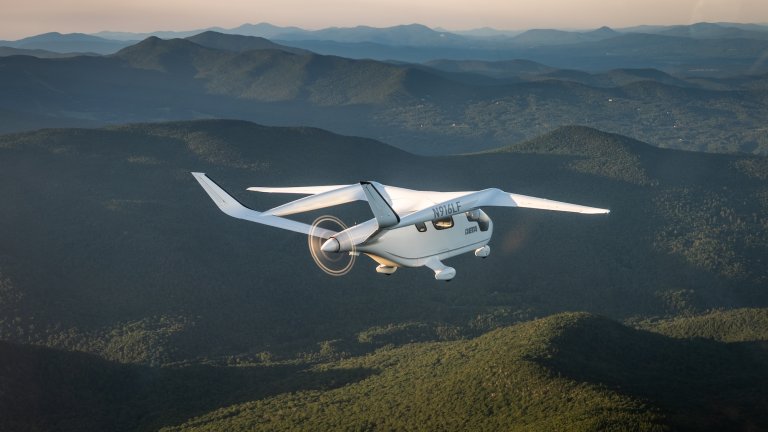
Odysseus, an autonomous surveillance-plane concept, 
will fly for years on end, powered by nothing but the sun

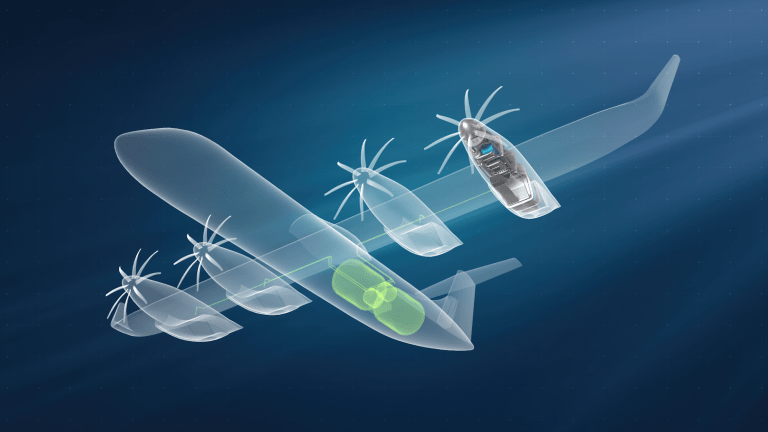
Hang Time Odysseus would mainly circle above stationary targets for long periods of time, but it is capable of long-distance flight and therefore could be redeployed — slowly — to other sites around the world John MacNeill (See the features of Odysseus up close)

Nine days: That's the longest any airplane has stayed in the air. Burt and Dick Rutan's Voyager set the record in 1986 by flying 24,986 miles around the world without refueling. But nine days of uninterrupted flight won't cut it for Darpa, the Pentagon's advanced-research organization. It's challenged the aviation industry to come up with an unmanned surveillance and communications plane that can circle targets for half a decade — and do so on nothing but solar power.

The aircraft you see here, Odysseus, was the first entry in the Vulture program, the competition Darpa created to make its extreme-endurance dreams come true. If the plane's designers at Aurora Flight Sciences beat rival entries by Boeing and Lockheed — Darpa could pick a winner as early as this year — it will have the opportunity to make this concept into the real thing: a 492-foot-wide folding aircraft that can cruise at 140 mph at 70,000 feet for five years straight, powered by the solar panels that cover the top of the plane.

In fact, Odysseus is three planes in one, a collection of 164-foot-long wing-shaped constituent aircraft that take off separately and dock in the stratosphere, where the air is calmer and less stressful on the massive structure. (Aurora CEO John Langford says the company hasn't chosen a docking mechanism yet but that it's considering something based on the system that connected NASA's Apollo command and lunar modules.) Each piece is interchangeable and can be swapped out in midair for repairs or upgrades. The three-piece construction allows Odysseus to autonomously change shape throughout the day to trap as much solar energy as it can. It could pleat like an accordion into a "Z" to absorb sunlight at low angles — at dusk, for example — and flatten into a more aerodynamically efficient traditional wing at night.

Catching as much sun as possible is essential, because energy — specifically, energy storage — is one of the biggest obstacles to solar flight, particularly solar flight that must continue without fail for years on end. Langford says Aurora is exploring storage methods, including flywheels, fuel cells and an array of batteries embedded throughout the airframe. The plane also needs to be light, so Aurora's design relies on featherweight carbon composites. The huge craft could weigh in at under 7,000 pounds — approximately 2,000 pounds less than a fully fueled Voyager, which was less than a quarter of Odysseus's size.

Although it's designed to be a surveillance platform, the lanky Odysseus would probably appear to the naked eye as a starlike glint, so it could be used for less-covert missions, such as patrolling a border or watching over suspected nuclear-reactor sites. And it could have civilian applications: Langford imagines it as an atmospheric buoy, monitoring storm development, climate change or the health of the ozone layer. Either way, he says, it would demonstrate the potential of solar power and serve as a testbed for green aircraft technology. "If we can build an airplane that can stay up for five years with nothing but sunlight," he says, "what else can we do?"

Want to read more articles on the military, aviation, and space? Subscribe to Popular Science and enter to win $5,000!

11 Comments

5 years from now, a solar plane will come crashing down on my house.

Don't be so pessimistic, with Murphy's law, it will crash on the house of the designer! Anyway, hope the technology turns out, because we need the energy storage devices that can pull off these stunts.

Pretty cool, I hope it works. However, your facts about the longest any airplane has stayed in the air are WAAAAYYYYY off. Try 64 days 22 hours 19 minutes and 5 seconds set by Bob Timm and John Cook in Las Vegas, NV in a Cessna 172 from December 04 1958 until February 07 1959. The flight of the Voyager set the record for a non-refueling flight. The Odysseus would not fall in that category as it would be continuously refueling it's energy storage mechanisms.

Great idea, these will make great airborne repeaters with cell phone and satellite communication antennas and could deploy cameras for Military applications such as recon work over Iraq, Iran and N. Korea.

Someone better hire an Aeronautical aerodynamics engineer to first fix the asymmetrical design problem...you will need either a stretched letter "M" or "W" symmetrical wing design as I do not see how that current lazy "Z" letter wing design is going to fly straight? That design would always be wanting to turn as you have now created asymmetrical lift and added weight, which is favoring the crafts left side!

This isn't all that new. Check out NASA's aircraft that set a world record in 2001 before eventually breaking up during a subsequent flight:

www.nasa.gov/centers/dryden/news/ResearchUpdate/Helios/index.html

I'd LEED certify that plane with an additional 6 points for Innovation in Design. :-) http://www.everblueenergy.com

"Someone better hire an Aeronautical aerodynamics engineer to first fix the asymmetrical design problem...you will need either a stretched letter "M" or "W" symmetrical wing design as I do not see how that current lazy "Z" letter wing design is going to fly straight? That design would always be wanting to turn as you have now created asymmetrical lift and added weight, which is favoring the crafts left side!"-

in order for the plane to use as little energy as posible and still stay in the same place, this wing design would be ideal. how else would you turn? on route to its destination, Aurora might put on a fourth wing, or take one off so that it flys strait, but would return the plane to what it shows in the picture on arival to it's destination

of course, the military might assemble the plane on location, which would solve the transportation problem, and would cause the flight plan to be simmilar to a vulture

Aside from the fact that it looks pretty cool,
AUTONOMOUS is very impossible for this craft.
And, pretty much,, enough else is said.
GOOD LUCK.

I am a mechanic (aircraft) I see engineers doing wonders on paper all the time.

Just make sure you keep it away from my "no fly" zone.

My home.

hey i got an idea, if this plane can generate lift with solar panels as a fuel source why not place solar panels on top of dirigibles, and motors on the back and sides? If the helium (or hydrogen) can take of most of the weight, and the motors will create lift then the craft could lift tons, and transport them, without creating any polution!!! Of course it's just an idea.

Why the funkey shape?

"Nine days: That's the longest ANY airplane has stayed in the air. Burt and Dick Rutan's Voyager set the record in 1986"

Wrong, the Keyes brothers set the record back in 1935, at 27 days. The plane is in the Smithsonian. A little reserch would have turned this up.


Download Our iPhone App

Stay up to date on the latest news of the future of science and technology from your iPhone with full articles, images and offline viewing


Follow Us On Twitter

Featuring every article from the magazine and website, plus links from around the Web. Also see our PopSci DIY feed


Become a Fan On Facebook

Share links with friends, comment on stories and more


December 2009: Best of What's New

In our December issue, Popular Science names the 100 best innovations of the year: bombproof wallpaper, self-parking cars, the fastest helicopter, and 97 more. Plus inventor profiles and videos.

Check out the best of what's new here.

Popular Science Photo Pool


Share your photos in the Pop Sci pool at www.flickr.com!
tags_sprite.png
POP_embeddedForm_cover_May09.jpg