
Gray Matter
Chemicals can turn any tree stump into virtual gunpowder

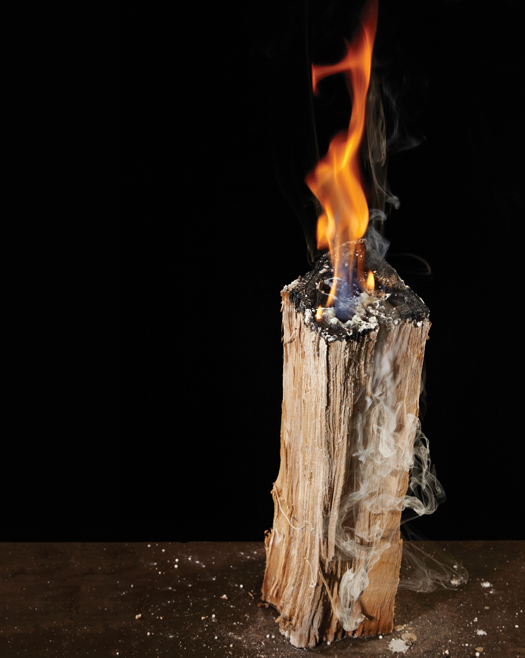
Slow Burn Wood treated with stump remover burns with a purple-blue flame at and below its surface. Mike Walker

When you need to remove a tree stump, you have several options. Sissies call a tree service. Tough guys loop a chain around the stump, hook it to the bumper of their truck, and find out which one is stronger. Others use gunpowder to blow them up, though this is not advisable in most jurisdictions (unless your cousin is the sheriff and you let him watch). But my favorite method is to convert the stump itself into gunpowder and then burn it up. That is the secret behind how chemical stump remover works.

You might think you could just light stumps on fire and let them burn until they disappear. But since they’re underground, there’s no source of oxygen to sustain the flame. Even with kerosene soaked into the wood, the part of the stump under the surface won’t burn. Gunpowder, on the other hand, burns even inside a sealed space because it contains its own source of oxygen in the form of potassium nitrate, or KNO3, better known as saltpeter. Get saltpeter into the stump, and it supplies oxygen to combust the wood.
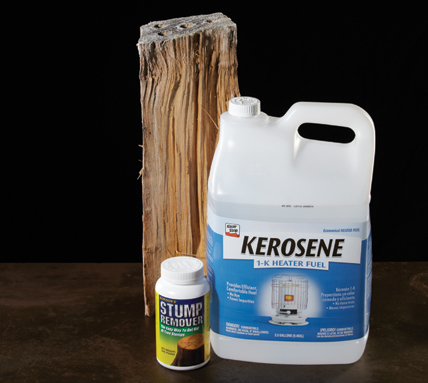
Better Landscaping Through Chemistry: Saltpeter changes the composition of a tree stump, allowing it to burn underground after it's been soaked with kerosene  Mike Walker
Most common brands of chemical stump remover are nothing more than saltpeter. The instructions say to drill holes down into the stump, pour in the powder, and let it soak with water for up to a few months. This dissolves the saltpeter and distributes it throughout the stump. Then you soak the stump with kerosene and light it, causing it to burn all the way down to the roots with a fizzing, popping, purple-blue flame.

The stump’s altered chemical composition—potassium nitrate combined with organic carbon to produce heat and gas—is similar to gunpowder. That explains the unusual flame. The burn is slower, though, taking minutes instead of milliseconds to complete.

It might be surprising to discover that you can buy the key ingredient in gunpowder at any garden center. But here’s the kicker: The other two ingredients are readily available as well. If you want to find out what those are, and read about my adventures making gunpowder, you’ll just have to check out next month’s issue.

Want to read more articles like this, plus tips and tricks, home hacks, DIY projects, and more? Subscribe to Popular Science today, for less than $1 per issue!

2 Comments

Make sure you do not have your natural gas line near a tree when you do this.Gunpowder,fire ,Natural gas do not mix well. My gas line is 2 feet away from the city's huge tree. I want them to remove it. It is wound in power lines. With the weather we have been having this year ,this tree can be ripped up by the roots ,the natural gas line with it. The power lines can ignite the tree And the natural gas,blowing me out of bed only if it is my lucky day. I do this as safety warning to all the good readers here. I was in the Air Force 1963-1967. air craft mechanic C-130 Hercules transport plane. It could drop a tank fully loaded with a parachute out the back door. I learned real Quick to turn off Any power,flames if We smelled Any flammable substance !

you could also try nitroglycerin but that will attract unnecessary attention

Popular Tags

Regular Features


June 2013: American Energy Independence

Five amazing, clean technologies that will set us free, in this month's energy-focused issue. Also: how to build a better bomb detector, the robotic toys that are raising your children, a human catapult, the world's smallest arcade, and much more.


Online Content Director: Suzanne LaBarre | Email
Senior Editor: Paul Adams | Email
Associate Editor: Dan Nosowitz | Email
Assistant Editor: Colin Lecher | Email
Assistant Editor: Rose Pastore | Email

Contributing Writers:
Rebecca Boyle | Email
Kelsey D. Atherton | Email
Francie Diep | Email
Shaunacy Ferro | Email

circ-top-header.gif
circ-cover.gif
bmxmag-ps