insects

New Uncrawlable Material for Household Surfaces Gives Cockroaches the Slip


A new coating turns insects' sticky climbing feet into a slippery mess, and could be the future of pest repellent, according to a new research paper. You hear that, bugs? If you can't crawl up my kitchen counter from the floor, you can't go waving your disgusting antennae all over my pizza, you insects-who-shall-not-be-named of apartment horror.

[ Read Full Story ]

Video: DARPA's Remote-Controlled Cyborg Beetle Takes Flight

A new paper explains how they built the zombie insect

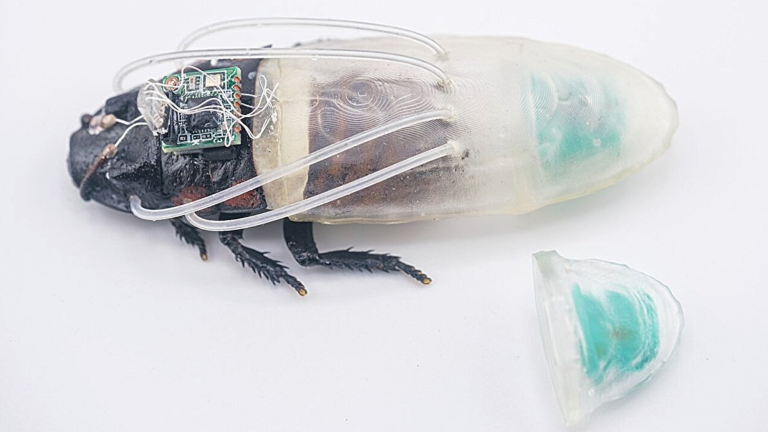
In January, researchers from the University of California, Berkeley, told a stunned conference audience that they had managed to create a remote-controlled cyborg beetle by attaching a computer chip to the brain of a giant insect. Now, the paper explaining how they did it has been published in the journal Frontiers In Neuroscience, and they have released a video of the cyber-bug in action.

[ Read Full Story ]

Genetically Engineered Corn Sends Out Chemical SOS When Attacked


What do you do when you're under attack? Call for help, naturally. Unfortunately, if you're an ear of corn, and you're being attacked by parasitic beetle larvae, you have nothing to call for help with. Until now.

Scientists at the University of Missouri have genetically modified corn to release a chemical distress signal when under attack from beetle larvae. The chemical 911 call attracts droves of parastitic roundworms that naturally attack the larvae. Within three days of receiving the distress signal, the worms had killed them all.

[ Read Full Story ]

A Flight Simulator For Flies Helps Humans Build Better UAVs


Fluorescent Fly Brain :  courtesy of Cognition for Technical Systems

Flies may not seem like nature's ace pilots when they're bumping up against a closed window or getting squashed beneath a rolled-up copy of the New York Times Magazine, but a German company hopes to unravel the secrets of insect flight by tapping their brains. Literally.

[ Read Full Story ]
Robot of the Week

This Is How a Robot Will Crawl Through Your Veins

Virob will twitch through your circulatory system performing microsurgery; a fantastically creepy voyage


There's something magnificently creepy about this tiny bot, just one millimeter wide, developed at Israel's Technion University. Maybe it's the resemblance to a twitching tick or flea, or the fact that it's so small there could be insectile bots all around you right now and you'd hardly notice. (The robot, called Virob, has no internal power source--it derives its power from external magnetic fields.

Or maybe it's that the bug is designed to infiltrate human veins, autonomously crawling around our circulatory systems, taking pictures and poking its feelers where no 'bot has gone before.

[ Read Full Story ]
READ MORE ABOUT > , , , ,

Network of Wi-Fi-Enabled Cyborg Insects Hunts Down WMDs

A wireless network allows electronically enhanced bugs to chirp, tweet, and blog (some day!) about weapons they find

In its attempts to quash weapons of mass destruction, the Pentagon has been trying novel ways to track down dangerous materiel. For years, DARPA has been trying to train insects and bugs to sniff out toxic substances, providing more sensitive detection, as well as access that conventional sensors might not have.

[ Read Full Story ]
Missing Links

Epic Battles

Good ideas vs. stupid ones, beetle vs. beetle, shark vs. whale

Willy Wonka would have liked this, but I can't imagine a whole lot of human cooks worth their -- ahem -- salt, will have much interest: a company is selling a book of spices made from edible paper. Want some chili flavoring in a dish? Just rip out the perforated page and put in the pan.

In today's links: forcing people to smoke fails, why it's sometimes better to eat bland food, and more.

[ Read Full Story ]

Hammer Of The Gods, Indeed

Townsfolk fight locusts with the power of rock, Vice gets technical, and students break down geology on the M-I-C

As a respite from the nonstop flu blogging, I decided it was time to have a little fun and show the lighter side of science.

First up is a story from the Wall Street Journal about the residents of Tuscarora, Nevada, driving off a swarm of insects by blasting Led Zeppelin.

[ Read Full Story ]
The Sex Files

The Pros and Cons of Asexual Reproduction

Opposite-sex partners: can't live with 'em, can't evolve without 'em

Making babies requires a male and a female, a sperm and an egg, right? Well, the wild world of animals is often more creative than the lot of us humans when it comes to making whoopee. In fact, some animals don't have sex at all, thank you very much.

Just this month, bug biologists found the first all-female ant species, Mycocepurus smithii. The queen ant clones herself by making eggs that develop into adult females without fertilization. Some of those females will then become queens themselves. Apparently the species has been sexless for enough generations that the ants might not be able to mate even if they wanted to. Dissections showed that a key female sex part that normally interlocks with a male organ during mating had shrunken to a ghost of its former self.

[ Read Full Story ]

A Lousy Reason for Asthma and Allergies

Parasites may reduce their hosts' risk of developing immune dysfunctions

The incidence of asthma and allergies are on the rise. In the United States alone, asthma rates have doubled since the 1980s. And, according to a recent article by the BBC, doctors once estimated 15 percent of the population had some type of allergy, but now believe the figure is closer to 40. More patients are also suffering from multiple allergies than ever before. The reason for this trend has been widely disputed, but a new study points the finger at a surprising culprit: lice.

[ Read Full Story ]
Page 1 of 3 123next ›last »


Download Our iPhone App

Stay up to date on the latest news of the future of science and technology from your iPhone with full articles, images and offline viewing


Follow Us On Twitter

Featuring every article from the magazine and website, plus links from around the Web. Also see our PopSci DIY feed


Become a Fan On Facebook

Share links with friends, comment on stories and more


December 2009: Best of What's New

In our December issue, Popular Science names the 100 best innovations of the year: bombproof wallpaper, self-parking cars, the fastest helicopter, and 97 more. Plus inventor profiles and videos.

Check out the best of what's new here.

Popular Science Photo Pool


Share your photos in the Pop Sci pool at www.flickr.com!
tags_sprite.png
POP_embeddedForm_cover_May09.jpg