
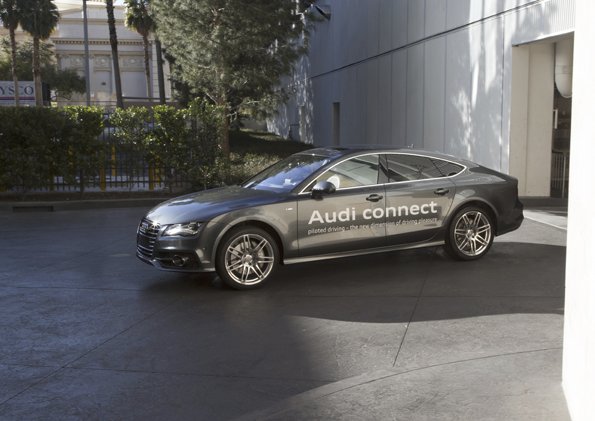
Move over, Google: Audi has demonstrated its own self-driving car here at CES 2013, although engineers involved with the project say its most likely a decade away from production.
Last year, Audi presented its vision of a “self-piloting” car, where the driver could choose to cede control to the car during a traffic jam, for example, taking over when he or she wanted to drive. “Our vision of piloted driving is when I don’t want to drive, I allow myself to be driven,” said Ricky Hudi, chief executive engineer of electrics/electronics at Audi AG, during a press conference here.
This year, those executives said, Audi’s self-driving car is a reality. A day after the press conference, Audi representatives showed off a stock Audi A7 sedan, equipped with additional sensors, in two settings: during a traffic jam, and negotiating the tight confines of a parking garage. Popular Science viewed the latter demonstration.
Here’s how it works: the autonomous cars that Lexus showed off, plus Google’s own Toyota Priuses, use Light Detection and Ranging (LIDAR) technology developed by Velodyne, which creates a “map” of the car’s surroundings using a rapidly rotating laser beam. At its press conference, Hudi said that Audi has developed its own, much smaller LIDAR that it intends to mount in the A7’s grille, eliminating the unsightly “can” at the top of other vehicles.
In the demonstration, Audi used a prototype smartphone app to “call” the car from a parking spot to the front of the Mandarin Oriental Hotel in Las Vegas. The car started by itself, eased its way out of the garage, turned a corner, and parallel parked. Audi then showed off the car returning to the spot, parked normally between two cars.
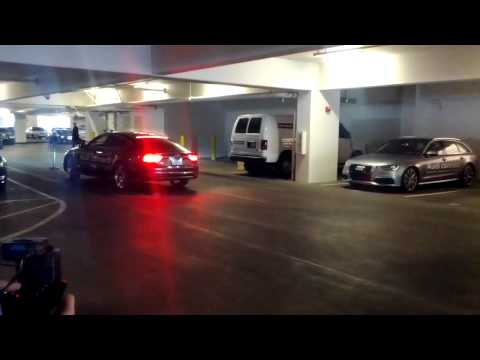
Automatic parallel parking is an optional feature on several cars, including European-specific Audi models, and the “radar” that Audi helped the car park are stock features. Negotiating rope obstacles, parking gates, and other cars required the car to “know” where it was at all times, however. Vehicle-to-vehicle communication was also used.
According to Audi senior engineer Annie Lien, Audi maintains several sets of test vehicles: a set for close-quarters perpendicular parking, and the “traffic jam” set, among others. The latter vehicles are equipped with several more sensors, including LIDAR, radar, and ultrasonic sensors. Although they can negotiate the state’s highways at whatever speed Audi chooses, Lien said they’re being tested only at speeds up to 60 km/h (37 MPH) or so. In 2010, however, Audi's driverless car climbed the windy mountain roads of Pike’s Peak in 27 minutes, versus the 10 minutes or so the fastest human drivers require.
Why will it take a decade for self-driving cars to enter production? Two reasons: governments and miniaturization. Only Nevada is moving ahead with testing of autonomous vehicles, although California and Florida are not far behind. Also, according to Hudi, self-driving cars require a trunkful of electronics, in addition to the other sensors. Audi will need to hide that extra computing horsepower within the existing electronics to maintain the sense of effortless elegance the brand is trying to project.

140 years of Popular Science at your fingertips.
Each issue has been completely reimagined for your iPad. See our amazing new vision for magazines that goes far beyond the printed page
Stay up to date on the latest news of the future of science and technology from your iPhone or Android phone with full articles, images and offline viewing
Featuring every article from the magazine and website, plus links from around the Web. Also see our PopSci DIY feed
Engineers are racing to build robots that can take the place of rescuers. That story, plus a city that storms can't break and how having fun could lead to breakthrough science.
Also! A leech detective, the solution to America's train-crash problems, the world's fastest baby carriage, and more.


Online Content Director: Suzanne LaBarre | Email
Senior Editor: Paul Adams | Email
Associate Editor: Dan Nosowitz | Email
Contributing Writers:
Clay Dillow | Email
Rebecca Boyle | Email
Colin Lecher | Email
Emily Elert | Email
Intern:
Shaunacy Ferro | Email
Why the parenthesis in "know"? The car computer knows where it is and acts accordingly, just like your brain, but using different sensors and algorithms to get the same result, avoid obstacles and get to the destination.
@zerox012
agreed. even though you wont consider a car(synthetic tech) as a person, those are the same basics that our brain uses
---
(Type 0.72) = We are still just cleaver monkeys!
in order to thank everyone, characteristic, novel style, varieties, low price and good quality, and the low sale price. Thank everyone
http://al.ly/_9v
http://al.ly/_9v
http://al.ly/_9v
│\_╭╭╭╭╭_/│
│ │\|/
│ ● ● │—☆—
│○ ╰┬┬┬╯ ○│/|\
│ ╰—╯ /
╰—┬○————┬○╯
╭│ │╮
╰┴—————┴╯
"for example, taking over when he or she wanted to drive"
That's just dumb, why would anyone choose to drive when they want to when the car can already do it????
@solarflare, haven't you seen iRobot? What happens when the robots start taking over and you need to drive yourself?
All kiding aside, many people play golf, watch football, hunt, fish as hobbies... I personally have one true passion and that is driving, still having the control to drive would be extremely important to me, and I am a little biased as, been a loyal fan/owner/enthusiast of Audi for the better part of a decade.
from Northfield, Vt
@solarflare bad road conditions, bad weather conditions, the gps location if off(recently google maps has taken me to the wrong location 3 times) etc.
@PSYC0TIC ONE Audi4life yo
I would be really intersted to know if they have even begun to tackle weather issues that may interfere with optical sensors, such as laser or camera's.
I live in Toronto, Canada and quite often headlights, grill, and most other places where optical sensors would be mounted will be covered in snow and ice. I wonder if they have even begun to tackle this problem, and or how the vehicle would respond to losing sensors once the vehicle has already taken over. Would it simply warn you and expect you to take control? What if your sound asleep? Would the vehicle just stop? Or perhaps it would be programmed to pull over as soon as it's safe to do so?
Not to mention our roads are horrible during snow fall! Most painted dividing lines on the road are non existent, and cannot be seen at all. In these cases during wicked snow, our motorists have become accustomed to turning double lane's into one, and sticking close to the shoulder to guage distance from oncoming traffic. Would a driverless vehicle do this? How about during wicked rain fall where glare, faded painted road lines are barely visible? Or, what about situations where painted road lines have been painted over with black paint when a road way is expanded or reduced and new lines are painted. In heavy rainfall conditions that black dividing line no longer blends with the black ashphalt, it now shines with the slick rain and road glare and becomes a very noticeable line which is very easy to confuse with other faded road lines.
If you havent driven on our road way's, you will notice immediately that we do not have "raised" reflective road dividers as these would be torn to shreds by snow plows. So we often learn to cope with horribly faded painted road dividers. Food for thought!
The way i see it, there is still a very long way to go yet before a vehicle can become completely "self driving". I bet you so far these vehicles are being tested in "ideal" conditions where these weather hazards do not exist.
Now we can safely text and drive. or better, surf the net, check facebook, watch netflix, check stock market and all the good stuff...
too bad you can't tint the windshields +:O
I like driving. What I really want is to have high speed hand gloves and shoes with wheels that let me go 80mph or better; perhaps side mounted wings to my body too!
Weeeee!
What we're really headed towards is a future where people never really learn to drive and completely rely on technology to do it for them. You think there are mindless idiots on the road today? Just you wait when they don't even get in that practice, and one day have to drive for themselves when the tech breaks down! Same thing goes for park assist vehicles, this technology is really just enabling the horrendous drivers who never really learned to parallel park on their own to go on blissfully ignorant until one day they find themselves having to do it themselves!
Also, I wonder if anyone has taken a look at the legal remifacations that would come from the first auto death where the vehicle was deemed to be at fault. Would the manufacturer be at fault in that case? Would we have to sign some sort of legal disclaimer waiving the right to sue in the event of any bodily injury or death as a result of this technology when we purchase and or before stepping into one of these vehicles?
Meatman, it seems that manufacturers are going to take over the liability. And they'll be happy to, because the pool of liability will be so much smaller — I wrote a story about it a year or so ago:
http://www.popsci.com/cars/article/2012-04/who-blame-when-robotic-car-crashes
If you think Lillian`s story is neat,, last month my friend's dad actually earned $9944 workin a ninteen hour week at home and the're friend's step-mother`s neighbour has been doing this for seven months and earned over $9944 parttime online. applie the steps at this website, http://www.bit90.com