
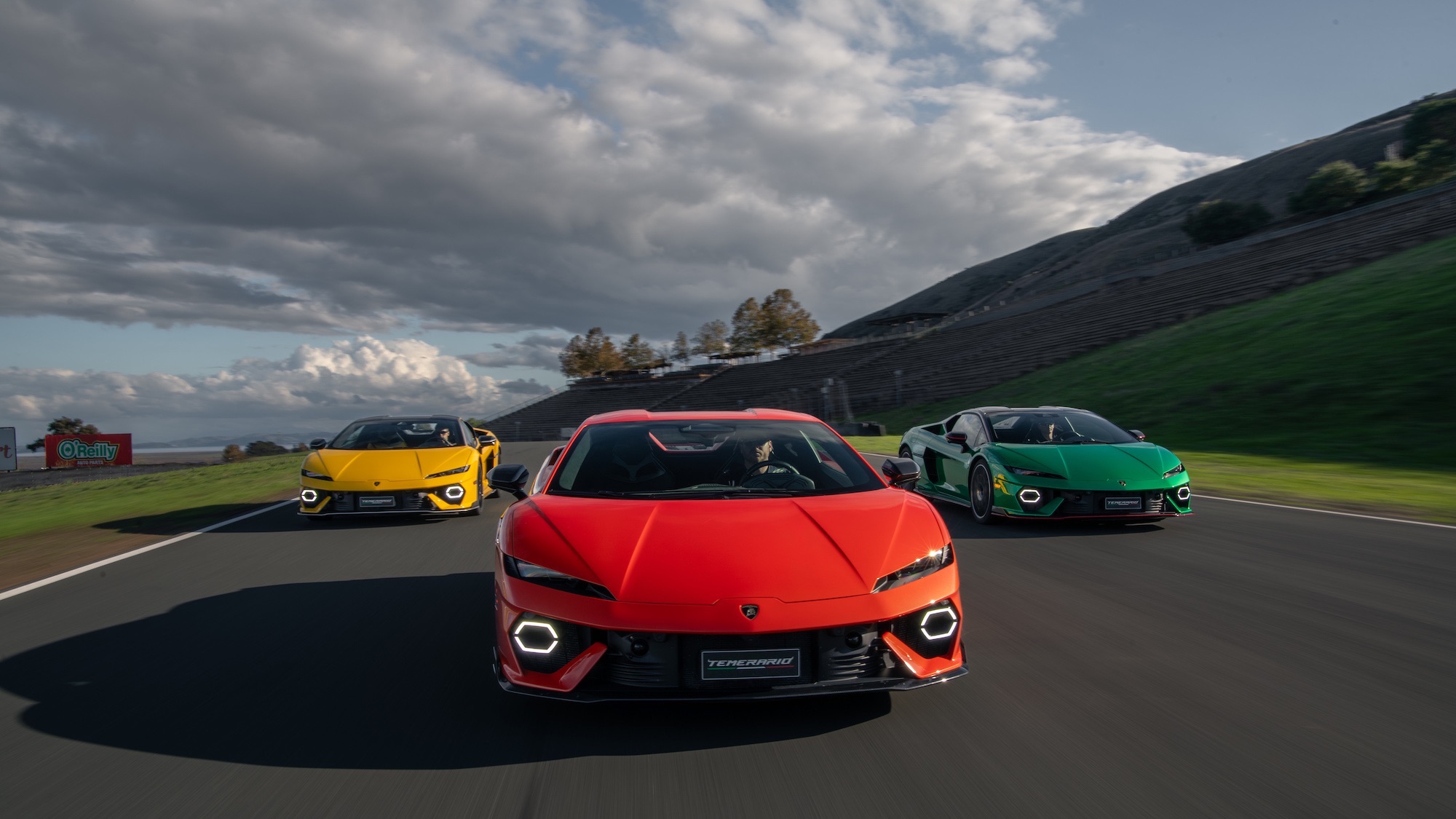
Lamborghini’s legacy gas-only machines have been unapologetically loud, brash, and in your face with sonorous symphonies conducted by fuel-guzzling V12 and V10 engines. Today, the brand is in its electrification age, with three plug-in hybrids: the Urus SE SUV, the top-tier Revuelto, and the newest Raging Bull, the Temerario. Don’t call them PHEVs, though. Lamborghini calls them HPEVs, or high-performance electric vehicles. Emphasis is on the performance, not the efficiency, although the hybrid lineup benefits from both.
While skeptics may have not believed a Lamborghini hybrid could match the excitement of its predecessors, the statistics prove them wrong. Just compare the Temerario to the car it’s replacing, the iconic Huracán. The power delta alone is impressive; the Temerario boasts a total of 907 horsepower generated by a brand-new twin-turbo 4.0-liter V8 that’s boosted by three electric motors, while the most powerful versions of the V10-toting Huracán tapped out at 631 hp.
Can the Temerario match the popularity of the Huracán, Lamborghini’s best-selling supercar ever? Automobili Lamborghini Chief Technical Officer Rouven Mohr says yes.
“To be honest, the Temerario is a much more mature car,” he says. “It has a performance level that was never possible before. It’s in a different league and it’s even more enjoyable.”
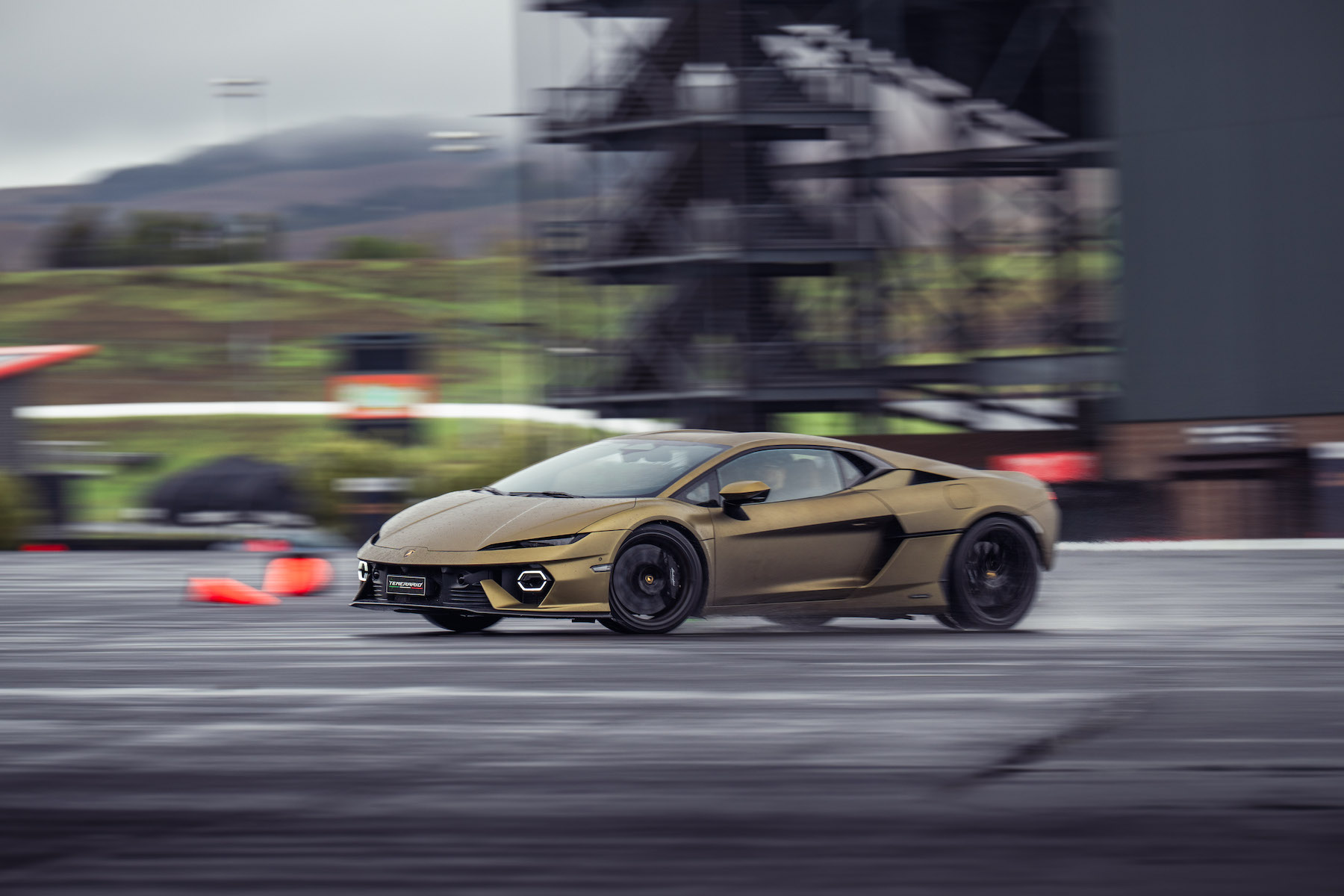
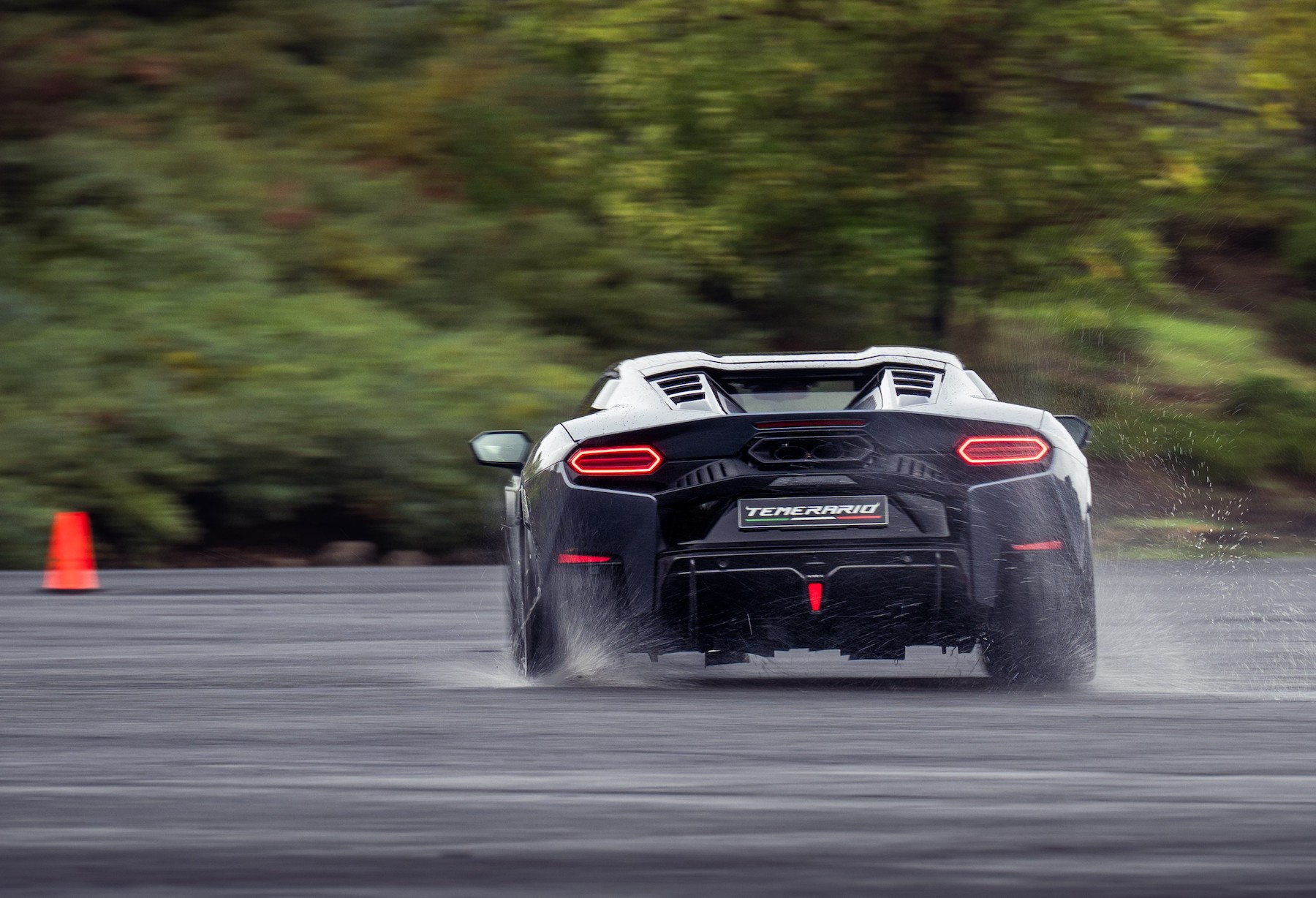
As a cherry on the proverbial sundae, the Temerario is the first Lamborghini supercar equipped with Drift Mode. Push a button on the steering wheel to activate its tail-wagging prowess, and you’re ready to go. Riding on grippy Potenza Sport tires co-developed with Bridgestone, the Temerario is eager to slide sideways on the track as though it’s on ice.
Revving it up to 10… thousand
The Temerario’s hybrid setup is all new, carrying over nothing from the Huracán’s fierce powertrain, Mohr says. Using a “hot V” setup, which places the turbochargers inside the V-shape of the piston configuration, the turbos spool up faster than they do in a “cold V,” in which the turbos are further from the heat.
A cold V can only rev up to 7,500 rpm, Mohr says, and Lamborghini was targeting a higher number. With a “hot V,” the turbochargers are nestled closer to the exhaust manifolds, so the gases have a shorter path to the turbine. As a result, there is better pressure consistency, temperature and speed, improving efficiency. And better efficiency means less turbo lag—honestly, nobody wants a supercar with turbo lag.
Lamborghini says the Temerario is the first and only production super sports car engine able to reach 10,000 rpm, a feat typically only achieved in motorsports. That’s no lie; even the newest Ferrari in the stable, the non-hybrid 6.5-liter V12 powered 12Cilindri supercar, falls slightly behind the Temerario at a rate of up to 9,500 revolutions per minute.
In order to achieve the Lamborghini model’s performance curve with a turbocharged engine, Mohr and team started from zero. They decided to go with huge turbochargers to enable a power explosion at high revs, but they also needed to balance that with good drivability without turbo lag, Mohr explains.
The magic behind this supercar is a triple electric motor infusion, one at each front wheel and one between the engine and the eight-speed dual-clutch transmission. All three are axial flux motors built by YASA, a subsidiary of Mercedes-Benz. Axial flux electric motors are 50 percent lighter and 20 percent of the depth of a typical radial machine used in many EVs, YASA states. The difference visually evokes the difference in width between vintage television or computer and today’s flat screen TVs, and the performance is even more important than the looks. Using stacked construction, an axial flux motor packs a dense amount of power into a compact machine.
Training the body for a new engine experience
The first time he drove the Temerario, Mohr says, he had to train himself for the new driving character. That required him to change the way he shifted gears.
“You have in your brain two categories: the naturally aspirated [engine], which has no low torque at all, so you have to rev it up because otherwise you feel bored and slow,” Mohr says. “And you have the turbo category, which gives you high torque at low revs, but then nothing is really happening. If you rev it up it gets a bit louder but it’s missing this extra punch.”
The Temerario, he explains, combines both. There’s the linearity, the boost, the torque level and a seemingly never-ending power curve. At first Mohr automatically started shifting at about 6,000 rpm and he says he forced himself to learn to stay on the throttle. What he found was that what happens between 6,000 rpm and 10,000 is breathtaking.
“There are not even many naturally aspirated engines in the world that rev up to 10,000,” he says. “For a turbo engine there is only one other in my mind: the Formula 1 base engine.”
The Temerario has a completely different character than the Revuelto, Mohr says. In contrast, the pricier Revuelto is powered by a naturally aspirated 6.5-liter V12 engine plus three electric motors. Starting at $600,000-plus, this is the flagship vehicle of the Lamborghini brand, representing what Mohr calls the “pinnacle” of the product range.
On the other hand, the Temerario was designed more as a daily driver. Everything from the body design to the aerodynamics to the engine were calibrated for a fun, more casual experience than the elegantly engineered Revuelto. Kind of like an exuberant puppy in the same kennel as a mature show dog.
For the first time in any of its cars, Lamborghini added a true drift mode to the Temerario. That’s not to say that some people haven’t drifted other models before this, of course. However, this factory-equipped drift mode enables and even encourages the slip and slide from a button on the steering wheel. The driver can choose between three levels of drift that get progressively looser.
“You might say other manufacturers have done this before, and yes, that is partially right. But we do it in a different way,” Mohr explains. “We are not braking; we are using the front axle with torque vectoring to control the driving, which gives it a more natural feeling.”
Level 1 allows oversteer while limiting the angle of yaw, the result of shifting the weight of the vehicle from its center of gravity to one side or another. Boosting it up to Level 2, the Temerario allows 30 degrees of drifting angle, doubling what it offers at Level 1. Level 3 takes it up another notch to 40 degrees, a thrilling option for experienced drifters. All three levels create experiences commensurate with the Lamborghini name. If this is the future of hybrid supercars, bring it on.
