

Contrary to the assumptions of early paleontologists, most dinosaurs weren’t lumbering slowpokes. Centuries of evolutionary reevaluation now indicates the ancestors of present-day birds didn’t simply keep a steady pace—many of them boasted impressive speed. These active lifestyles also forced scientists to reconsider another anatomical detail. Once thought universally cold-blooded, a lot of dinosaurs eventually evolved warmer blood.
Thanks to recent technological breakthroughs, paleontologists have finally settled a longtime dinosaur debate: Was Tyrannosaurus rex warm blooded or cold blooded? A study published today in the journal Science Advances settles the debate: The famous “Tyrant king” had an internal temperature surprisingly similar to today’s warm-blooded humans—around 97 degrees Fahrenheit.
“No one’s been able to make a temperature measurement like this before,” Robert Eagle, a study co-author and geobiologist at the University of California Los Angeles (UCLA), said in a statement.
This places T. rex’s internal temperature ahead of today’s cold-blooded reptiles and even sloths, but short of their avian descendents, which range between 104 and 109 degrees Fahrenheit. Eagle’s team offers the first conclusive chemical proof, but their findings built on years of mounting evidence in support of the warm-blood T. rex theory.
“The temperature is about what I would have guessed,” added Eagle.
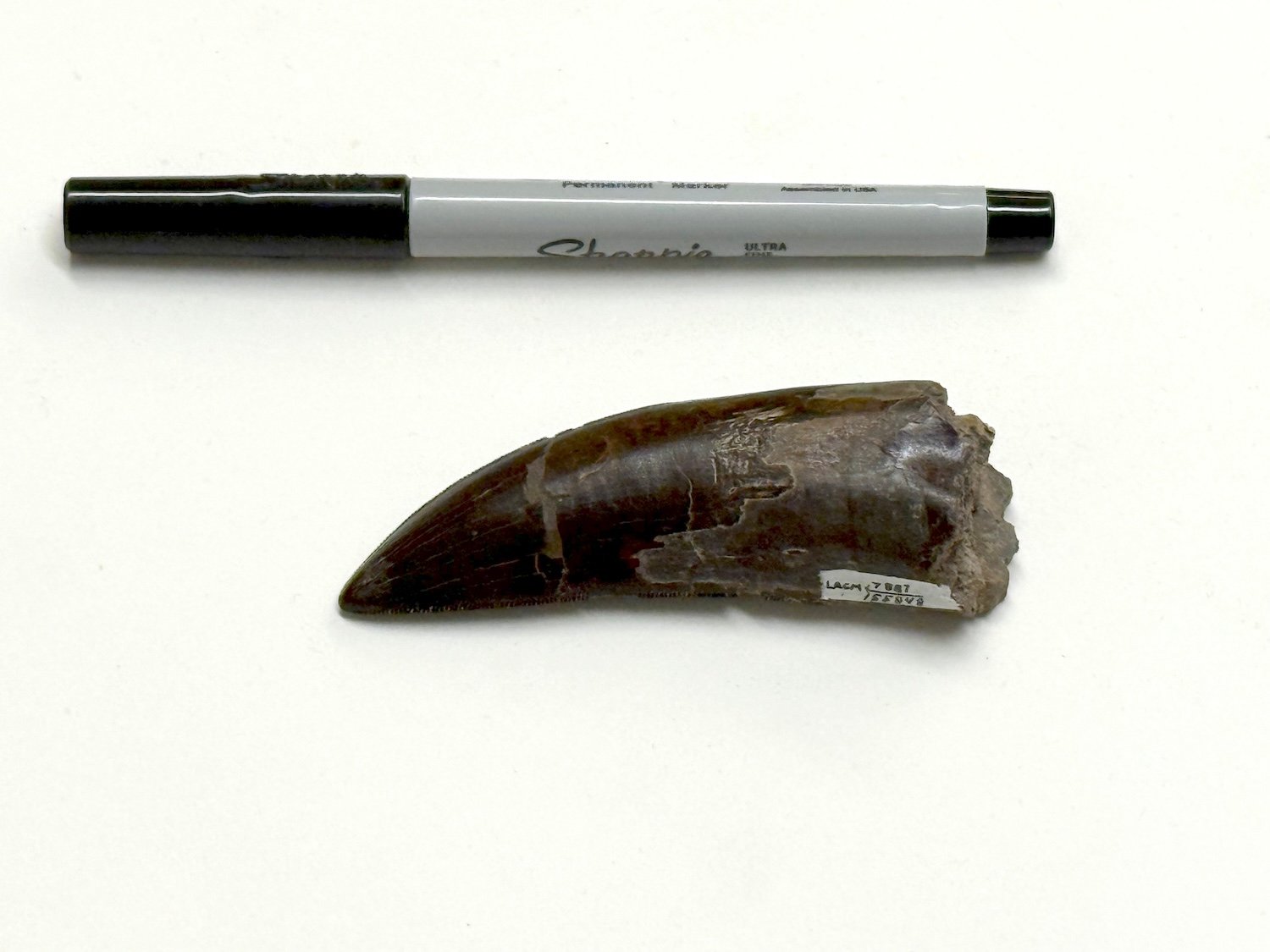
About 10 years ago, paleontologists developed a way to learn an extinct species’ blood temperature by examining certain rare carbon–oxygen bonds that form in fossilized bone. As Eagle explained, tooth enamel offers the best medium for samples because its large crystalline composition remains extremely resilient to deterioration for millions of years. It’s this method that allowed his team to previously confirm that warm blood flowed inside megalodon (Otodus megalodon).
But while paleontologists have long suspected these carbon-oxygen chemical bonds could pinpoint a T. rex’s blood temperature, earlier iterations of the process required a large fossil sample. Drilling so much material from a bone also damages it. So while there were plenty of megalodon teeth in museum archives, institutions weren’t willing to donate a much rarer T. rex chomper.
Researchers have since refined the technique to reduce the necessary sample size to about 90 percent smaller than the original requirement. This convinced curators at the Los Angeles Natural History Museum to finally part with sections of two teeth from their own Thomas the T. rex. Using a dental drill, Eagle and his team extracted fossilized enamel that they then dissolved in phosphoric acid. This released carbon dioxide gas filled with the coveted isotopic bonds. From there, they employed a mass spectrometer to determine the chemical ratios after pressurizing the CO2. Subsequent analysis led them to conclude the T. rex’s blood temperature was about 97 degrees Fahrenheit.
A warm-blooded T. rex makes sense for the apex predator’s active hunting lifestyle and fast metabolism. It also helps explain how the dinosaur roamed such a large territory encompassing wide temperature shifts. It’s a big reason why paleontologists have found T. rex fossils in places like present-day Alaska that are otherwise devoid of cold-blooded ancient reptiles.
“The teeth tell us T. rex was warmer than the environment around it,” said UCLA geochemist and study co-author Aradhna Tripati. “A warm-blooded T. rex [could] go almost anywhere on the continent, including the Arctic.”
The groundbreaking discovery was a long time coming, but the findings were unthinkable until the recent methodological breakthroughs dramatically reduced the fossil sample’s minimum size.
“Nobody hands you a T. rex tooth unless you can show them you only need a few milligrams,” said Tripati.
