
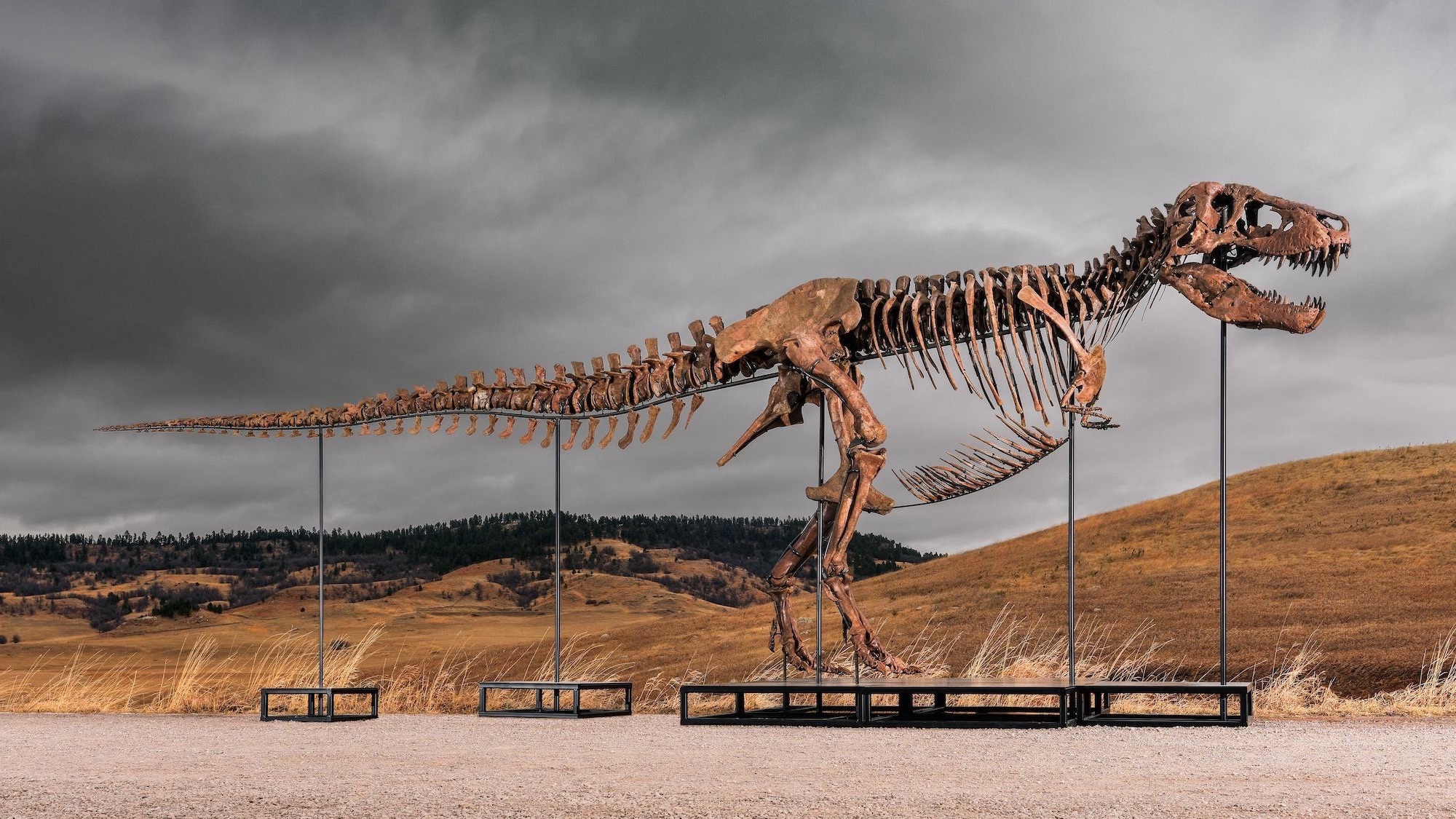
Dinosaur enthusiasts with deep pockets will have their chance to buy one of the largest and most complete Tyrannosaurus rex specimens ever discovered. Meet Gus, a 12.5-foot tall skeleton that took paleontologists three years to excavate. Auction house Sotheby’s values the specimen at $20–30 million, the highest estimate ever placed on a dinosaur.
Late cattle rancher Gary “Gus” Licking found Gus on his land in South Dakota. For years, Licking came across teeth and small bone fragments on his ranch, and realized more bones may be lurking beneath the soil. To find out, he recruited Thomas Heitkamp and his team from Theropoda Expeditions.
Licking suggested that the team start digging in a 6,500-acre parcel of land. And that’s exactly where Gus was found in 2021. Licking died only one year into the excavation, so he never got to see the complete specimen. The team named the T. rex “Gus” in his honor.
“This specimen took three years to excavate—with the team sometimes working for weeks straight without finding a thing,” Heitkamp said in a press release. “The site was a complex fossil bed and preserved many fossils of the flora and fauna that comprised the larger Cretaceous ecosystem. We documented each stage with quarry maps, inventories, and collection data. In the end, our diligence paid off and we were delighted to discover what turned out to be a huge and incredibly complete T. rex specimen.”
In addition to the three summers it took to excavate, the team also had three years of lab work. In the lab, they carefully extracted the fossil from the rock before the bones could be prepared, cleaned, and identified.
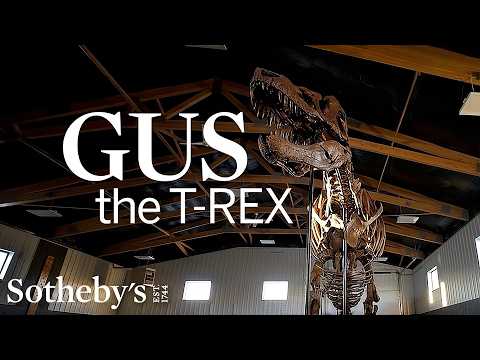
Meet “Gus”: The 40 Foot Long T-Rex Skeleton Exhibited for the First Time at Sotheby’s Breuer
The skeleton is made up of 183 fossil bones representing 82 percent of all of the dinosaur’s bones, including a well preserved skull, furcula (wishbone), and a completely represented pelvis. Its body is roughly 38-feet long and its skull alone is over four-feet long.
“It really does feel like tackling the world’s hardest puzzle, except we have to find all the pieces first,” said Heitkamp. “All those bones separated for 67 million years that we can now, almost magically, fit back together. There’s something deeply satisfying about that.”
Gus will be up for auction on July 14 during Sotheby’s Natural History auction. The fossil will also be on display to the public at Sotheby’s galleries in New York City beginning on July 1.
“For me the added bonus was knowing that Gus was just one of the many pieces of history hidden in the land that Gary and I loved to share,” added Licking’s wife, Dana. “It will be exciting to see how many others will get to enjoy this spectacular discovery.”
The first T. rex to be auctioned off was a specimen named Sue. Now on display at the Field Museum in Chicago, she was sold for over $8 million in October 1997. Ever since, dinosaur auctions like these have courted controversy. Some critics say that fossils kept in private collections are lost to science. They also believe it encourages finding complete or marketable fossils over scientific study, and could lead to incomplete research.
There’s also the question of the fees private landowners may receive, meaning that the person with the largest bank account may receive favorable access over scientists. Some countries including South Africa, Brazil, and Canada have gone as far as to place heavy restrictions on significant fossils wherever they are found.
