
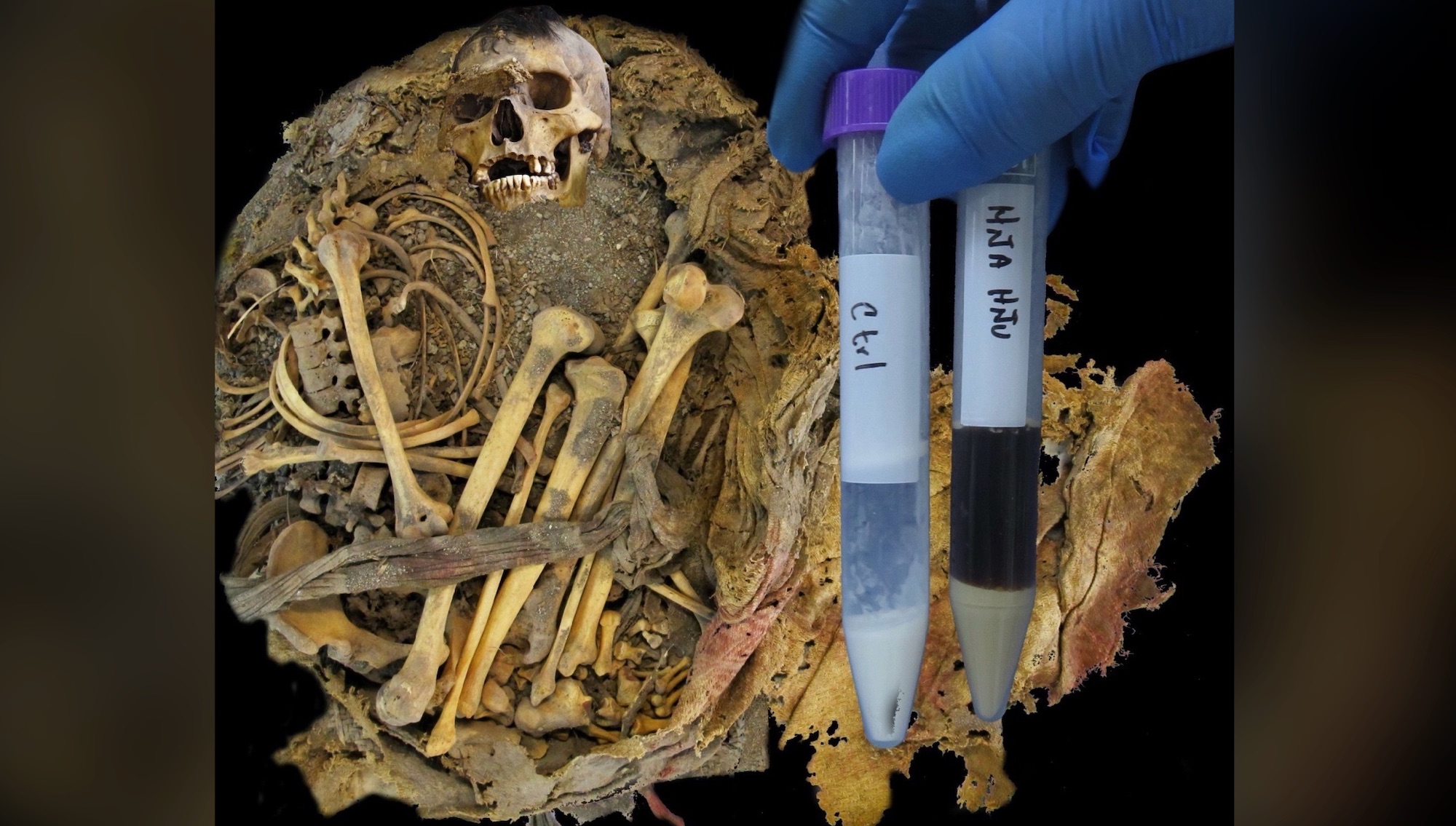
Underneath the remains of an ancient young adult man and his preserved feces lies a microscopic world. These microorganisms beneath the cloth hold clues to what the world may have looked like hundreds of years ago. Now, a new look at a 1,000-year-old mummy called the Zimapán man could tell us what ancient Mesoamericans ate, where they lived, and show us how much our world has changed since.
Who is the Zimapán man?
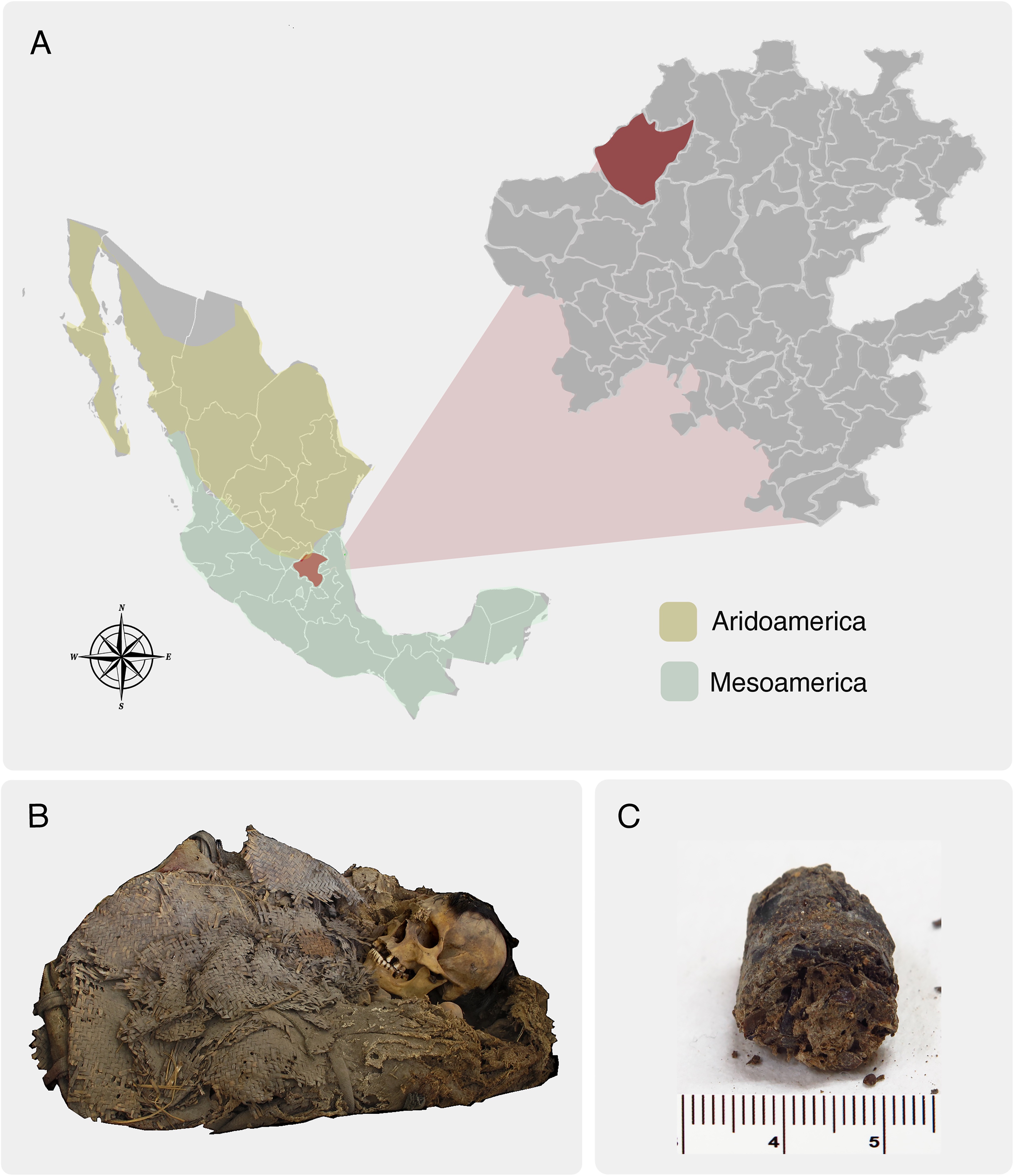
In 2014, locals near Zimapán, Mexico discovered a mummy in an ancient rock shelter. Scientists believe that the Zimapán man was most likely a hunter-gatherer and part of the ancient Mesoamerican Otopame culture. He died about 1,000 years ago between the ages of 21 and 35.
Intestinal tissue and feces were also preserved, allowing scientists to take a deep dive into the Zimapán man’s microbiome. Their findings are detailed in a study recently published in the journal PLOS One.
“Zimapán man’s remains were neatly wrapped like a bundle, which can be interpreted as indicating that they were an important figure within the community,” the study’s authors wrote in a statement. “The outer layer of the bundle was made of a mat, that is, long fibers, apparently maguey, intertwined to form a strong yet malleable rectangle. Beneath this mat, and on top of which Zimapán man was placed, was a perfectly woven sheet of native brown cotton.”
What is the gut microbiome?
Inside all of our intestines is a bevy of bustling natural bacteria and other microorganisms working together called the gut microbiome. Most of these microorganisms have a symbiotic relationship with us, meaning we both benefit from the relationship. We give them food and a place to live, while they provide services in return. The gut microbiome helps our bodies digest important nutrients, train our immune system, and can even stimulate the production of important neurotransmitters in our brains. Importantly, they also help to keep potentially harmful microorganisms in check.
There are certain types of bacteria that are widely associated with the human gut microbiome. However, factors including age, diet, health, and where they live can affect an individual’s particular mix of bacteria. Finding and studying ancient microbiomes from mummies and other human remains can be a sort of microscopic time machine that tells us how the human microbiome may have changed over time. For example, an analysis of Germany’s Tyrolean Iceman (a natural mummy who lived between 3350 and 3105 BCE) found a gut microbiome with a wider variety of fungal species than is seen in the western world today.
[ Related: Iceman’s Stomach Bug Gives Clues To Humans’ Spread Into Europe. ]
Of mummies and microbes
In this new study, a team led by Santiago Rosas-Plaza of the Universidad Nacional Autónoma de México looked at the Zimapán man. They used a standard method called 16S rRNA gene sequencing on the mummified intestinal tissue and some preserved feces.
They found several families of bacteria that are associated with the human microbiome, including Peptostreptococcaceae, Enterobacteriaceae, and Enterococcaceae. The team also detected high levels of bacteria in the Clostridiaceae family. Clostridiaceae have previously been found in the intestinal tissue of mummies from ancient Andean civilizations in South America. They also had some bacteria (Romboutsia hominis) that are associated with the modern human gut microbiome that have not been uncovered in ancient microbiomes until now.
According to the team, further analysis is needed to confirm these results and determine the full composition of the Zimapán man’s microbiome. It also speaks to the detailed mummification techniques of the Otopame culture and the types of grasses they used to weave fabrics.
“Studying the mathematical composition of the knots within the fabric, we concluded that it was a peculiar and complex arrangement to carry out,” the authors wrote. “For almost eight years now, Master Luisa Mainauo, who safeguards the mortuary bundle, has been working with her team to restore the savannah and soon be able to show it not only to the people of Mexico but to the entire world.”
