
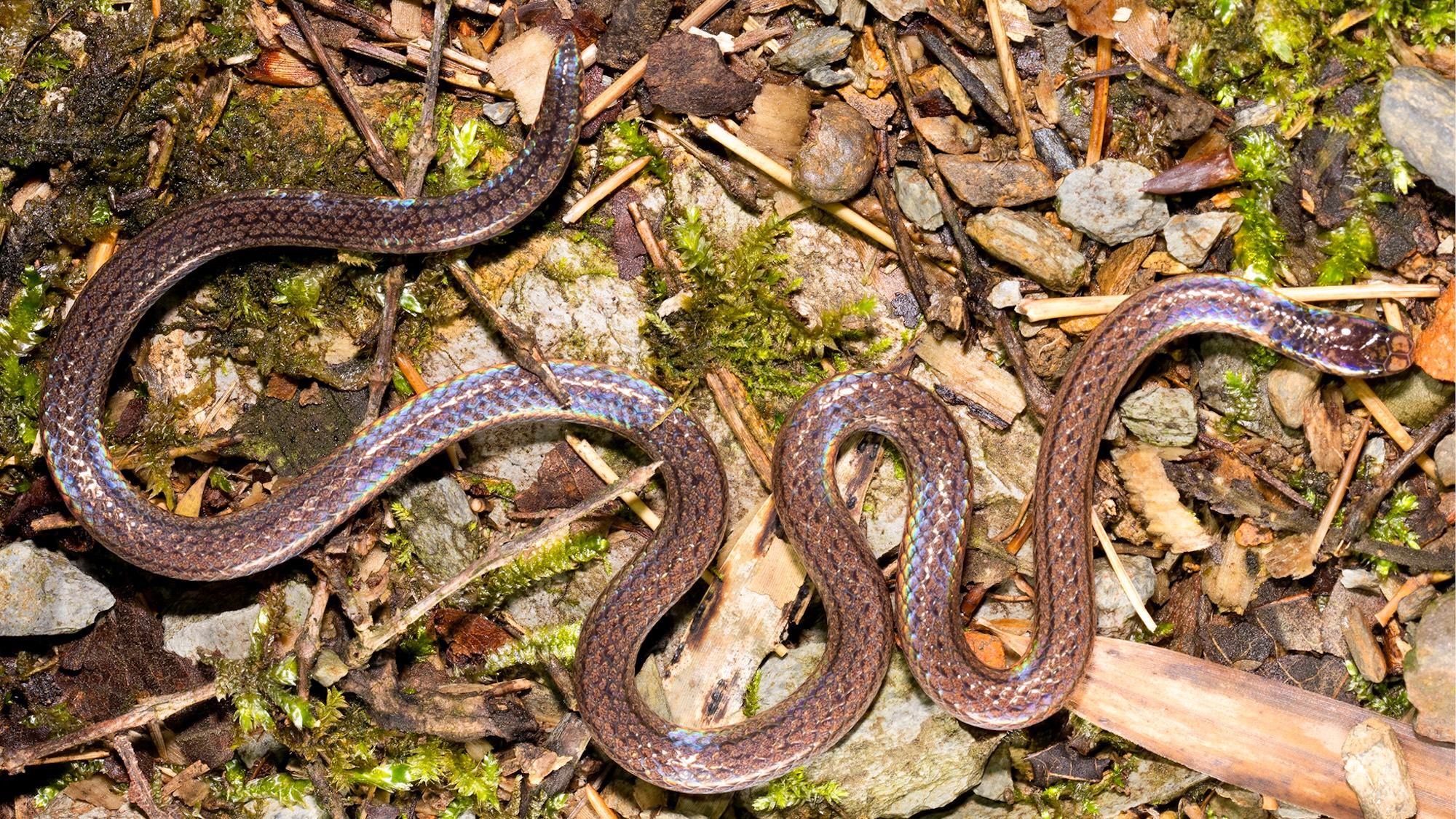
Only around 600 of the nearly 4,000 known snake species are venomous. The recently discovered Guangxi reed snake (Calamaria incredibilis) in China is not one of those species, but its alternative defense mechanism is strange enough to keep most predators at bay. According to a study recently published in the journal Zoosystematics and Evolution by biologists at the Natural History Museum of Guangxi, C. incredibilis wields its wide, stubby tail like a second head to scare away potential threats.
Researchers first spotted the Guangxi reed snake during a biodiversity study in China’s Huaping National Nature Reserve near the nation’s southern border with Vietnam. The mostly nocturnal, non-venomous serpent grows to about eight-inches-long, and is identifiable by its small brown scales and seven darker stripes. Largely docile, it prefers to hide away between rocks and underneath leaves, and prefers a diet of insect larvae and earthworms.
Although largely timid, the Guangxi reed snake has evolved a strategy to bluff its way out of dangerous situations. Whenever it feels threatened, the reptile raises its tail off the ground and begins waving it like an additional head. The tail even features similar markings to those seen on the snake’s head, which adds to the overall realism.
As People recently noted, the reed snake is far from the first new snake species discovered in 2026. Earlier this year, researchers identified both a vibrantly turquoise pit viper and a flying snake in a Cambodian cave alongside previously unknown geckos, millipedes, and microsnails.
The study’s authors explained the Guangxi reed snake “highlights the underestimated diversity” in the reptile’s larger family, as well as underscores the region’s role as an “ important hotspot” of unique animals.
