Most of us generally think of precipitation in terms of three varieties: rain, snow, and sleet. But for meteorologists and climate scientists, the trio is far from adequate. In fact, a team of researchers including NASA engineers spent almost a decade analyzing weather data to fine-tune these categories. After utilizing machine learning to digest the ensuing mountains of data, the group has put forth a total of nine different types of precipitation. As they explained in a study recently published in the journal Science Advances, they aren’t trying to nitpick—they’re hoping to save lives.
It’s understandable to think that snow only enters a forecast when the temperature drops below freezing, but that’s actually not the case for meteorologists. Depending on a cloudfront’s microphysics, both rain and snow are equally likely to occur whenever the temperature ranges between 26.6 and 41 degrees Fahrenheit. This is one of the many reasons why even today’s most reliable weather models can have difficulty predicting precipitation. Meanwhile, satellite systems are good at tracking cloud movement from space, but they aren’t as strong at monitoring on-the-ground conditions.
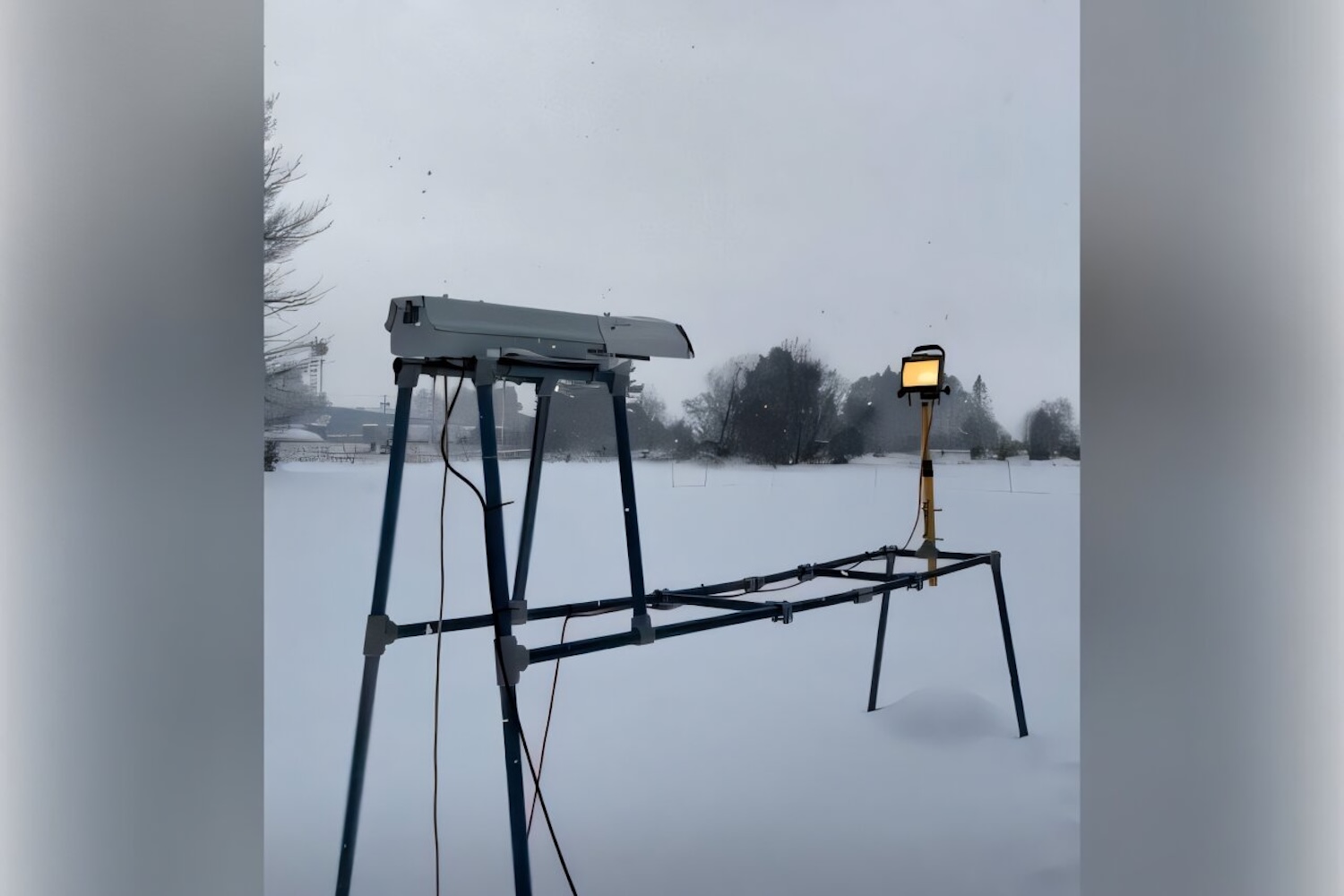
In an effort to improve and strengthen the available data used in weather models, researchers at the University of Michigan partnered with NASA on this multiyear project. To start, they installed a specially designed camera array from NASA called the Precipitation Imaging Package (PIP) at seven strategic sites across the United States, Canada, and Europe. Once running, PIP recorded any surrounding precipitation with a brightly lit, high-speed camera, while an instrument known as a disdrometer measured the speed and size distribution of liquid particles as they fell from the clouds.
After nine years, researchers amassed around 1.5 million small-scale particle measurements, as well as surface weather station measurements including temperature, dewpoint, relative humidity, pressure, and wind speed. A basic calculator can’t crunch all of that information, so researchers relied on a statistical method called dimensionality reduction to simplify their data in order to identify any patterns. They then built two machine learning models based on this technique—a conventional linear version measuring direct particle relationships and a nonlinear option that considered conditional relationships like the more subtle ways that particles interact and move.

After comparing both models against independent weather data, the nonlinear method proved the clear winner. Not only did it track precipitation transitions in alignment with radar data, it also reduced ambiguity by 36 percent compared to the linear approach.
After some final computational touches, the team unveiled its Uniform Manifold Approximation and Projection system, or UMAP. In addition to reducing the data’s complexity, UMAP highlights three primary contributors to a precipitation’s final form: particle characteristics, intensity, and phase. UMAP also allows for a better understanding of how these types of precipitation transition between one another.
So, what are the nine technical categories to be on the lookout for this fall and winter? According to the study’s authors, they are:
- Drizzle—light, steady rainfall
- Heavy rainfall—intense rainfall with numerous small drops
- Light rain-to-mix transition—light sleet with dense ice pellets
- Heavy rain-to-mix transition—intense sleet with dense ice pellets
- Light mixed-phase—a low volume of slushy, partially frozen particles
- Heavy mixed-phase—a high volume of slushy, partially frozen particles
- Heavy snow-to-mix transition—large snowflakes and aggregate particles
- Light snowfall—light, fluffy snowfall
- Heavy snowfall—an intense, heavy snowstorm
For University of Michigan climate scientist and study co-author Claire Pettersen, UMAP’s benefits are both immediate and far-reaching.
“In the short term, better forecasting can help people adjust their daily commute or prepare for big events like floods or an ice storm,” she said in a statement. “On longer time scales, it can help predict how snowpack or runoff timing will change fresh water availability for a region.”
Pettersen and colleagues don’t want their work restricted to experienced scientists, however. To make UMAP’s benefits more accessible, they have also released an interactive plot for viewing the data, as well as a public-facing interface that’s easier to use for the average weather enthusiast.
“Precipitation processes are very nonlinear. Many things influence precipitation as it falls that affect what we experience at the surface,” added Pettersen.
And for those out there who really wanna delve into the findings, it’s all available on Deep Blue Data.