

Jonathan Allen, a biology professor at William & Mary in Virginia, has a very strange pet: a very very long ribbon worm (phylum nemertea) named Baseodiscus the Eldest, or just B for short. Ribbon worms, also called nemerteans, are one of the longest animals on Earth, but Allen isn’t horrified by his pal. B has been living its best life in its tank, following Allen from job to job for two decades.
“They are gorgeous animals,” Allen tells Popular Science. “And [thy] are ecologically very important predators in nearly all marine systems.”
Recently, the duo’s long-term friendship revealed that B isn’t just any old ribbon worm—he’s the oldest ribbon worm known to science, and the star of a recent paper Allen co-authored in the Journal of Experimental Zoology. The new research could influence how researchers think about the animal’s fundamental biology and stages of life.

If you thought we were going to say that B is the longest ribbon worm, it’s hard to beat the 180-foot specimen found in Scotland in 1864. By comparison, B is only three feet long.
The seeds of this worm’s stardom were planted when Chloe Goodsell, Allen’s former student and current graduate student at University of California, Irvine, asked about B’s age. By that point B was decades-old, and Goodsell, also co-author of the new study, suggested sending a sample of the worm to Svetlana Maslakova at the Oregon Institute of Marine Biology. Maslakova is an expert on nemertean genetics and also a co-author. The genetic analysis identified B as a Baseodiscus punnetti.
When B came into Allen’s care in 2005, the worm was at least seven years old, “and likely older than that. I’ve kept it in my care for the past 20 years now,” Allen explains. “We now know who it is and have a minimum estimate of its age (27 years). This exceeds prior estimates for this phylum of animals by an order of magnitude.”
Specifically, B is now the oldest known ribbon worm by over 23 years. While biologists had theorized that ribbon worms might be long-lived creatures, the length of their lifespans had been a mystery before this study.
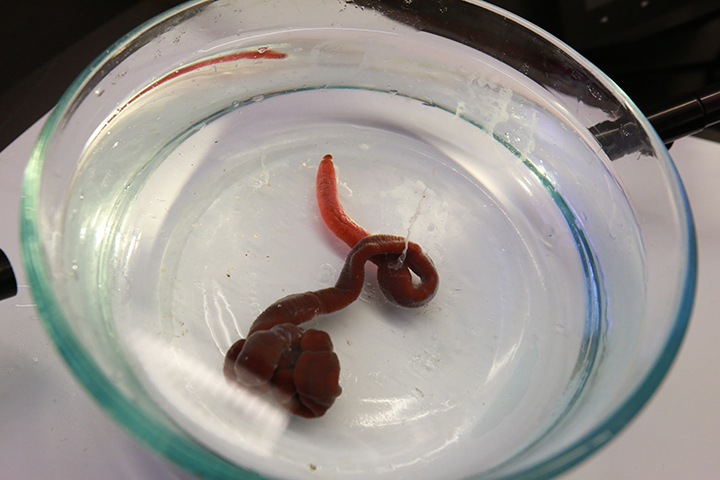
It’s impossible to understand how old a ribbon worm is (besides sticking around long enough to find out), “partly because no one has been bothered to look and partly because there are few hard parts in the animals to use to track growth rings,” Allen explains. “Some species do have a stylet (a calcified harpoon of sorts) but not our animal. So without internal hard parts or growth rings, this can be a real challenge and somewhat ‘accidental’ studies like ours are really the only way to get at this information.”
Ribbon worms are mysterious in a number of ways, Maslakova tells Popular Science, which is part of the reason why barely anyone investigates them. For example, it can be difficult to track them down in the wild, and it’s hard to identify particular species.
More broadly, this newfound data—that ribbon worms can live so incredibly long—influences researchers’ understanding of a “major group of marine predators,” Allen said in a statement. “Nemerteans are incredibly important members of benthic ecosystems and having their lifespan be multi-decadal can really change the way we think about their role in food webs,” he adds to Popular Science.
