
This article was originally featured on Knowable Magazine.
While visiting the Mediterranean coast, Luis Zelaya-Lainez found himself captivated by more than its sparkling seas and sun-dappled beaches. Everywhere he looked there were sea worms, clinging defiantly to rocks despite “waves smashing into them, 24-7.”
The biomechanical engineer, who’s based at the Vienna University of Technology, was transfixed. He became obsessed with the creatures, especially their jaws — a wonder tool used for feeding, fighting, digging, anchoring and more. “They’re really thin … so from a geometrical perspective, they should be really delicate,” says Zelaya-Lainez, who most recently studied a bristly marine ragworm called Perinereis cultrifera. “But they’re not, they’re really dramatically strong.”
In a recent paper, Zelaya-Lainez, along with collaborators in Vienna including Christian Hellmich and Florian Raible, revealed the secret behind the worm jaws’ super strength: They’re made of proteins bonded with metal ions such as zinc. The resulting material — a novel substance the researchers dubbed a “bio-metal” — is hard like conventional, crystalline metals, yet elastic like some polymers.
It’s a winning combination that could inspire a new generation of biomaterials, such as long-lasting hip implants and lightweight alternatives to conventional metals. And P. cultrifera produces this metal-like substance at ambient temperatures and low pressures, says Zelaya-Lainez, which could be a boon for eco-friendly manufacturing.
The worm is a type of polychaete, a group of segmented creatures with protruding bristles that power locomotion (and can scare off predators). “Those bristles come in lots of different forms,” says marine biologist Karen Osborn, curator of annelids and peracarids at the Smithsonian’s National Museum of Natural History. The bristles can resemble hooks, spines, feathers and even oars.
Osborn isn’t surprised that P. cultrifera can “pick things up from the environment and incorporate them into their teeth” to form bio-metals. Bristle worms are a resourceful group of animals that dates back more than 500 million years and has survived five mass extinctions. The 10,000 or more species that exist today live mainly in the ocean, occupying every habitat imaginable, from the sandy seafloor to the open water column, from scalding hydrothermal vents to frigid Antarctic ice.
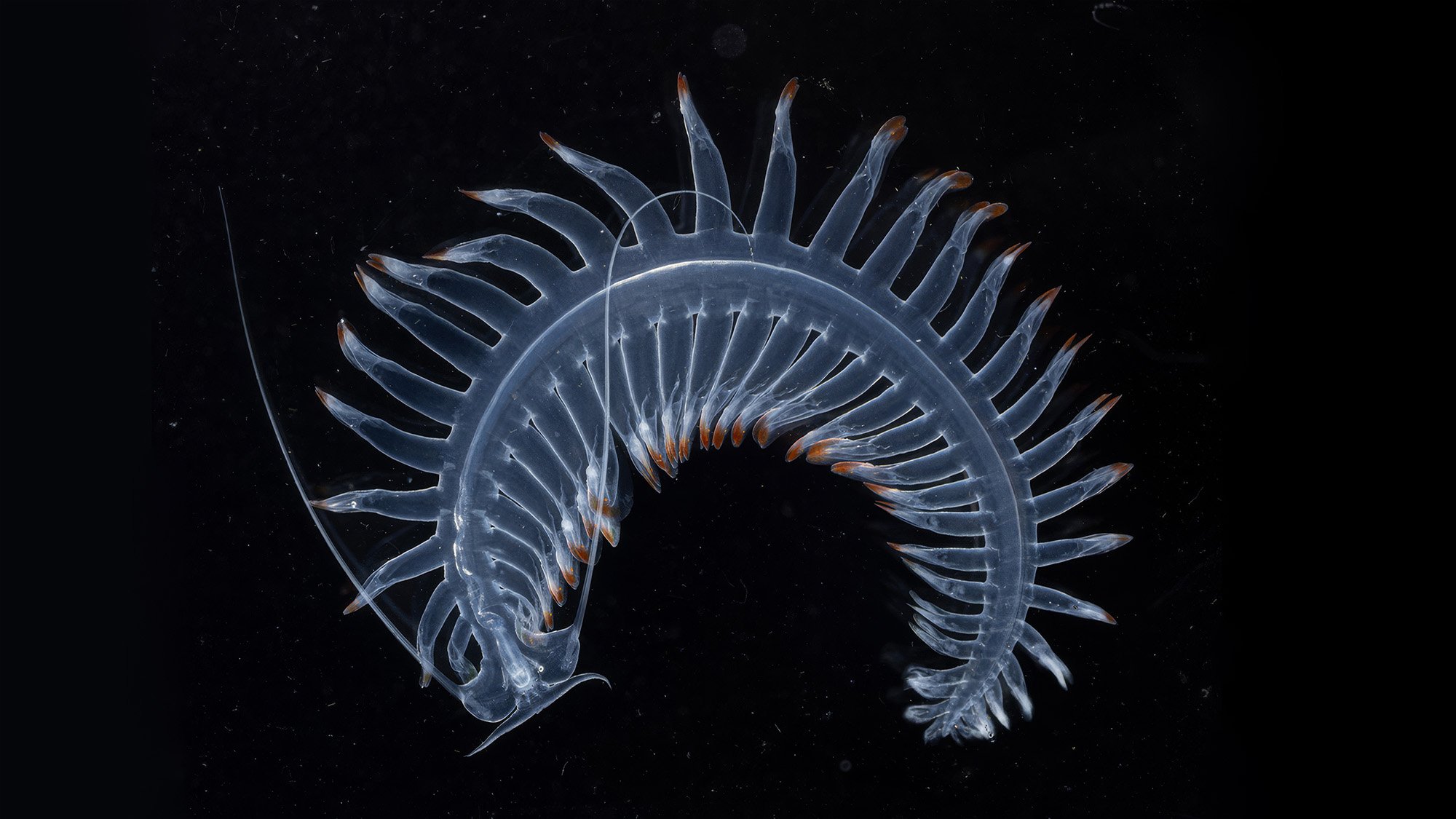
Osborn’s favorite are the gossamer worms, which live mid-water and resemble transparent fern fronds. “It’s absolutely mesmerizing to watch them swim,” she says. They are also one of the rare creatures that emit yellow luminescence, instead of the usual blue or green, which they can shoot out of their bristles to confuse attackers.
Aesthetics aside, researchers are studying the worms’ movements because they hold important lessons for soft robotics. “They can swim forward and backward without turning around,” explains Osborn. “Not very many things can do that.”
And some bristle worm species have remarkably keen vision — on par with mammals like mice. For example, scientists recently learned that Alciopids polychaetes can see in high resolution thanks to a pair of well-developed eyes that weigh 20 times more than the rest of its head. These camera-like eyes, comprising corneas, irises and lenses, are highly sensitive to ultraviolet light, which researchers believe the worms use “as a secret language” to communicate or to find mates in the dark, without alerting visible-spectrum predators.
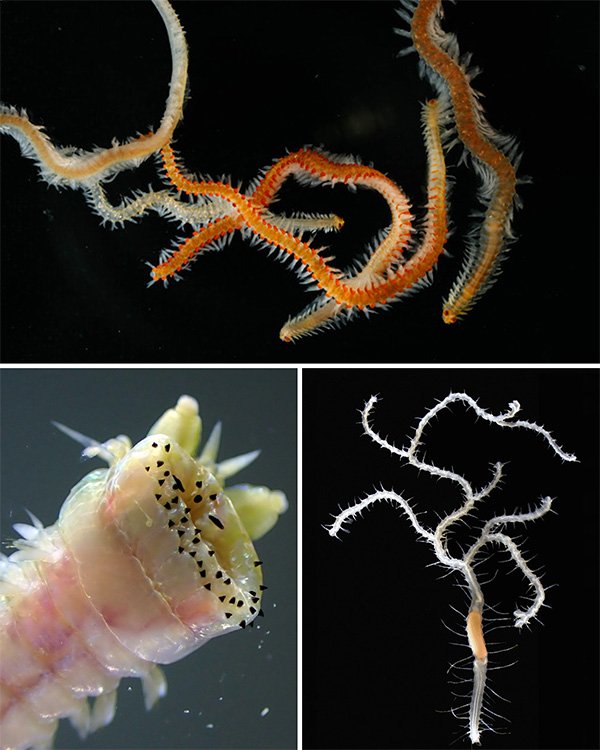
For other polychaetes, moonlight holds the key to precisely timed mating rituals, some of which can be quite dramatic. Syllid worms, for instance, develop detachable rear ends called stolons that are filled with eggs or sperm; these reproductive units also are equipped with simple eyes and a “brain.” The stolons separate from the parent worm and swim to the ocean’s surface for mass spawning when triggered by lunar cues. Species such as Ramisyllis multicaudata and Ramisyllis kingghidorahi form hundreds of these detachable posteriors at a time.
Other species, such as the pile worm, transform their entire bodies during reproduction, shrinking their stomachs to make room for gametes, while enlarging their eyes and morphing bristles into paddle-like arms for the journey to the top.
“It’s amazing what you can discover with these small creatures,” says Zelaya-Lainez, who continues to study bristle worms today.
They’re a perfect reminder to remain curious about our world, adds Osborn. “We know less than half of them that are out there … let alone what they do and how they do it.”
