
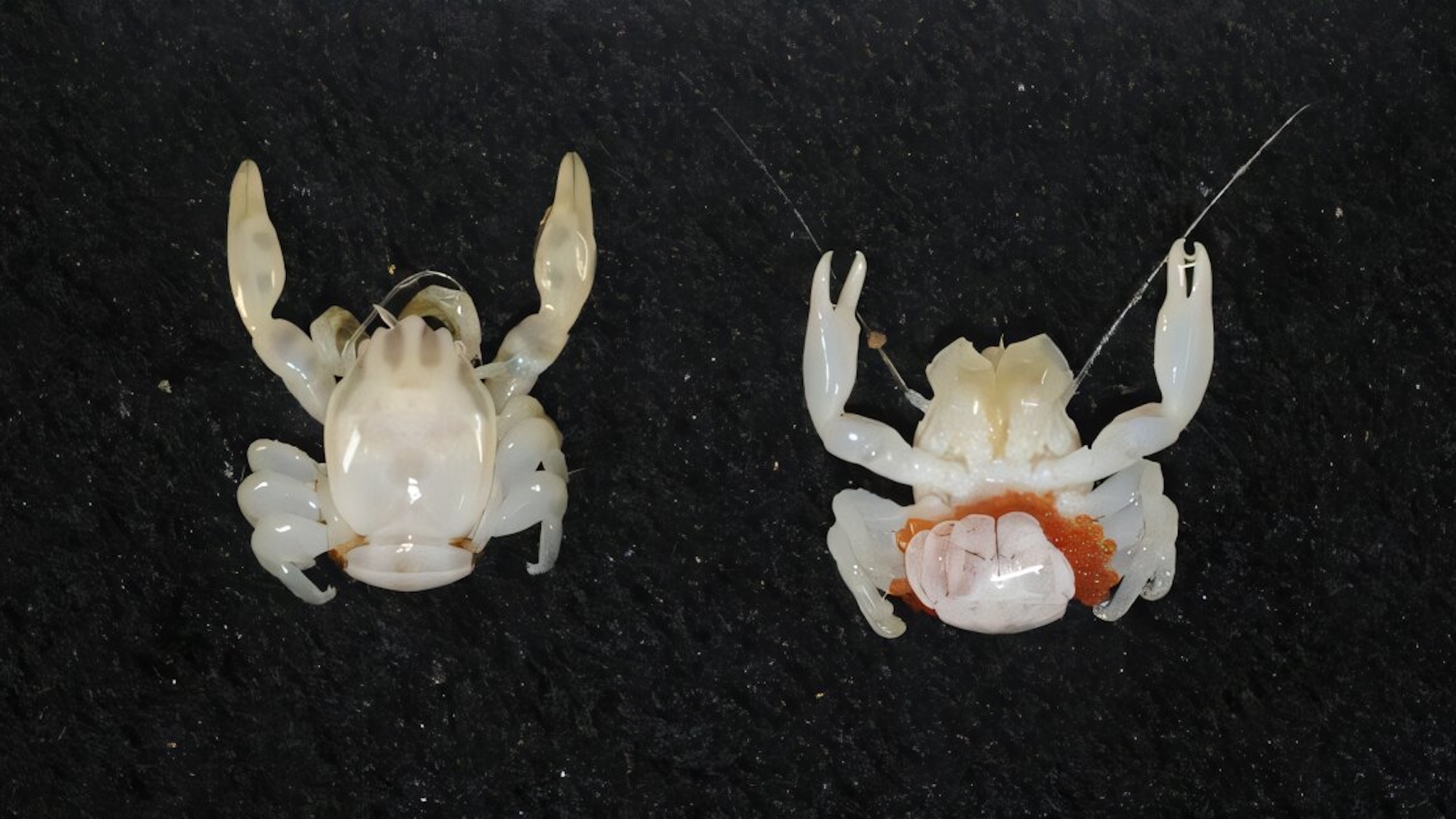
Oceanographers scouring the waters off of Western Australia have discovered two new deep-sea oddities. On October 6, Australia’s Commonwealth Scientific and Industrial Research Organization (CSIRO) showcased these new species originally collected in 2022: a bioluminescent lanternshark and a tiny, semi-translucent porcelain crab.
CSIRO tasked oceanographers aboard its research vessel (RV) Investigator with a biodiversity discovery mission about three years ago. The team revealed two of its initial finds—the painted hornshark and the ridged-egg catshark—in 2023. The new Western Australian lanternshark (Etmopterus westraliensis) represents the third shark species collected during the excursion.
“Lanternsharks are an amazing group of sharks,” ichthyologist Will White said in a statement. “[They] are bioluminescent, with light produced by photophores located on their belly and flanks, which is where their common name comes from.”
E. westraliensis is named in reference to the region it was found, and lives around 2,000 feet below the ocean’s surface. Don’t expect a hulking, glowing, Jaws-like predator. The largest specimen measures only about 1.3 feet long. Like many deep sea creatures, E. westraliensis has evolved large eyes to help see through the dim murkiness, and features a thin body topped with small dorsal fins and a sharp spine.
The other species announced by CSIRO is even smaller than a lanternshark. Porcellanella brevidentata is a unique porcelain crab that lives symbiotically with sea pens, a type of soft coral similar to sea fans. Opalescent and only about 0.05 inches wide, its coloration allows it to blend in well with the coral’s similarly bleached hue. P. brevidentata can be found in slightly shallower waters than E. westraliensis. In this case, researchers scooped up their specimens at a depth of 400 feet along the Ningaloo coast in northwestern Australia. Unlike most other familiar crabs, P. brevidentata doesn’t rely on its pincers to capture food.
“Porcelain crabs are known as filter feeders, feeding on plankton by using modified mouthparts with long hairs to sweep the water for small pieces of food such as plankton” explained researcher Andrew Hosie.
E. westraliensis and P. brevidentata bring the 2022 voyage’s total number of new species up to almost 20 animals, but that’s only a fraction of what’s left. According to CSIRO, the single survey mission may yield as many as 600 new animals. This team of oceanographers isn’t waiting around, however. As one group continues to describe and catalogue the species, another squad is gearing up for yet another discovery excursion in the coming months—this time to the Coral Sea off Australia’s northeastern shores.
