
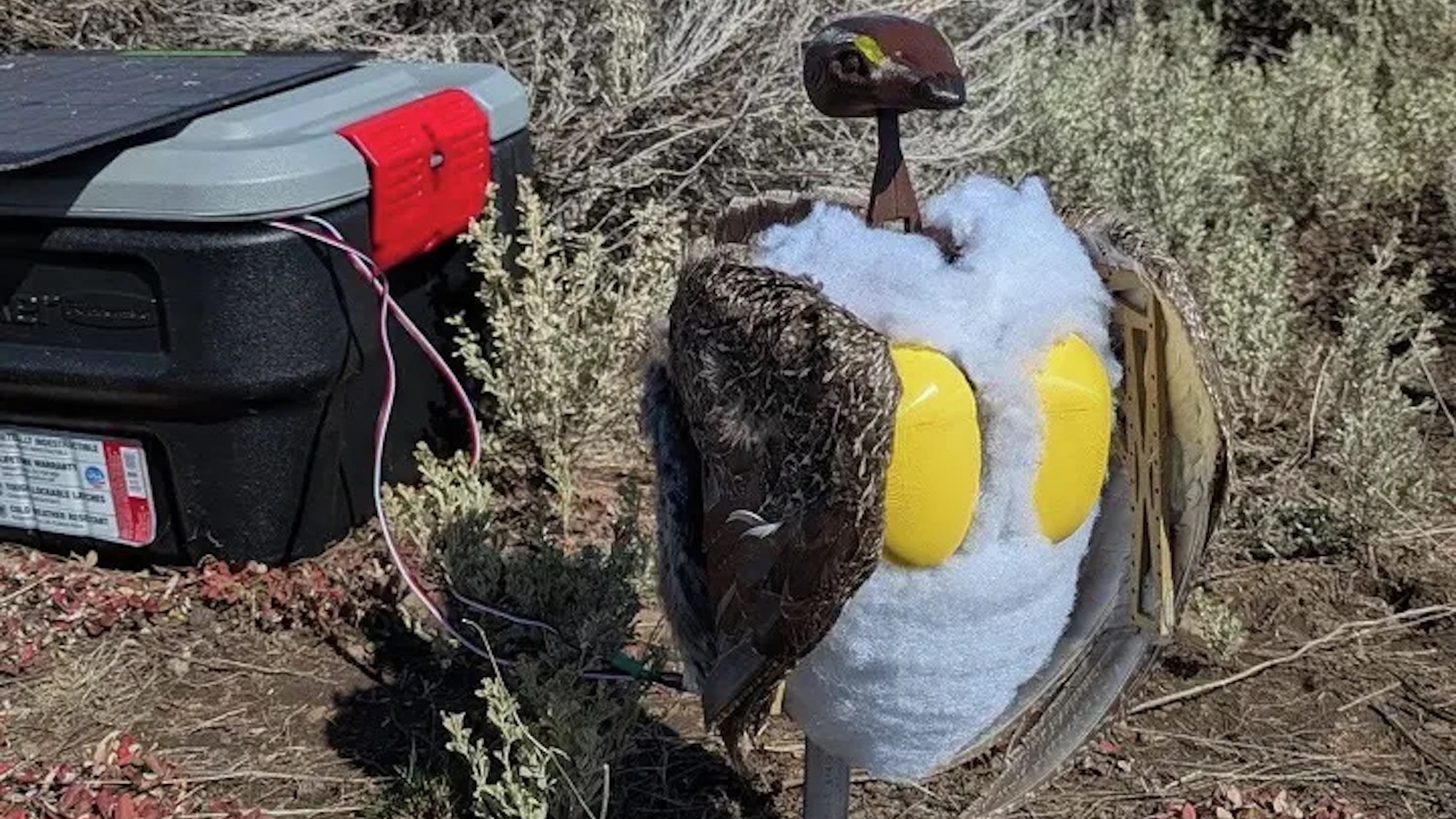
Spring is here, and that can only mean one thing: the return of robot birds. In Wyoming’s Grand Teton National Park, rangers and conservationists are once again deploying specially designed robotic decoys of the greater sage-grouse (Centrocercus urophasianus) in a bid to encourage breeding. Although they may not exactly look like the real thing to human park visitors, ecologists hope the robo-birds can convince the region’s dwindling grouse population to start reproducing. .
The greater sage-grouse is a prime example of the consequences of habitat loss. Around 16 million of the chicken-sized birds lived across North America at the beginning of the 20th century. Ecological surveys now indicate that by the late 1960s, grouse populations in the West began to decline an average of 2.3 percent every year. While the species as a whole isn’t endangered, populations in areas like Grand Teton National Park are at serious risk of completely disappearing. At one of the park’s breeding sites—known as leks—conservationists only tallied three male grouses last year.
A major reason for Grand Teton’s declining population is owed to years of grazing cows destroying their typical food supplies and hiding spots. Although it’s been decades since the last cattle herds trampled over the region, grouse numbers have yet to improve. Part of this is also due to the nearby Jackson Hole Airport. As the only airport inside the national park, plane traffic has further disrupted the birds’ lives. In some cases, aircraft have even struck and killed unlucky grouse.
Over the last eight years, Grand Teton staff have partnered with various community organizations and local schools to restore around 100 acres of pasture near the airport. They have particularly focused on reintroducing native plants and maintaining leks for grouse breeding. But building up the space is only one part of the battle.
“One of the challenges with restoration is that even when you create great habitat, wildlife doesn’t always show up right away,” Grand Teton Park spokesperson Emily Davis explained in a recent SFGATE profile.
Like a similar project last year, rangers tasked local high schoolers to help bring back the grouse. For 2026, they enlisted the RoboBroncs—Jackson Hole High School’s robotics team—to design and build mechanical grouse decoys. While the bodies are largely composed of repurposed materials like blankets and packing foam, the Wyoming Game and Fish Department supplied actual pointy tail feathers.
There are two types of robo-grouse installed at Grand Teton Park—stationary mounts, as well as automated models built to move and dance like the actual birds during mating rituals. Some of them are even capable of puffing their chests like a male grouse. To boost the realism, recorded breeding calls are also played every day beginning at 5 a.m. on nearby concealed speakers.
“The idea is to encourage birds to begin displaying and mating at the restored site,” Davis explained. “Because brood-rearing happens near the lek, this can help draw more sage-grouse to the area over time.”
With any luck, the robotic assistants will help steer sage-grouse away from the airport towards restored habitats, where they will meet mates and breed. The standard courtship season lasts through mid-May, and rangers will be monitoring each step of the way using a trail camera.
