Two million times sharper than human vision
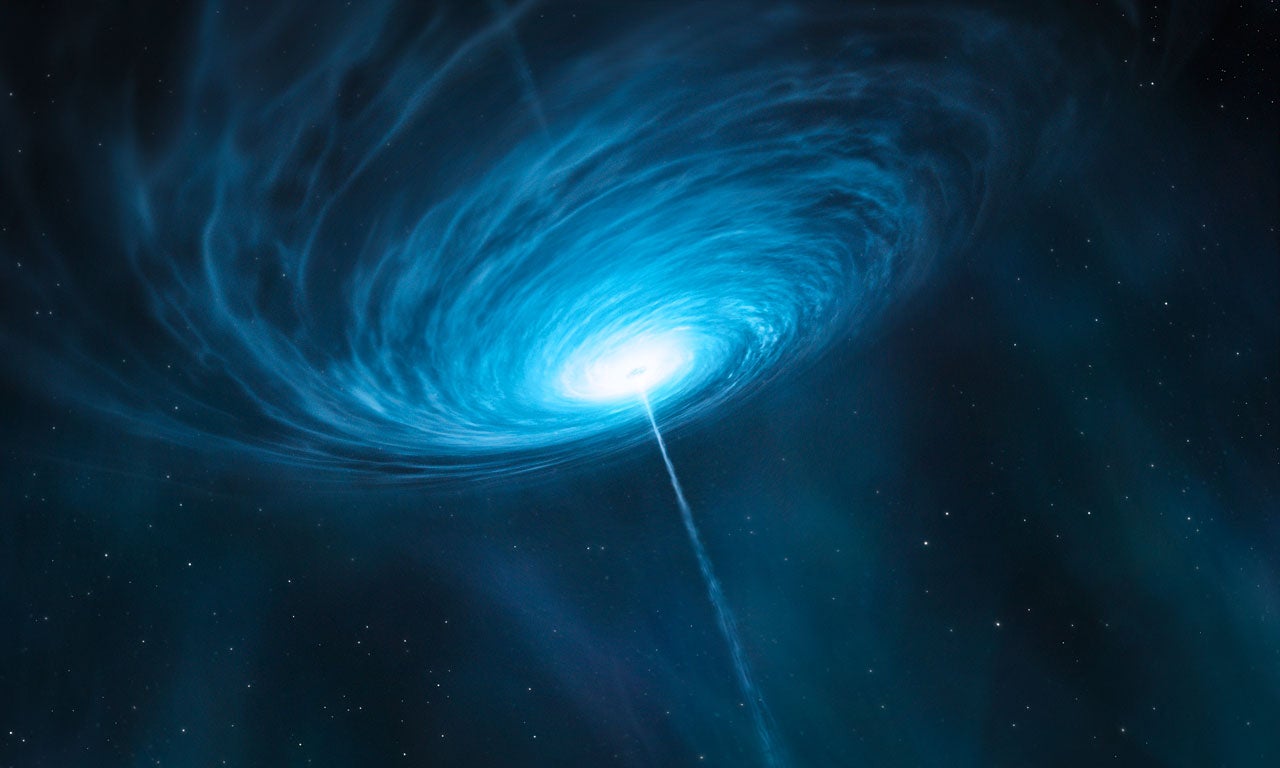
Quasar 3C 279 (Artist's Impression) ESO/M. Kornmesser

By tying together the observational power of three radio telescopes, astronomers have made the sharpest observation of a distant galaxy, some two million times sharper than human vision. That’s big news in an of itself, but it’s even bigger news for astronomers pursuing next-level Very Long Baseline Interferometry (VLBI). The observation demonstrates a kind of telescopic collaboration that’s never been seen before, hinting at the future of astronomical observation.

VLBI is a means of linking telescopes together in a way that basically creates a single huge telescope as large as the distance between the telescopes (there’s a good primer on VLBI in our previous coverage of the Event Horizon Telescope, which aims to use VLBI to create a virtual telescope the size of planet Earth). Doing so requires a lot of technological backbone--atomic clocks to sync up the observations at geographically disparate telescopes, high rates of data transfer, computational capacity to process large loads of data streaming in from various sources around the globe--and this most recent observation shows just how far the astronomical community has come on this front.

The galaxy 3C 279 (astronomers actually classify it as a quasar because it shines extremely brightly as material falls into its supermassive black hole) in the constellation Virgo is 5 billion light-years from Earth, yet astronomers were able to resolve details down to 1 light-year or less. The observations were made at a wavelength of 1.3 millimeters, the shortest wavelengths ever used to image at such long baselines.

VLBI in Action:  ESO/L. Calçada

And the baselines were very long. The observations connected the Atacama Pathfinder Experiment (APEX) in Chile, the Submillimeter Array in Hawaii, and the Submillimeter Telescope in Arizona, putting thousands of miles between each of the three telescopes. It marks the first time APEX has been used for VLBI observations and required the installation of new data systems and an atomic clock by the European Southern Observatory.

That’s important for a further reason. APEX shares both its geographic home and a lot of its technology with ALMA, the Atacama Large Millimeter/submillimeter Array, a huge new 66-antenna radio telescope that is still under construction and that when complete will multiply the observational potential of global VLBI by an order of magnitude. Astronomers intend to use ALMA and other telescopes around the world to image all kinds of cosmic features in unprecedented detail, including the black hole at the center of our own galaxy. That’s why the observation of 3C 279 is such a big deal: while record-setting in its own right, it’s just the beginning of what’s possible.

21 Comments

Could three or more satellites be spread out around the solar system to accomplish this with far greater resolution?

^If a terrestrially bound system can resolve a light year or smaller, how far apart would three space telescopes have to be to resolve an exoplanet?

If one stranded or lost on Earth long ago and they wanted the home planet in searching for intelligent life across the cosmos and to find them, then it finding exact lines and shapes on a planet would be a sign of intelligent life, which is what we get when looking at the monolith granite structures on Earth from Space.

And if the home planet saw a reflection of its own constellation of stars being depicted on the Earth, this would give a feeling of its home people on Earth as well.
Again, many of the monolithic structures on Earth, represent constilations or star positions.

Perhaps an alien race, capable of flying across the stars, was temporarily stranded on Earth 5,000 -10,000 years ago, maybe longer. They used the local people with their local superstitions to their advantage. Did some tweaking of their DNA to upgrade the quality of their workers. Taught the local people about the stars, language, math and calendars. They gather raw materials of value from Earth, built monolithic structures on Earth to be seen from the stars, beyond the local people abilities to create, too.

One day the local alien race was rescued, picked up their toys, gadgets, gizmos, tools and personal knowledge and left.

All we Earthlings have from their visit, is upgraded DNA, mysterious built monolithic structures across the Earth, various languages, mathmatics and yes good working calendars.

Imagine having 3 Hubbles working together...

Robot it sounds like they left us everything we need to go find them. Too bad we are all so very "busy" doing "important" things.

sweet!

The idea of 3 orbital telescopes, unhindered from the bubble of the atmosphere, is fantastical. The order of magnetude that the image quality would be advanced is staggering. Why are we still focusing on terrestrial based imaging?

@Robot and @KillerT, with you there guys, it's funny how evolution works for all other creatures and plants and works for Human up to a point, then jumps to modern day humans then starts working again. Makes you wonder what happened during that extremely short span to create such a dramatic advancement in our DNA and intelligence. The largest proponate against evolution is that gap. Only only needs to theorize that either our DNA was affected either on purpose or by accident. What if a simple visit from another being or even an astroid strike introduced something that had unforeseen effects on our DNA. At the moment, we can only guess.
Playing Devil's Advocate since 1978

"The only constant in the universe is change"
-Heraclitus of Ephesus 535 BC - 475 BC

My guess the issue would be streaming all that data from orbital observatories would be to slow to achieve the resolution they are achieving with land based ones.

"Make it so"

Intelligent design, God created humans. If there are aliens, the chances of them evolving into bipedal humaoids is statistically impossible. Just like the big bang, goes against everything science teacehes us (somethign from nothing? God created the heavens and the earth and the humans.

Holy s**t guys. We went from commenting on space based telescopes to theology and speculative evolutionary theories in the span of one post. You (all of you) need to seriously consider where it is you're sharing your wildly diverse ideas. Make a blog. Stop making the PopSci comments a f****ing laughing stock of the scientific community.

I like the fact that we’re are getting even better at seeing stuff in the cosmos. I can’t wait until they can actually capture an exoplanet with this technology. I'm getting tired of seeing an artist’s rendition and just want to see the real planet like we do with planets in our solar system.

Quasar 3C 279 (Artist's Impression)?

canterol, D13,
First I adore free speech and in that all can comment.

Second, what you do not realize and often happens with my comments, I get ignored too. You and others are not obligated to travel the bunny trail that I am inspired to take. If you wish to inspire others to focus more on topic, then write something others will be inspired to follow.

Third, people do at times write contrary, bad or argue comments to my comments and this is fine too. Take care. I adore the variety of comments and the more the better!

You beat me to it Guapo. I was going to say the same thing. But it deserves repeating so I'll repeat you.

Artist's impresssion? I want to see the ACTUAL image. Please?

The comment section has been taken over by lunatics. Very sad.

ALH, there is a theory out there that states that there was something before the big bang, and that the bang was simply the tipping point that created the universe as we know it.

I have my own theory, and would like everyone to comment on it.

If we take the theory primary theory to be true, and then take the theory of an unending universe to be true, that means an unending amount of this primordial matter could have been possible. And if that were true, then it would be theoretically possible for there to be several "universes" in the real universe. Meaning, the "universe"we live in is nil more than a micro-verse. What keeps these verses from colliding? Well, distance one, and two possibly could be a type of dark matter field, a wall of sorts that keeps these verses from colliding.

In my theory, the big bang wasn't more than a gravitational bomb, drawing in more and more of the primitive matter, until it had grabbed everything nearby. everything else just escaped because it was far enough away. Big bang was the birth of gravity, not the universe.

It does amaze me that so many folks here don't stop to actually think about the article before they post. Here is one example:

There is an artist's conception graphic because we cannot see the wavelength used to "see" this measurement. You have a lot of data but it is not a photograph, nor can you just shift the wavelength using computers to something we can see with our eyes. The data just isn't captured that way.

First, if you are REALLY interested, go to the ESO (European Southern Observatory) website and learn more - or even read the link PopSci provided.

Next, wait a while. There are very talented people who will take the processed data and painstakingly convert it into a graphic that will resemble a photograph. If THIS interests you, take some time to find out how it's done, download the software and give it a try yourself. The incredibly beautiful scenes usually described as Hubble photographs take a lot of work and artistic talent to create.

Jack Cain

Bucks, Blisters or Blood - Everyone needs to pay for the freedoms we enjoy!


June 2013: American Energy Independence

Five amazing, clean technologies that will set us free, in this month's energy-focused issue. Also: how to build a better bomb detector, the robotic toys that are raising your children, a human catapult, the world's smallest arcade, and much more.


Online Content Director: Suzanne LaBarre | Email
Senior Editor: Paul Adams | Email
Associate Editor: Dan Nosowitz | Email
Assistant Editor: Colin Lecher | Email
Assistant Editor: Rose Pastore | Email

Contributing Writers:
Rebecca Boyle | Email
Kelsey D. Atherton | Email
Francie Diep | Email
Shaunacy Ferro | Email

circ-top-header.gif
circ-cover.gif