
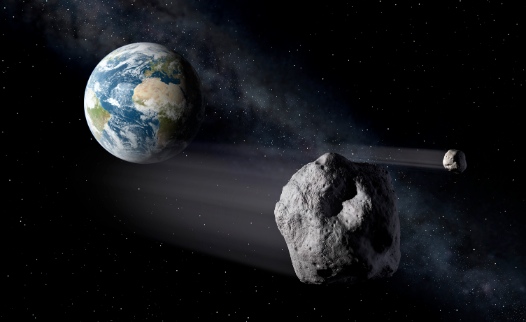
One way or another, it’s on everyone’s minds, living somewhere in the back of our collective consciousness. Hollywood knows it, and continues to plumb it for box office numbers. Sci-fi is rife with it. The fossil record shouts warnings across millennia about it. Even the dinosaurs developed a particular, albeit brief, loathing for it. The killer asteroid--the one that we might never even see coming--could end life on this planet and there would be nothing humans could do about it. It creates a kind of helplessness that’s difficult to even think about, and it’s Robert Weaver’s job to think about it all the time.
Weaver, a scientist at Los Alamos National Laboratory (LANL), doesn’t hunt for killer asteroids, but he does study the ways humans might use their vast nuclear arsenals--designed to wipe each other off the face of the planet--to save the whole of humanity from a catastrophic asteroid impact. Weaver has been running simulations on LANL’s Cielo supercomputer to determine humanity’s capacity to mitigate an impending asteroid threat using a one-megaton nuclear energy source--one roughly 50 times more powerful than the blasts inflicted upon Hiroshima and Nagasaki at the close of World War II.
There’s more than one way to divert an asteroid of course. With the proper notice, like that afforded us by the asteroid Apophis or 2011 AG5, humans could fly a spacecraft out to intercept an asteroid in deep space. This spacecraft could impact the asteroid to nudge it slightly off course, or it could fly abreast of the threat, acting as a kind of “gravity tractor” whose slight gravitational tug would push it off its collision course over time. It’s even been suggested that a spacecraft could bombard one side of a killer asteroid with a laser, heating it enough to change its orbital characteristics and its path.
That’s if we have time. “From my perspective, the nuclear option is for the surprise asteroid or comet that we haven’t seen before, one that basically comes out of nowhere and we have just a few months to respond to it,” Weaver says. In other words, lacking the time to deploy something more elegant, we can pull out the method of last resort and blast the threat out of existence with the biggest energy source at our disposal. There’s no telling exactly how an asteroid deflection mission would transpire because it’s never been tried before, but scientists like Weaver are hard at work simulating the ins and outs of mitigating of an incoming impactor. It’s knowledge we hope we’ll never have to use, but should we ever have to, this is how it would work.
Interception
Weaver conducted a whole parameter study on his simulated asteroid mitigation mission that included all kinds of variables including composition, the size of the constituent rocks making up the asteroid, the porosity of the asteroid, and so on. But he had to start with some fixed parameters. For the 3-D simulation (depicted in the video below) he chose to model the potato-shaped Itokawa asteroid, the same one visited by Japan’s Hayabusa asteroid lander back in 2005.
Weaver’s simulations don’t address the delivery of a nuclear energy source to the asteroid, though there are people out there who do study that very issue. For instance, at the biannual Planetary Defense Conference global partners hash out the thorny politics inherent in hurling the world’s most powerful weapons into space for peaceful purposes.
But we know we can intercept asteroids in deep space. Japan’s Hayabusa probe actually landed on and returned from Itokawa during the last decade, and NASA’s Dawn spacecraft is currently in orbit around the asteroid 4 Vesta in the asteroid belt. We’ve even crashed into a comet before, via NASA’s Deep Impact mission, which hurled a probe into the center of comet 9P/Tempel. If it’s close enough to be a threat, we can rendezvous with it.
Detonation
Weaver’s simulations have shown something that should boost humanity’s confidence in this endeavor: for an asteroid of the oblong shape and size of Itokawa--roughly 1,640 feet across--there’s no need to drill down into the center of the asteroid to mitigate the threat. “I varied the location of the explosion from the center of the asteroid to the surface of the asteroid both along the long side and the short side,” Weaver says. “The center was by far the most effective because it just blew the whole thing apart. But effective enough was an explosion at the surface of the asteroid, both on the short side and the long side, with the short side being most effective. Once I discovered that, my study focused on surface explosions because it’s just a much simpler mission.”
A surface explosion, known as a contact burst, wouldn’t actually take place right at the surface. Based on what we know about asteroid composition--and there’s still much to be learned--many asteroids are more like huge orbiting piles of smaller rocks than cohesive, solid chunks of hard material. There appears to be a soft dust layer, known as the regolith, that covers asteroids like Itokawa, a layer that could be as much as 30 feet deep. A nuclear energy source rammed into an asteroid could penetrate down into this layer with little trouble, giving it some of the kinetic advantages of being buried within the asteroid. And once the energy source is in direct contact with the asteroid, it’s all pretty much over with.
“The big plume that you see coming out of the top of the asteroid in the simulation is the effect of all that heated rock in the vicinity of the explosion being expelled from the asteroid at high velocities,” Weaver says. “There’s rock-to-rock kinetic energy transfer that happens. These rock-to-rock interactions propagate the energy from the surface all the way through to the opposite end of the asteroid, totally disrupting these rubble piles.”
In other words, the blast is transferred all the way through the asteroid, scattering the once cohesive rubble in every direction. The asteroid threat is no more.
Aftermath
In the simulations, the asteroids essentially come apart, hurling rock outward with the force of the nuclear blast. But the most visible objection to this kind of asteroid mitigation is the idea that by blowing an asteroid apart, we might just create many smaller rocks that could still be big enough to threaten Earth. Moreover, if the rocks aren’t sufficiently scattered the asteroid could potentially recombine under their own gravity, making the nuclear blast a moot point.
But Weaver’s simulations showed something unexpected: the rock expelled from the far side of the asteroid by the blast was kicked out at velocities that surprised even Weaver. Given that the escape velocity--the velocity at which the constituent rocks need to be traveling to escape the asteroid’s own gravity--for an asteroid Itokawa’s size is less than a centimeter per second, the possibility of the asteroid recombining after the blast is virtually non-existent.“In my 2-D calculations I’m seeing velocities imparted to expelled rock on the opposite side of the asteroid of meters per second,” Weaver says. “The escape velocity for an asteroid such as the one I’m looking at is fractions of a centimeter per second. I was calculating velocities of expelled rock at one to ten meters per second, well in excess--by orders of magnitude--of the escape velocity. That was a surprise to me and gave me some confidence that this really is an effective mitigation technique. The asteroid will not recollect, and it will not pose a hazard of a bunch of smaller rocks hitting the Earth.”
This, of course, is according to the calculations.
“All this depends obviously on exactly where the intercept is done, how far away from the Earth it is, how much time we have left--and all of these are unknowns until we discover a threatening asteroid,” Weaver says. “All of these assumptions are assumptions. What I think I’m bringing to the table for the first time are truly validated simulations of these non-uniform, non-circular compositions that will hopefully give policy makers a better understanding of what their options are.”
With those options defined, at least for the scenario of an Itokawa-sized threatening asteroid, Weaver will next turn to an expanding set of parameters simulating larger and larger rocks of varying compositions up to the size of a “dinosaur killer” (about 6.2 miles across). To that end, Weaver and LANL will soon begin a collaboration with Lawrence Livermore National Laboratory that will pool computational and funding resources that will take this kind of asteroid mitigation exploration to the next level, assessing a range of potential threats. For now, those killer asteroids live solely in the simulations running on LANL’s supercomputers. But that might not always be the case.

The incredible innovations, like drone swarms and perpetual flight, bringing aviation into the world of tomorrow. Plus: today's greatest sci-fi writers predict the future, the science behind the summer's biggest blockbusters, a Doctor Who-themed DIY 'bot, the organs you can do without, and much more.


Online Content Director: Suzanne LaBarre | Email
Senior Editor: Paul Adams | Email
Associate Editor: Dan Nosowitz | Email
Assistant Editor: Colin Lecher | Email
Assistant Editor: Rose Pastore | Email
Contributing Writers:
Kelsey D. Atherton | Email
Francie Diep | Email
Shaunacy Ferro | Email
one tiny issue....radioactive fragments
Juggernog,
What if the nuclear explosion happen behind the asteroid as it approach Earth and perhaps at a 30% tilt outward from orbit of Earth. The asteroid would end up accelerating and its fragments going further out into space. Of course, I am just guessing, while Robert Weaver has actually done simulations upon the best approach and attack of the asteroid.
.............................
Science sees no further than what it can sense, i.e. facts.
Religion sees beyond the senses, i.e. faith.
Open your mind and see!
and most of the fragments will ether blast away or burn up in the atmosphere. Your explanation Robot, seems to make sense. At least to a 13-year-old :P.
p.s. @Robot I have always admired you. your comments are always humorous or have an excellent supporting statement.
~Ghast Hunter (13)
honestly im a bit more concerned about the solid asteroids....a block of iron the size of city block...
The best way to test these theories is to put them to the test by blasting an asteroid in the asteroid belt. Of course, the bouncing asteroids could impinge other asteroids and bump one or more of them into earth crossing orbits!
Risky game cosmic billiards!
Waste of time and money. What are the chances of a asteroid of any size hitting us in the next 500 years. Slim to none.
Ghast Hunter,
Awww, you give me love by a thump on the head. Should I thank you for caring or get ice for my bump?
Perhaps you will delight us with your genius and allow others to pick the skin off it too, hmmm?
.............................
Science sees no further than what it can sense, i.e. facts.
Religion sees beyond the senses, i.e. faith.
Open your mind and see!
lol imagine an asteroid made of iron or titanium getting hit by a nuclear weapon, would it destroy it/annihilate it?
"religion is like a prison for the seekers of wisdom"
-Killah Priest
JediMindset,
If a titanium asteroid should be hit with a nuclear weapon, it may resonate like a microwave bell and ring for the aliens across the cosmos to pay attention signaling, "COME, IT IS TIME TO EAT DINNER, THE EARTHINGS ARE ABOUT TO BE COOKED"!
.............................
Science sees no further than what it can sense, i.e. facts.
Religion sees beyond the senses, i.e. faith.
Open your mind and see!
@robot/space/bubbagump,
LMAO!! good one. good theory. in that moment of total annihilation maybe aliens would reveal themselves and portray themselves as gods.
"religion is like a prison for the seekers of wisdom"
-Killah Priest
JediMindset,
Now, while culture tends to confuse Gods and aliens in historic records, you should not confuse me with any other. I am just me, the one and only and I not familiar with that last name you typed.
If we humanity did set off a nuclear type device\explosion, I would think it would explode and emit frequencies not typical of normal background radiation and may alert aliens of our presence.
.............................
Science sees no further than what it can sense, i.e. facts.
Religion sees beyond the senses, i.e. faith.
Open your mind and see!
@robot
Because we aren't already spewing radio/microwave/etc signals?
I always thought a multi stage warhead would be better for nudging. Why do we always have to kick it, why not have smaller explosions in series to gently speed up or deflect a rock with minimal debris creation? Seems like a happy medium between a nuke and gravity tractor to me. I also never understood why we only had to use ONE method of deflection.
@Robot,
maybe it could open a portal to another dimension. aliens live there for sure.
"religion is like a prison for the seekers of wisdom"
-Killah Priest
Pardon my ignorance on d subject but how would a nuclear bomb work in a vacuum? I always thought d shock-wave is created by d rapid expansion of air which then rushes back to fill d void, thus d mushroom of dust @ ground zero. & if d theory is true, then why doesn't d sun drastically alter d trajectory of objects like comets when they when they have a near encounter?
johnt007871,
You are very correct about the Humanity\Earth producing a large quantity of radio signals into space.
I was just thinking a nuclear bomb in space would be louder and while there are good guy aliens that observe us Earthlings all the time, it may gain attention of the bad guy aliens.
With Earth we use our satellites to watch for the rocket launches and radiation of exploded nuclear bombs.
.............................
Science sees no further than what it can sense, i.e. facts.
Religion sees beyond the senses, i.e. faith.
Open your mind and see!
Good grief, why is anyone even thinking about sending nuclear bombs out into the universe? We have altered our environment to the point that we now have to deal with larger and more frequent tornadoes, hurricanes, tsunami, floods, earthquakes, and drought. And now someone thinks it's a good idea to send our nuclear bombs into the heavens! We had better learn how to control our environment or it won't really matter whether a killer asteriod destroys the Earth.
And suppose we nudge it out of its path toward Earth and send it hurtling toward another, possibly inhabited, planet. And further suppose that that planet has much more advanced technology than ours and it reacts by destroying Earth itself.
Why don't we mind our own business?
It is an interesting idea. Yet, it will fail if it relies on the USA doing anything: the US Government will be stalemated by the nay-sayers who'll deny any proof that the asteroid will hit the Earth and by the Abrahamists who'll rely solely on prayers to Yahweh and public stonings of "sinners" to make the asteroid disappear.
@kcbon, great question. Local space isn't a true vacuum, there are still enough molecules in our vicinity of space that they would help transfer force. Not only that, but there is also the rapid expansion and high amounts of energy of the bomb materials, and the regolith surrounding the bomb (if penetrated) which would also serve to transfer the forces to the asteroid. Those are just a couple of the many ways the force can be transferred. The reason the sun isn't throwing everything around is partially because the distances and relative masses involved tend to add up to make gravity orders of magnitude stronger than the forces from solar explosions.
@neer-do-well, I agree that we need more control over our environment, but this might possibly be the best way to use AND dispose of our nukes. Hurricanes and earthquakes destroy cities, droughts destroy countries, but the right size asteroid can destroy civilization. Also, the force imparted to the asteroid from a nuke shouldn't be nearly enough to eject it from the solar system, and I like thinking we're the most advanced in our area. If it did somehow get ejected, it would probably take thousands of years, if not millions, before it got anywhere near another star. The odds of it hitting another planet with life are astronomical.
This is terrible news for mankind.- The chances of a random asteroid hitting the earth= once every 50 million years. The chances of some twisted person/group of persons redirecting an asteroid into hitting the earth are in the sub thousands of years.
@ kcbon.
A nuclear detonation does create a massive shock wave in liquid, gas and various stated of solids.But the main effect of a nuclear blast at zero ground is the instant vaporization of solids.
In Hiroshima nearly ever thing at ground zero was vaporized.This sudden creation of vaporous mass in the vacuum of space would have the effect of a balloon flying around the room after being blown up and released.
Now I Have never heard of titanium asteroids.But lets just say there is one.
It would be resistant to blasting(my guess)but It would be prone to vaporization.
My idea(for what it's worth)Is to place a small nuclear reactor on the surface of an n.e.o. and fire it up to allow it to slowly vaporize material and jet into space in one direction in effect making jet propulsion device.If the body spins it could be programmed to pulse with the rotation to always emit in the best direction.
Sort of a mass driver.
I believe this would work.Look at Chernoble.That core burned through the floor and in to the ground.And that was not a reaction as strong as a nuclear device.
"The whole of science is nothing more than a refinement of everyday thinking." Einstein
I am curious though about the effect of a megaton or multi-megaton thermonuclear device upon a 'solid' asteroid or comet which is 5 miles or more across? A nuclear blast may work on a 'rubble pile' type asteroid, but I didn't see what his results, if any, were for a simulation pitting a surface blast from one or more megaton thermonuclear devices against a solid type asteroid or comet composed of rock or nickel-iron and large enough (5 miles or more in size) to cause an extinction level event regardless of where it impacts upon the Earth?
I gave 24 year old Stevie Spielberg both the Armageddon and the Deep Impact stories. OK, I sorta stole one of them. Who knew that the little squirrel would actually do it? OK, I egged him on, but hey, right?
Anyway, glad to see our laboratories chasing meteors.
Meanwhile, I've found the cure for pedophilia, homosexuality, criminality, delinquency, drug addiction, and runaway behavior.
About 24 y.o. Spielberg, read Hillary's Angel by Ross Nicholson.
About the pheromone one dose cure for sociopathy, read Exocrinology by Bubba Nicholson. Yes, I wrote both books, the adolescent memoir and the medical book and yes, Bubba is an alias, a title placed upon me by my people. Get over it.
@robrieke. Thank u very much. That makes sense. I've always wondered how d space shuttle maneuvers in space when it's supposed to be absolutely empty. U need a medium to push back. & I wonder if there's any such thing as absolute vacuum.
hollycow 04/09/12 at 6:41 pm
Waste of time and money. What are the chances of a asteroid of any size hitting us in the next 500 years. Slim to none.
........................
Based on WHAT?!? For all of the depth our collective human scientific knowledge provides, what we do NOT know overwhelms what we DO know by factors in the thousands.
It's also interesting to see that you show concern for what may occur 'tomorrow' - in a cosmological timeline, 500 years is barely tomorrow.
Running for POTUS this election cycle? The scary thought is that you could just win - based on your statistics. ;)
There's always time to do it better NOW.
The detonation of a nuclear device in space will result in the bathing of earth in radioactive particles. In space, explosions are "spherical". That means that the forces are dispersed in all directions, including straight back at Earth. What can you people be thinking?
In space it's all about velocities and mass.
Shooting it with a high velocity bullet would be just as effective without the radioactive result.
BillTheBruce-
As Force=Mass*Acceleration, we'd be hurling depleted uranium projectiles (about the hardest and most dense material we can come up with for railgun projectiles) weighing maybe 5kg at an asteroid potentially 5+ miles in diameter. . .It would be like shooting spit wads at it with a straw. They'd leave a mark, but they simply wouldn't impart the asteroid with sufficient force to alter it's trajectory in my opinion (and as an engineer).
Just to back up my opinion. . .railguns right now are operating somewhere in the 9 megajoule range (that's how much energy they use to launch each projectile). Since no mechanical system is 100% efficient and must lose some energy (due to friction and drag, for instance), we'd be safe to assume that the railgun's projectile is ending up with less than 9megajoules of energy, but for the sake of argument we'll just say that the railgun IS 100% efficient. Well, here's what a one megaton nuke has to offer: 4.184 PETAjoules.
9 megajoules is equal to 9x10^-9 petajoules, or 0.000000009 petajoules. If you do the math, that means you'd have to launch about 465,000,000 railgun projectiles to equal the force that a single one megaton nuke will do. Plus, we've detonated nukes in space before, and undoubtedly much, much closer than when an asteroid-destroying mission would ever have to detonate (hopefully we aren't cutting things THAT close!). When the US responded to the Soviet atmospheric nuclear test during the Cold War (Soviets detonated a lil' nuke, the good ol' U S of A flexed it's muscles a bit and went for a full megaton atmospheric test. It obscured the natural Van Allen radiation belt for about a decade I believe, but it didn't ever pose any big threat to those of us on earth. Even the ENORMOUS amount of radioactive material that we scattered throughout our upper atmosphere and into space from that blast dispersed so quickly that it was undetectable in 10 years.
If it were me, I'd be pressing the bigger of the two red buttons if this situation arose.
The first, best comet/meteor collision book was Lucifer's Hammer. I have no doubt that it would have made a much better movie than any of the ones that Did see the screen. Come to think of it, it probably would take too long for a film, maybe a mini series, since it dwelt a lot on the aftermath and the religious doomsday groups that sprang up afterwards. Kind off like a No Blade of Grass or Day of the Triffids but with a terrestrial impact instead.
Something that can save us all is never a waste of money no matter how slim the chances! The government and other institutions waste more money elsewhere.
Most of the force of the kinetic energy would be lost in space by a nuclear explosion because space has no air to expand but the significant amount of heat created would be much more effective than the laser plan and more easily implemented considering we already have nuclear weapons and delivery systems constructed. The heat would cause the material to vaporize off of the asteroid pushing the asteroid in the opposite direction. Although multiply nukes would have to be used to keep the asteroid from cooling to fast. Also space is full of radiation and radioactive particles fall to earth everyday. Radioactive fragments from the nuclear explosion would be negligible compared to what falls to earth everyday.
Other scenario is it breaks up into several pieces but this wouldn't be bad either as small pieces burn up in the atmosphere and whats too big to will cancel each other out if a majority hit the ocean. Throw a big stone in a puddle and watch and then throw several small stones and much of the wave energy is lost when the waves hit each other.
@holycow: The threat of an asteroid is very, very slim. In fact, I'm pretty sure I have better chances of winning the lottery than of living to see the day an Asteroid hits (and destroys) Earth... However, there is still a chance! And as long as there's a chance of a big chunk of rock and metal hurling toward Earth, ready to wipe out everything in existence on our wonderful planet, we NEED to focus on ways to deflect or destroy it! This is what we would call the OPPOSITE of a waste of money. A waste of money is when you spend money on something that will absolutely NEVER have any tangible benefits to our country... This is NOT one of those times.
@BilltheBruce. Yep, I like the idea of firing tungstun projectiles at it using an electromagnetic 'gun' such as the Navy is testing. Just like the hubble, it could focus on a pinpoint indefinitely, then blast away from orbit until there was nothing left of the targets.
Though I'm not overly worried about nuclear fallout, as nuclear weapons can be constructed to deliver massive radiation (Cobalt 60) or very little (Neutron) as examples.
As far as neer-do-well's concerns, we'd mark each tungstun impacter "A gift from the Aragnolds in the Vega system" and apologies for any unintentional damage of course, with a map showing them how to get to the Vega system.
What about a bomb pumped LASER? Like project Excalibur?
How to minimize the effect of a Comet or asteroid impact.
The first obstacle would be time, how long do we have before impact? we have lets say a few years we send probes to study the object,learn all we can,We would need to know its composition, what its made of ,its shape,weight telemetry, once we have this information we can start running computer simulations on how it would react to a nuclear explosion.
So striking an object would cause it to break up and we get a shower ,this we want to avoid (Shoemaker levy 9).so we dont hit it with one nuke we use hundreds, you my say, ‘’the time and cost’’, time to make 0,cost to make 0$,we already have a massive sur plus just sitting around here in stockpiles,im sure the U.S and Russia could help with that and with all the technology developed for the study of Mars im sure we could whip something up fast in the face of ELE. The planet would split the bill.
The second obstacle would be actual strike on the object, By now we have studied the object and we know where to hit it, so we send out a single mega nuke and it breaks up,a short time later we send a cluster in a wide spread to detonate in the path of what is now a pile of rocks, then we send another cluster and another,by now our pile of rocks would be no drastically minimized, we may still get hit but I take the lesser of 2 evils.