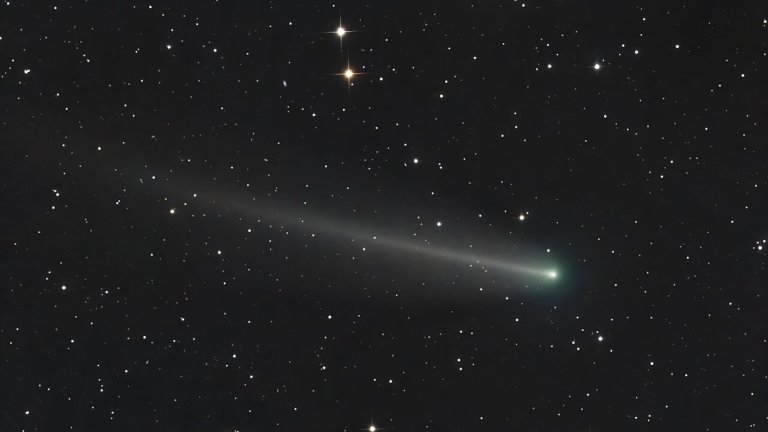
All eyes are on the asteroid Apophis, but a new threat--just 460 feet wide--dominated the conversation at a recent meeting of the UN Action Team on near-Earth objects (NEOs). Known as 2011 AG5, the asteroid could well be on a collision course with Earth in 2040, and some are already calling on scientists to figure out how to deflect it.
Discovered early last year, 2011 AG5 is still somewhat of a mystery to astronomers, as they have a pretty good idea how big it is but have only been able to observe it for roughly half an orbit. That makes it difficult to project the object's path over time--and to verify whether it may be a threat in 2040. Ideally, researchers would like to observe at least two full orbits before making projections about an NEO’s path, but that hasn’t stopped several in the astronomy from fixing odds on an impact in 2040.
Specifically, those odds are currently at 1 in 625 for an impact on Feb. 5, 2040. But like most odds, these are fluid. From 2013 to 2016, the asteroid will be observable from the ground, and that will give NEO watchers a better idea of its orbit and future trajectory. If those observations don’t vastly diminish the odds of an impact, there should still be time to do something about it before its 2023 keyhole pass.Like Apophis, which may or may not impact Earth in 2036, 2011 AG5 has a keyhole--a region is space near Earth through which it would travel if indeed it is going to impact us on its next pass. It will make its keyhole pass on its approach near Earth in February 2023 when it comes within just 0.02 astronomical units of Earth (that’s roughly 1.86 million miles). NASA’s Jet Propulsion Lab estimates 2011 AG5’s keyhole is about 62 miles wide--not big at all by astronomical standards, but bigger than Apophis’s.
If 2011 AG5 does look like it is going to pass through that keyhole after the 2013-2016 observations, scientists will have a few years to figure out how to alter its orbit and push it outside of the keyhole in 2023, thus averting disaster 17 years later. Such a deflection mission could be good practice. Apophis will make a run at its keyhole in 2029.
Much more on 2011 AG5 at SPACE.
[SPACE]
The incredible innovations, like drone swarms and perpetual flight, bringing aviation into the world of tomorrow. Plus: today's greatest sci-fi writers predict the future, the science behind the summer's biggest blockbusters, a Doctor Who-themed DIY 'bot, the organs you can do without, and much more.


Online Content Director: Suzanne LaBarre | Email
Senior Editor: Paul Adams | Email
Associate Editor: Dan Nosowitz | Email
Assistant Editor: Colin Lecher | Email
Assistant Editor: Rose Pastore | Email
Contributing Writers:
Kelsey D. Atherton | Email
Francie Diep | Email
Shaunacy Ferro | Email
For the Science Fiction Fans in all of us....
NASA initially estimated the energy that Apophis (1150 feet) would have released if it struck Earth as the equivalent of 1480 megatons of TNT. A later, more refined NASA estimate was 880 megatons, then revised to 510 megatons.
If the asteroid is as big as a 20-story building (200 feet) on a side traveling at 30,000mph, it has an amount of energy equal to the largest nuclear bombs made today -- on the order of 25 to 50 megatons. An asteroid like this would flatten reinforced concrete buildings five miles from ground zero. It would completely destroy most major cities in the United States.
By the time you get up to a mile-wide asteroid, you are working in the 1 million megaton range. This asteroid has the energy that's 10 million times greater than the bomb that fell on Hiroshima. It's able to flatten everything for 100 to 200 miles out from ground zero. In other words, if a mile-wide asteroid were to directly hit New York City, the force of the impact probably would completely flatten every single thing from Washington D.C. to Boston, and would cause extensive damage perhaps 1,000 miles out -- that's as far away as Chicago. The amount of dust and debris thrown up into the atmosphere would block out the sun and cause most living things on the planet to perish. If an asteroid that big were to land in the ocean, it would cause massive tidal waves hundreds of feet high that would completely scrub the coastlines in the vicinity.
Here is an interesting link of what NASA thinks about 2011 AG5.
http://neo.jpl.nasa.gov/risk/2011ag5.html
The asteroid is currently considered a risk of 1, which means "...A routine discovery in which a pass near the Earth is predicted that poses no unusual level of danger. Current calculations show the chance of collision is extremely unlikely with no cause for public attention or public concern. New telescopic observations very likely will lead to re-assignment to Level 0..."
.............................
Science sees no further than what it can sense.
Religion sees beyond the senses.
I'm not a scientist, and maybe someone knows more about this, but being that the Earth is mostly water, wouldn't an ocean hit cause catastrophic Tsunami?
WE ARE ALL GONNA DIE!!!!!!!!!
some day, cheers
When I die, I want it to be by a being hit by a Chocolate Milk truck.
Aw, death by being smothered in chocolate!!!
The only way to go!
.............................
Science sees no further than what it can sense.
Religion sees beyond the senses.
Personally, I hope they do find that one of these is going to hit.
This is what it would take to get the politicians to cooperate and finally provide the funds for some space development.
Someone call Bruce Willis and Ben Affleck!
@nom
Wish thinking bro
They will still fight over petty crap...its just a bunch of grown men that act like chidlren on a playground
No, someone call Bruce Wayne and Ben Kenobi!
Or better yet, Bruce Banner and Ben Grimm! They could hit the asteroid back into space with their fists.
If it hits let us hope it hits a spot that does some good--like Afghanistan or Iran.
I like to twist this asteroid into an opportunity!!!
We need to create a highly advance technical observatory, communication broadcast and listening post of this asteroid and land on it and use it.
Followed land a extreme propulsion system on it and give this asteroid a lot more acceleration and send it off into deep space.
Once it establishes and extreme orbit and a harmless one planet Earth, let it beam back to us all the things it sees in the COSMOS!
.............................
Science sees no further than what it can sense.
Religion sees beyond the senses.
Fantasies, fantasies as usual, Robot. But while we're doing this, let me pitch in. Let's slow it, but not waste it by sending it out of the Solar system. We have the Voyagers for that. Why not turn it into the counterweight for the space elevator? That Japanese trying to build it are complaining that they'll need to haul a lot of matter in space. It's already there!
@gizmowiz: I hope you're joking, because that was the most ignorant and cruel thing I've ever heard in my life.
Wait a second, when i was watching the elenin simulations, I let it play out till 2060 or so. Trying to watch the entire orbit. Apothis and several other NEO's were also apart of this.
The next closest object after elenin was apothis in february? 2013
And projected to be much closer then elenin was.
apothis last i checked was 1.5 miles across and 5-6 miles long and 3000 ft in circumfrance. 40,000ft of what i soppose is loosely compacted iron mostly.
If elenin passed between the moon and the earth, and continued on. Would seem to suggest if an object was to strike earth, it would have a direct path, and alot of speed to be of any potential threat. Unless earth hit it.
Anything else continues on or holds it's orbit.
I love the name of the Astorid. The Sci-Fi show Stargate SG1 had an episode where the evil villian Apophis hurtles a Naquadah enriched astorid at Earth. Apparently someone at NASA is a Stargate fan. Awesome! :)
---
In space, no one can hear a tree fall in the forest.
GMarsack,
Umm, just curious, was it an Astorid or Asteroid?
Take care!
..........................................
See life in all its beautiful colors, and
from different perspectives too!
eh if it is going to impact us, or any NEO, we're gonna have to call china to do something about it.
Haha it is so far off from being possible one their is a gaint rock infront of our planet, we call it our home away from home. The moon! Two I doubt that it is traveling 30,000 mph where did it get is momentum,I thought space was a vast place of emptiness not a gaint hill. Oh and finally the earth always moves around the sun! Think about it NASA! The comet is on one side of the sun and we are on the other how would it hit us?! Science of the most part is a guessing game they guess and guess until someone's like oh hey that makes sense. And on another note nobody should believe a space industry that isn't in space! Then we leave up to the UN to figure out HAH they can't figure out squat so this was my comment on why I don't care, yah it makes sense in everyway.
@GMarsack
That was a season 5 episode and it was ironically Anubis that sent the naquadah asteroid towards Earth. Not Apophis. He was dead by then.
"Where did all those Saturday nights go?"
I think that this is a trajec event but with today's technology we could deflect it if it were to hit tomorrow, because of all the seceret information that the government is hiding. Imagine the technology the government will have in 18 years from now. So I'm not worried about anything.
spencer5160 i think nasa and the neo division team have calculated where the earth and moonnmight be when it comes within earth's orbit path. even if it hit the moon it could have huge consequences. but its a long time till it gets here so maybe in 5-10 years we will have a better understanding. your right space is not a hill. but there are other forces like gravitational fields from planets that can slingshot things out of thier orbit ,such as our deep space voyagers, much faster than that