
The Effect of Exoplanet Mining on Debris Distribution in Asteroid Belts Forgan and Elvis via arXiv

Finding advanced alien races in other parts of the galaxy isn’t so hard, according to Duncan Forgan of the University of Edinburgh and Martin Elvis at the Harvard Smithsonian Center for Astrophysics. Rather than look for direct evidence of cloud cities anchored to far-off rocks, we simply need to ask ourselves what our civilization might look like in the future, then look for signs of that. Specifically, we need to look at other planetary systems’ asteroid belts for signs of mining.

The idea is that at some point, our home planet will run short of natural resources, and when that happens we will have to tap asteroids for sources of metals and other materials that will enable future economies and technologies. Any other advanced, intelligent civilization would likely face the same challenge, and by scanning faraway asteroid belts for signs of interplanetary mining operations, we should be able to pick up signs of life with current and future telescope tech.

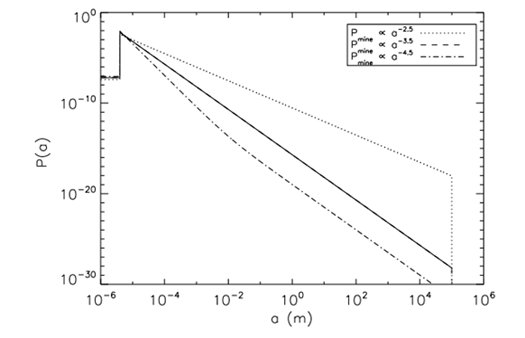
Extrasolar mining should produce three types of signatures that we can detect from Earth, Forgan and Elvis write in their paper. First, we know that debris belts contain certain ratios of elements, and using spectroscopy we could spot rings in other systems where those ratios are off. Second, it makes sense that we (and any other civilization) would mine large asteroids first rather than small ones, so we could monitor debris rings for artificial drops in the number of large rocks (also doable from earth).

Thirdly, all the dust kicked up by mining activities would absorb heat from the nearby star, generating an identifiable thermal signature. Find all three of these indicators in the same place, and you’ve probably got extrasolar mining going on and an intelligent race of beings to make contact with. Right?

Not exactly. Forgan and Elvis concede that all of these indicators can also occur naturally. So their asteroid-belt stress test for mining isn’t exactly a hard indicator of intelligent life. But, they say, monitoring for these telltale sings would help us flag solar systems that should get a second, harder look. And since planet hunting missions are already scanning the skies for some of these things, why not peruse the data for them?

Check out Forgan and Elvis’s paper here (PDF).

[Technology Review]

24 Comments

gotta keep an eye out for those shake n bake colonies =]

Well what if a rouge planet near the belt. Since the larger/more dense asteroids would be affected more by the gravity of the passing planet wouldn't that also seem like a 'quick' artificial drop?

The aliens are already mining the rings of Saturn.

A UFO book said that they were taking something from the antarctic ocean in the 50's.

I am not so sure a space-faring civilization capable of manipulating their environment at this level would necessarily be inclined to be so visible. That is, they might intentionally suppress such signatures to for the very simple reason that it would be like a neon sign visible for thousands of light years saying 'here we are, look what we can do'.

I'd like to point out that if we are seeing clouds from aliens mining asteroids then that means that this was done probably 100+ years ago and that at this point they have probably already traveled at the speed of light. I don't know where i'm going with this post I just wanted to point this out which is entirely possible, which you can choose whether to believe or not.

This is brilliant! As long as the possibilities are narrowed but not ignored this is excellent. Of course QuantumLeaper is right, without some 'warp drive' this is all archaeology but...wow.

The upside is that any civilization that does not/did not suppress its signature (of this type) might also have been at a stage where they did not or could not completely suppress their EM signature, to answer the point by aharkavy. The window of detectability might be very short as has been pointed out about gross EM emissions.

Unless some FTL solution exists AND some kind of camouflage/jamming can be applied retroactively, then this could be a good way to spot our "neighbors" in the kilo-parsec sense. If we have any. Interesting times, eh?

Actually...we would be reading the light/heat signatures directly. The light we receive here on earth may be as old as the star is far, but if we are magnifying the refraction of light on the asteroid belts, that image is current. The light from the foreign star is highlighting debris in the belt.

At least, that's how I understood it. I'm probably horribly wrong. Regardless. Any civilization capable of mining an Asteroid belt wouldn't likely leave their home system for several millenia...for sentimental reasons if nothing else.

Yes, both the Protoss and Zerg have been mining on asteroids.

I think what bothers me here is that we are assuming that other intelligent life will be as incapable of recycling resources as we are, and also as destructive at mining.

I just wonder why would we wait for that : "The idea is that at some point, our home planet will run short of natural resources, and when that happens we will have to tap asteroids for sources of metals and other materials that will enable future economies and technologies."

Why not doing this BEFORE we have no more resources... when we won't have resources anymore we won't be able to reach the rocks.

Actually, the less consumptive and destructive the species, the slower it would need to expand and innovate, and thus, the greater time it would take to reach technological hights.

On the other hand, a species that is too consumptive would like "burn out" before reaching the level of exploiting non-planetary resources. So, there is a necessesary balance.

Of course, the current search for "noise" is still likely the best course to take, since, looking at our own society, nothing is as far reaching in space as the wave level radio noise we have been expelling for decades.

I am not convinced, however, that there would be waste dust. There is in current mining practices where we take what is useful and leave the rest. Space mining is more likely to be a "take what is there" and make it useful (remember, in space, any matter is potential thrust - mass and velosity).

@Cylinder
We make the assumption that other life forms would be as bad at recycling as we are and need to mine asteroids because if it's not true then we wouldn't know what to look for. It's much like the assumption that life on other planets requires water; on our planet life requires water and we don't have another lowest common denominator to search for. Experience creates knowledge and to the best of our knowledge life needs water and advanced civilizations run out of resources.

ShaydeStar, you are correct, in that you are incorrect. Those "readings" would not be direct, light is the fastest currently known speed, any heat detection would required that signature to travel to our recievers. Now **IF** we had a laser thermo detector, we would need to point it at where we want to measure, then wait for the response, which would take double the time. Half the time is to send the laser out, the second half would be the wait for changes to come back to our detection unit.

Now, we do *NOT* have a laser that powerful, not yet anyway. So whatever detection method (prob color shift as with just about all other temp observations) we use, it will only be as fast as light itself, so if the belt we are checking out is 100 million light years away, our readings would be 100 million years old.

Alpha Centauri is our closest neighbor with 7 planets as of right now, and that's only 4.24 light years away and it's still FAR out of our reach right now.
Personally, we need to focus on our own back yard right now and worry about the neighbors later. We are like todlers looking out their back doors at the yard, and unable to climb the stairs to go explore it. Yet we have our eyes on the next door neighbors and those across the street who don't give a hoot about the little baby looking out the back door.

We need to grow first, get our back yard fully explored before we go looking to invite over the neighbors.
It's great to look, but spending all this time and money into looking just to look, if that money was spent into getting us off the door sill and out, we might be able to find a bit more, a bit faster than we are right now.

"but spending all this time and money into looking just to look, if that money was spent into getting us off the door sill and out, we might be able to find a bit more, a bit faster than we are right now."

I tend to think observation is key. The more we know about the universe and it's possible inhabitants, the better off we are when it comes time to meet them. Having the upper hand is ALWAYS beneficial. Perusing the data collected by telescopes is actually a relatively(in the world of science) low cost endeavor, as the same data can be used by many different studies. Now smashing tiny particles together to see what happens, that's expensive. In the end though, who doesn't love a good explosion?

Why is it assumed that any other life we find in the universe will be "more advanced" than us? What if they are more primitive?

Of course, this is also assuming that there will only be two ways another civilization could live: smarter than us or dumber than us. What if they're, you know, just *different*?

What assures us that ETs will have morals and not control the population of their particular planet?

With population control one would reduce the need to mine deposits in outer space- and actually build a sustainable population for that plant.

In Peter F Hamilton books, he suggests that once mined, the hollowed out asteroids could be used as habitats. They could even be turned into spaceships.

I guess we're not intelligent, then, because we haven't started mining our OWN asteroid belt. Of course, perhaps that's why there are no alien spacecraft in our skies right now - they're using our own technique, and we're invisible!

Ken Mitchell
Citrus Heights, CA

@chiefsteward
You have a good point that hollowed out asteroids couldn't be detected this way, but in most of the Peter F. Hamilton books that do this, they move the asteroids into orbit around their home planets prior to mining/habitating them. That we could detect.

I agre with Oakspar77777 that space mining doesn't mean that there will be more dust due to asteroid mining.

But full scale asteroid mining and interplanetary transport would meant the large scale use of ion-drives or similar. Would this leave a signature of a significant increase of ions that could be detected?

Not only do we fail the intelligence test, but we have no hope of ever passing it, thanks to the UN treaty which recognizes outer space and everything in it as "the Common Heritage of All Mankind."

The profit motive, which has fueled every advance in the history of mankind has been removed.

Sure, mining the asteroids is great stuff, but when the landowner is the UN and profits are outlawed, who is going to do it? Where does the capital come from?

@CurlyDave
Your interpretation of international space law is a tad flawed.
The "Common Heritage of All Mankind" objective is to stop nations claiming sovereignty over the moon or other bodies in space. It has nothing to do with preventing profits from mining. It certinly doesn't claim ownership of space to the UN.

But you are right in one thing. You did fail the intelligence test.

This is pointless...can't they spend our tax dollars on something worthwhile?

"Let's look at asteroids, cause in the future we will be mining there"

What kind of logic is that...advanced aliens won't have to mine asteroids becuase they will be able to thrive on what's on their own planet. Why do we always put our backwards personalities in the aliens body?

P.S there's nothing E.T's would want with the backwards population of earth, we can't even live together in peace, yet we want to be included in the galactic fraternaty?? NASA here's a hint...get your government to stop killing innocent people, feed the poor, educate the ignorant (evil-outionists)and when we have 100 years of peace...maybe just maybe we will be contacted.

@Aldron

Pretty sure you missed the point.


June 2013: American Energy Independence

Five amazing, clean technologies that will set us free, in this month's energy-focused issue. Also: how to build a better bomb detector, the robotic toys that are raising your children, a human catapult, the world's smallest arcade, and much more.


Online Content Director: Suzanne LaBarre | Email
Senior Editor: Paul Adams | Email
Associate Editor: Dan Nosowitz | Email
Assistant Editor: Colin Lecher | Email
Assistant Editor: Rose Pastore | Email

Contributing Writers:
Rebecca Boyle | Email
Kelsey D. Atherton | Email
Francie Diep | Email
Shaunacy Ferro | Email

circ-top-header.gif
circ-cover.gif
bmxmag-ps