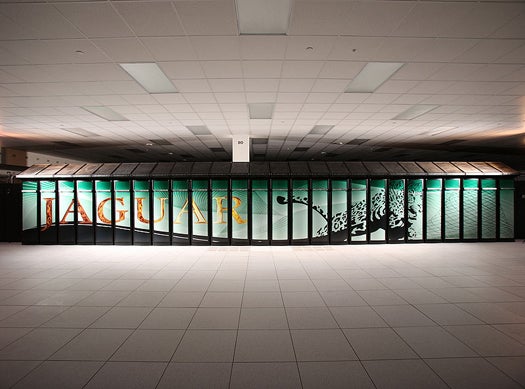
ORNL's Petascale Jaguar Supercomputer The petascale Jaguar is the nation's fastest computer, but the DOE wants to take computing to the next level.

“Better, stronger, faster,” seems to be the mantra over at DARPA, so why wouldn’t the Pentagon’s innovative R&D wing demand the baddest, fastest computers in the world? Under the umbrella of its Ubiquitous High Performance Computing (UHPC) program, DARPA is looking to develop computers that make the prefix “peta” seem lame by comparison: a platform that can carry out one quintillion (1,000,000,000,000,000,000) calculations per second. The exaflop era is upon us.

In DARPA’s own words: “To meet the relentlessly increasing demands for greater performance, higher energy efficiency, ease of programmability, system dependability, and security, revolutionary new research, development, and design will be essential to enable new generations of advanced DoD computing system capabilities and new classes of computer applications. Current evolutionary approaches to progress in computer designs are inadequate.”

The inadequacies of current designs are the same ones computer scientists the world over are trying to overcome, namely the fact that cramming more and more transistors onto a chip won’t keep computing in line with Moore’s law forever. Also problematic: faster clock speeds means more power consumption (and ostensibly more heat). To go beyond the petaflop, we’ll need to think outside our current server boxes.

To achieve such mind-numbing speeds, DARPA suggests developers get to work improving pretty much every aspect of computing (perhaps that’s why it’s called the Omnipresent High Performance Computing (OHPC) initiative), including hardware, software, processing algorithms, programming language, and power management. That last item is going to be key for computers that will run at such speeds, as one quintillion calculations per second can be expected to suck up some serious juice.

DARPA wants its UHPC systems (and its OHPC exaflop computers) by 2018.

[FedBizOpps via Network World]

11 Comments

Hopefully they will uses one od the new technologies like the nanocarbon chips, memresistors, or some kind of quantom dot elemennt. If they can start using these things for huge research teams then mabey they can trickle down to us.

How many exaflops does SkyNet need to run without freezing up?

Computations and logic can predict the final possibility of a result, but humans can still make the final choice in our actions. Often the odds will be against achieving a certain result, but we humans continue to persist to follow our hearts and continue forward against the computational impossible.
I fear in the future if we allow computers to run the world, the computers will find the humans inefficient and impractical for life on earth and conclude we humans a hazard deemed unnecessary.

mbrd7106/24/10 at 11:01 am
How many exaflops does SkyNet need to run without freezing up?

Dosent mater as long as the Matrix keeps running, our bodies should be able to repower the system to reboot skynet.

How much pornography is in an exaflop?

The problem is moving data around fast enough. Most of the complexity of todays computer chips is due to this. Solve this problem and chips will be simpler, faster and consume less energy. Which also means modules will be smaller and can be packed closer together which will make them faster.

They need to figure out how to build a vat computer, where all the computational centers are interconnected by the gel or liquid suspending them, and the inputs/outputs are electrochemically connected to the suspension medium's container.

An exaflop is a speed, not a space.

What if Skynet was just a part of the Matrix... so we'd be battling Terminators... in our heads?
That would suck.

juicekup you got a point there
but they could allways just put a bunch of thermoclouples on the radiotrs to get some more power if they wanted

one day, we will look back on that day so long ago, when 16 centillion was the highest named number...what crude fools we were.

Quinquagintaquadringentilliard


138 years of Popular Science at your fingertips.

Innovation Challenges


Popular Science+ For iPad

Each issue has been completely reimagined for your iPad. See our amazing new vision for magazines that goes far beyond the printed page


Download Our App

Stay up to date on the latest news of the future of science and technology from your iPhone or Android phone with full articles, images and offline viewing


Follow Us On Twitter

Featuring every article from the magazine and website, plus links from around the Web. Also see our PopSci DIY feed


February 2012: The Future of Fun

Science is reinventing play, from extreme sports to gamification to ridiculous roller coasters to the playgrounds of tomorrow, and this issue is chock full of fun. Also, on a less fun note: Did global warming destroy my hometown?


circ-top-header.gif
circ-cover.gif
bmxmag-ps