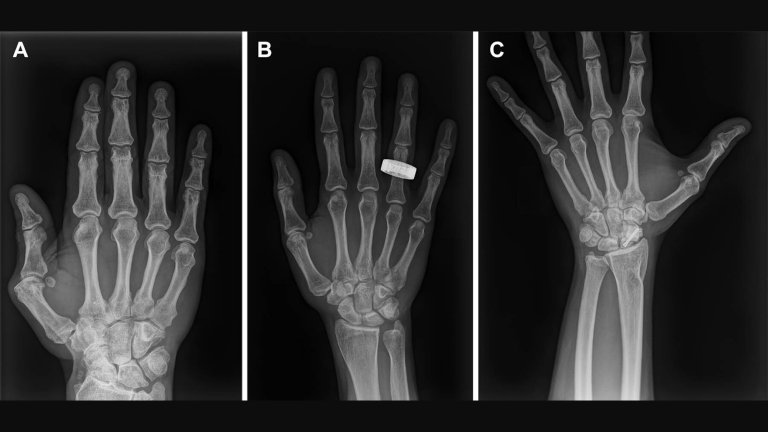
Like many pieces of modern medical equipment, X-ray machines are as bulky and energy dependent as they are vital. Even "portable" X-ray machines remain too heavy to carry across rough terrain, and too energy hungry to run off batteries. That's why Radius Health's portable, low energy X-ray machine may revolutionize medicine in disaster zones, on the front lines, and at patients homes. By using pyroelectric crystals as an X-ray source, Radius Health has created a machine small enough to fit in a suitcase, light enough to deploy anywhere, and energy efficient enough to run on a laptop battery.

Additionally, by using an array of crystal points, instead of the single, large X-ray source used in conventional machines, the Radius Health device can produce a usable image with a far lower dose of radiation. Not only does the lower dose mean less energy use, but it also makes the machine suitable for use on small children.
Radius Health expects to complete their first X-ray scanner in a couple of months, with a full-on prototype following by the end of the year. That should give aid workers working in disaster zones, medics on the battlefield, and the increasing number of doctors that make house calls just enough time to get the larger doctor bags needed to carry this time, money, and life saving innovation.
Five amazing, clean technologies that will set us free, in this month's energy-focused issue. Also: how to build a better bomb detector, the robotic toys that are raising your children, a human catapult, the world's smallest arcade, and much more.


Online Content Director: Suzanne LaBarre | Email
Senior Editor: Paul Adams | Email
Associate Editor: Dan Nosowitz | Email
Assistant Editor: Colin Lecher | Email
Assistant Editor: Rose Pastore | Email
Contributing Writers:
Rebecca Boyle | Email
Kelsey D. Atherton | Email
Francie Diep | Email
Shaunacy Ferro | Email
Would this work in reverse? Can these pyroelectric crystals detect x-rays, too? An x-ray emitter / detector pair could do line of site scan with real high resolution.
I wonder if this could be used to create a new type of TV based on this technology and older CRT technology that is energy efficient. It probably wouldn't be as efficient as a LED/LCD TV, but could be worth a shot just to see if it could work.
If the response time on these things is fast enough (and with a suitable detector), you might be able to make a phased array emitter/detector pair capable of creating 3D X-ray images. This would also be useful for non-destructive inspection of metallic objects such as engine parts.
Possible lighter, less expensive(?) X-Ray emitter. Lower dose, No. No photons go to waste in present X-Ray tubes, the receptor sensitivity determines dose. However since present detectors cost tens of thousands of dollars and are large arrays of detector "pixels", and present X-Ray tubes cost less than tens of thousands, cost savings may not initially be to be had.
Would love to hear differently since I sell a lot of X-Ray tubes.
marry this tech with the next gen of microelectronics and and sub systems and wala, Star Trek!