
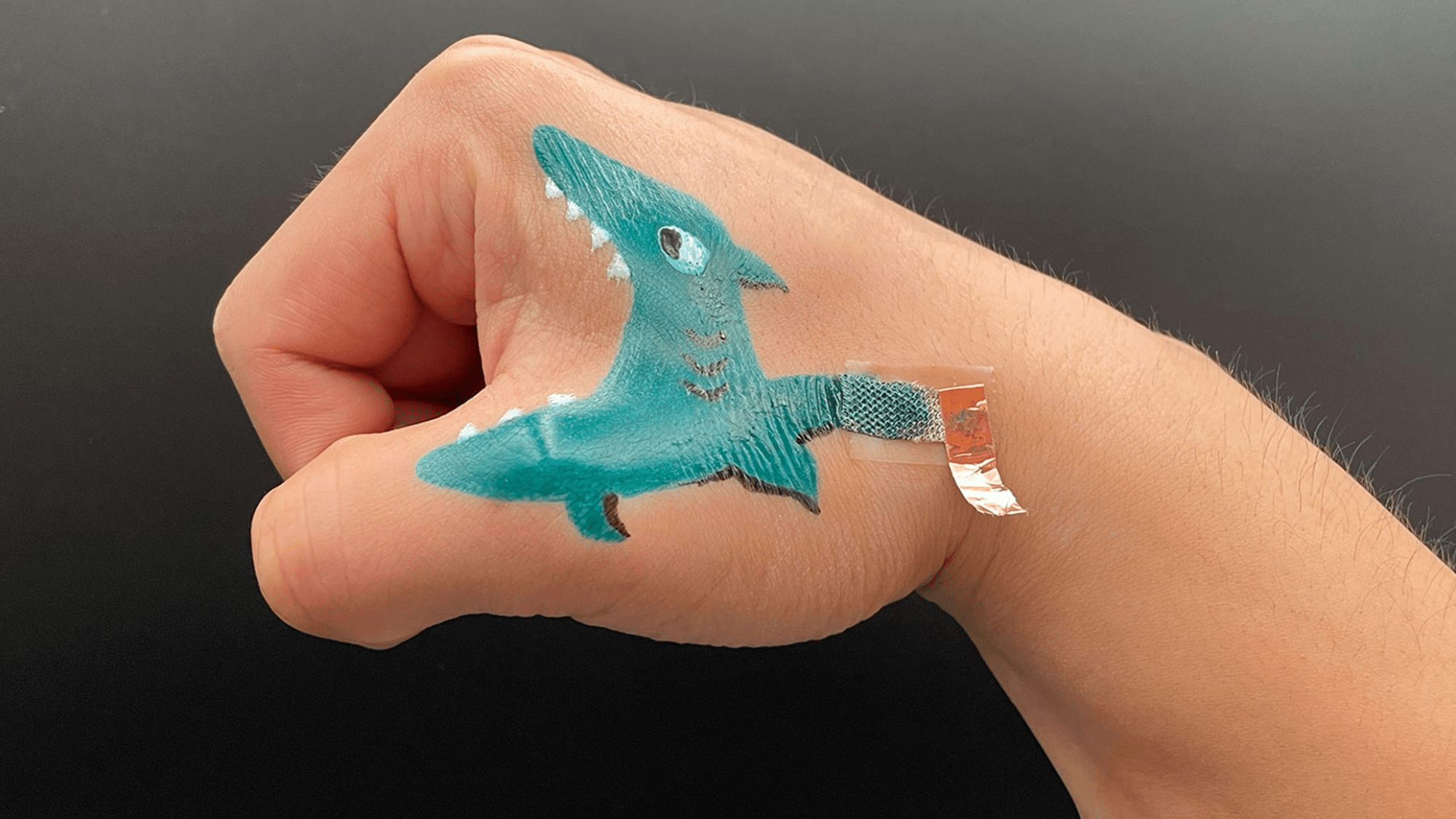
Picture it. A colorful tattoo tiger, shark, or rainbow that can read your brain waves, power robotic prosthetics, and even spot heart attacks earlier. Engineers at Penn State University filed a provisional patent for these colorful and customizable wearables that can be painted directly onto a patient’s skin. In addition to using all the colors of the rainbow, the sensors use materials that bond better with the skin, making them more sensitive, durable, and accurate. The stylish sensors are described in a study published today in the journal Proceedings of the National Academy of Sciences (PNAS).

Hand shark sensor
Improving wearables
All wearable healthcare technologies are powered by electrode contacts attached to the body. These electrodes can then interpret the health and activity of a patient’s heart, muscles, or brain by recording the different electrical signals produced by the body. Brain signals are processed into EEG readings, which mirror the activity in a patient’s neurons. Heart activity is processed into ECG signals, allowing physicians to measure a patient’s heart rate when exercising and record a detailed view of the heart’s electrical activity to monitor for issues. Muscle activity can be processed into EMG signals, which can track muscle contractions.
Electrode designs generally use rigid, metal-based materials. While these materials offer stability, they often struggle to stay attached to the body when a patient is moving. Many experimental designs use a soft, jelly-like material called hydrogel, which can absorb and swell with water. This helps them stretch and better match the body’s movement, but it can dehydrate over time. The electrodes then lose adhesion and stretchiness.
According to PhD student and study co-author Wanqing Zhang, the electrodes peeling off is not the only factor that contributes to less accurate sensor readings. The actual act of applying the sensors can affect how they work. Many commercially available sensors also have difficulty accurately recording what is going on inside of a patient’s body, especially when they are applied to hairy or sweaty skin.
“Most commercial electrodes are prefabricated in a lab or factory and then layered on the skin, meaning there is an air gap between the skin and the electrode, which negatively impacts sensing performance,” Zhang explained in a statement. “To address this, we’ve developed conductive ink that can be painted directly to the skin. After drying, it acts as a functional electrode.”
More than just fun colors
To create these new sensors, the team mixed several different types of polymers (or plastics) with acidic additives into a water-based solution to create the colorful ink. The new ink has the consistency of glue when it is wet, but can dry onto the skin in less than 10 minutes. The drying process can even be accelerated with the help of a regular hair dryer.
“The ink itself almost behaves like face paint,” study co-author Larry Cheng explained. “It starts out almost transparent, but you can use food dye to pigment the ink into whatever colors you need to paint whatever design you have in mind—like a cartoon or Superman. This allows us to completely personalize the wearable to a person’s preference.”
In addition to being fully customizable to whatever the patient can envision, the team says that the sensors powered by their electrodes are extremely responsive. Zhang explained that painting the material directly onto the skin helps it conform more closely to the skin’s texture, and in turn, improve measurements.
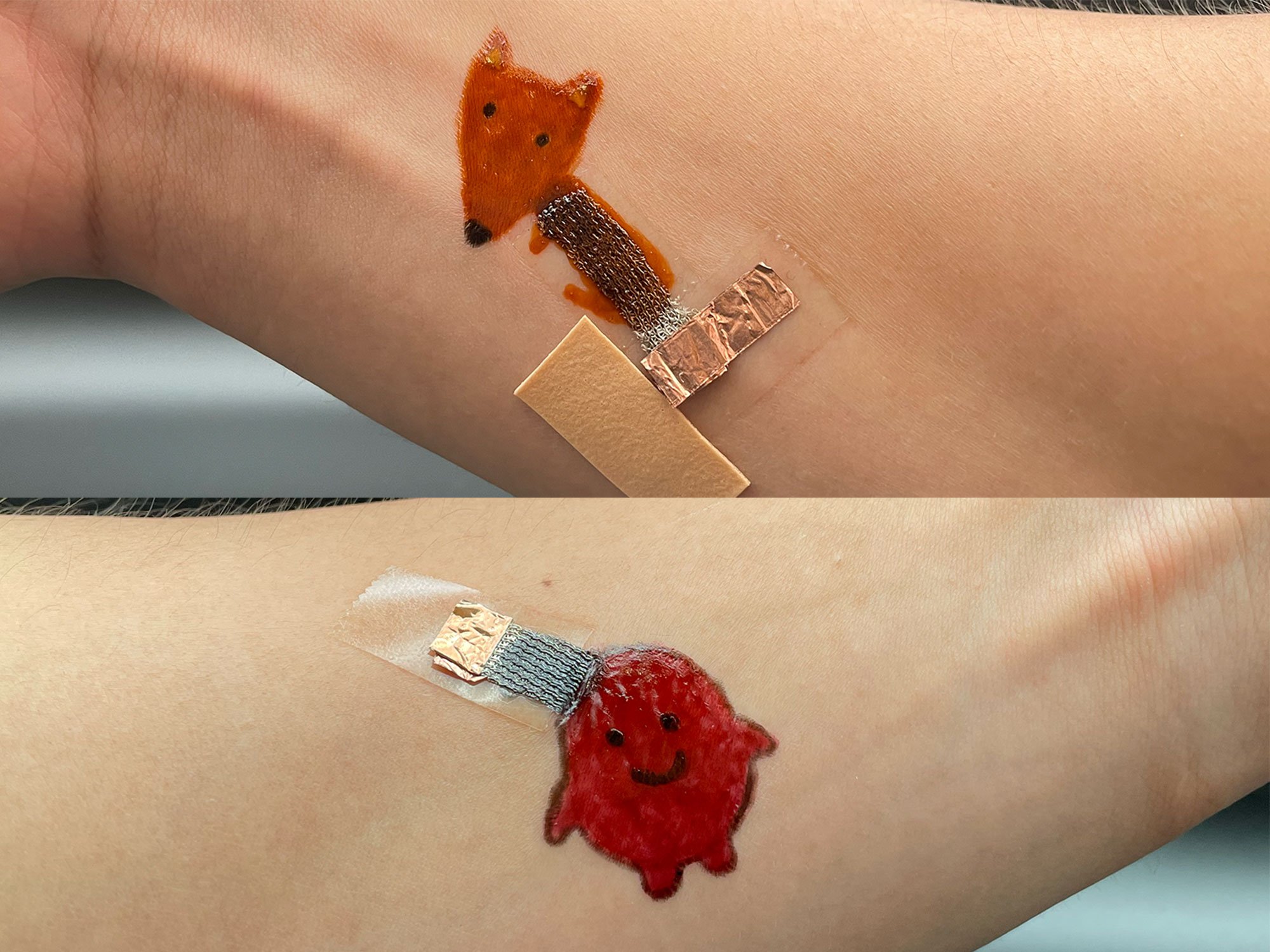
To enhance the stability between the electrodes and the sensors that they inform, a connective region of the electrodes is painted onto a porous, silver textile (somewhat like a metal fabric) placed onto the skin. The wet ink then flows into the textile, before hardening and sticking to the surface of the skin. That connective portion is then clipped into a port on the larger electric module. The electric component is taped on the wearer’s skin underneath their clothing, and wirelessly transmits the electrical signals collected by the ink to a computer via Bluetooth.
The textile’s porous structure allows the electrodes to stretch to over 150 percent of their original size without breaking, according to the study. At the same time, it helps them more uniformly adhere to the skin’s texture and record electrical signals more effectively.
“Over multiple days with other materials, sweat and moisture will accumulate on the electrode interface, potentially causing irritation or disconnection from the skin,” Cheng said. “By using a porous structure, we can allow moisture or hair to better pass through the material, making the electrodes more conductive, adhesive and comfortable.”
Getting inked
In one experiment, the painted electrodes could effectively track the ECG readings during a test subject’s daily activities over the course of 12 hours. During another test, a different subject tracked their readings while exercising, showing that the electrodes maintain their adhesion and accuracy even during physical activity. The team also tracked EMG signals of a subject’s forearm and fed them to a robotic prosthetic, allowing the individual to control the robotic hand without touching it.
“Although we tested the daily use application over a 12-hour period, this is not the limit for these electrodes,” Cheng said. “The electrodes themselves can be washed away and easily reapplied. The big idea behind this is that in the future, you could potentially have a more expensive sensing module that remains separate from the system, but the electrodes themselves can be disposable. A single bottle of ink could provide enough material to paint multiple electrodes over the course of several days or a week.”
The team plans to keep developing their electrodes so that they could one day be used to sense more advanced biomarkers, such as cortisol or glucose. The fun colors and design possibilities could also be particularly helpful for pediatricians, as going to the doctor is not exactly fun for most children.
