
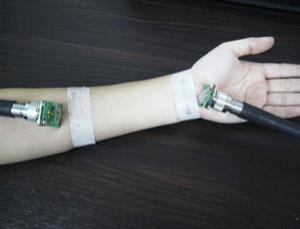
Human skin is apparently a very energy-efficient conduit for transmitting data. A recent experiment achieved a rate of 10 megabits per second, which may put my Internet connection to shame. The experiment used small, flexible electrodes and took place at Korea University in Seoul, New Scientist reports.
The finding may lead to a new generation of medical devices that can monitor blood sugar or electrical activity in the heart. Such devices cut energy needs for a monitoring network by about 90 percent compared to wireless devices running on batteries.
South Korean researchers placed electrodes about 12 inches (30 centimeters) apart on a person's arm, and found that the low-frequency electromagnetic waves travel easily through the skin without any outside interference.
The South Korean study improved on past attempts by using tiny metal electrodes coated with a silicon-rich polymer, which allowed the device to bend at a 90-degree angle 700,000 times without incident. Each electrode was just about the width of three human hairs.This may not seem all that surprising coming from South Korea, known as perhaps one of the most wired places on Earth for Internet. But we can't help but wonder if the researchers hadn't been watching some Battlestar Galactica goodness, given the tendency for a certain Cylon (played by Grace Park) to plug data cables into her arm for a bit of computer-on-computer consultation -- not that we're talking about brains communicating directly with devices just yet.
[via New Scientist]

Five amazing, clean technologies that will set us free, in this month's energy-focused issue. Also: how to build a better bomb detector, the robotic toys that are raising your children, a human catapult, the world's smallest arcade, and much more.


Online Content Director: Suzanne LaBarre | Email
Senior Editor: Paul Adams | Email
Associate Editor: Dan Nosowitz | Email
Assistant Editor: Colin Lecher | Email
Assistant Editor: Rose Pastore | Email
Contributing Writers:
Rebecca Boyle | Email
Kelsey D. Atherton | Email
Francie Diep | Email
Shaunacy Ferro | Email
I know it's sorta off topic, however... the internet is a series of cadaver filled tubes. Just thought I'd share.
mustard
so what is the plan, get all the koreans to hold hands to create the human network? pretty sure you would drop alot of packets, losing signal strength at each handlinkage.
now if the network consisted of a conga-line style orgy.. but how would that work unless someone's getting the ol' analprobe?
ooh ok read the story lol. internal devices networking with external devices via skin conductivity.. yeah korea good luck with that.. i guess bluetooth just didn't cut it. its all part of their plan to chip all their humans. no more losing your credit card, it's inside you. can't use your palmprint because you got your hands cut off for stealing? No worries, just touch your nub to the electrodes.
See, that's how the internet works in the "Matrix" movies.
Hmm, interesting concept. This sort of wireless, plugless interface could let people connect their portable devices together just by touch, instead of mucking around with cables. Need to transfer data from your PC to a flash drive? Just touch the drive, touch the electrode on your mouse/keyboard, and let the data flow through you. No more searching for USB ports. And when/if cybernetic implants ever become a reality, such a system might be easier to live with than surgically implanted ports.
I can see downsides, though. Just what would using your body as an electrical conductor, on a regular basis, do to your nervous system? There was recently an article discussing electro-hypersensitivity. If it exists, could this sort of activity bring it on?
I fail to see why this matters.
The skin-effect has been documented for hundreds of years.
High frequency current doesn't enter the body, it dances along the surface.
I suppose the Koreans will discover gravity by next year.
Little issue with medical device application here. Most of biomedical sensing on the body is done through amplification of very low voltage currents that run at various frequencies under 120Hz. This application will cause a dramatic interference with most of sensing systems. It might be possible to say upload a monitoring data from an implanted pace maker, but using it to network sensors on a body would be difficult.
Awesome!
I get it. We could all hire a guy to stand between our computer and our telephone connection, with those things clipped to his arm. Or maybe just get the kid to do it.
Someday we will find that nature invented a natural internet. That we lost the use of
I fear that North Korea may be watching. What a cheep way to make internet conduit. Just use the skin of the people working in Ilk's prison camps after they get too old to work, or for punishment. Shades of Hitler's lamp shades.
If they start charging for internet use, will it cost an arm and a leg?
This seems like one of those pointless yet intriguing scientific research projects that was only conducted for the press coverage. I mean seriously, what’s the practical application of this? If there is a broadband connection near my hand what possible need might I have for extending it up to my shoulder? I was going to express my disappointment at a fine journal such as yours perpetrating such claptrap but then you mentioned Grace Park. I can’t stay mad once I think of her. Mmmmm cylon babes....
www.broadband-expert.co.uk
It's always easy to dismiss stories like this, being we're already starting to see some 'real world' uses for this type of technology.
Here in the UK, Queen’s University in Belfast are working on similar technology with aim to improving and boosting mobile broadband signal strength.
These human sensors would interact with each other and provide mobile network connectivity when in range of other devices connected to the network.
As an example, the researchers said that if you were with a friend at a gig and wanted to stream the performance to them while they went to the bar, the video would be passed across the handsets of other concert goers at the venue.
www.mobilebroadband.net/news/human-networks-mobile-broadband-boost