
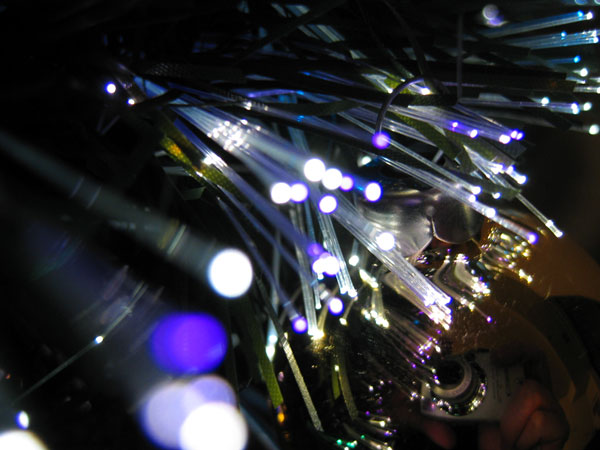
Fiber Optic Cables rpongsaj (CC licensed)

If it were up to us, everything would be faster by at least one order of magnitude, but the laws of physics often get in the way of unlimited speed and efficiency. Take fiber optic data transfer: the pulses of light carrying data through the worldwide network of fiber optics move really fast, but alas, cannot go any faster than they do. However, scientists at Cornell University have figured out a way to pack more data into those pulses of light, using a system they're calling a "time telescope," which has the potential to increase fiber optic data speeds by 27 times.

The "time telescope" works by passing the data-laden pulses of light through two "time lenses." A silicon waveguide combines a passing light pulse with another infrared laser pulse that vibrates the atoms of the waveguide, in turn shifting the frequencies of the pulse before it exits the waveguide. The front of the wave pulse is shifted down in frequency, the back end shifted up. The result: the front slows, the rear speeds up, and the light pulse crushes together like a soda can that's been stepped on, with the rear catching up to the front right at the lens's focal point.

In the Cornell team's test, they frequency-shifted a pulse carrying 24 bits of data. A second time lens at the end of the telescope then converted the compressed pulse back to its original state. But the second lens is stronger, creating a 24-bit pulse that is 1/27th as long as the original, shrinking the pulse duration to 92 picoseconds from 2.5 nanoseconds.

While all that sounds somewhat technical, the technology is essentially a simple telescope applied to fiber optic signals, but its potential is vast. If "time telescopes" were deployed across the optical networks that connect the entire globe, we could achieve data rates that dwarf the broadband we enjoy today. Using the same wavelength channels we are using now, we could pack 27 times more information with a decompression lag at the receiving end of only one millisecond. Even Ted Stevens won't be able to complain about the pipes getting clogged at those speeds.

[via New Scientist]

Want to learn more about breakthroughs in electronics, medicine, nanotech, and more?
Subscribe to Popular Science today, for less than $1 per issue!

8 Comments

Cool. Now i can download movies fast.

Not illegally of course...

Imagine downloading movies and entire libraries of music in less time than it takes to wait for water to boil. That would be extremely awesome.

Then again, the rest of the world would probably see that technology and the faster speeds except for America. Where the telcom giants charge $100+ for 5-10 Mbps. Why? Because they can and because they know Americans will pay for it.

The FCC and the rest of the government needs to start intervening for the consumers' sake because we are getting the short end of the stick compared to everyone else in the world. They need to draw a line in the ground and force these companies looking to gouge American consumers for every nickel and dime.

The FCC can bite my shiny metal ass. They should never have existed. It is government intervention that does not allow the market economy to work. Value is determined by what one will pay for it, not by what one would like to pay for it.

Full sensory VR online experiences. :)

I dream of the day and stuff like this helps it get that much closer.

The market economy is based on competition, right now there isn't any. So yes, the FCC does need to intervene. How many cable companies do you have the ability to choose from in your area? I only have 2 Verizon and Comcast.

Now, if they can get this into mass use, they just have to have a cheap service for everyone to use it. Good luck with that.

In The Netherlands you get 120 Mbps for 70 euros.

It would great benefit for astrophysics if someone somehow replace slow computers which delivers us photos from deep space ,one per day , so this ultra speed ftth can be used for good of mankind in real ;))


June 2013: American Energy Independence

Five amazing, clean technologies that will set us free, in this month's energy-focused issue. Also: how to build a better bomb detector, the robotic toys that are raising your children, a human catapult, the world's smallest arcade, and much more.


Online Content Director: Suzanne LaBarre | Email
Senior Editor: Paul Adams | Email
Associate Editor: Dan Nosowitz | Email
Assistant Editor: Colin Lecher | Email
Assistant Editor: Rose Pastore | Email

Contributing Writers:

Kelsey D. Atherton | Email
Francie Diep | Email
Shaunacy Ferro | Email

circ-top-header.gif
circ-cover.gif