
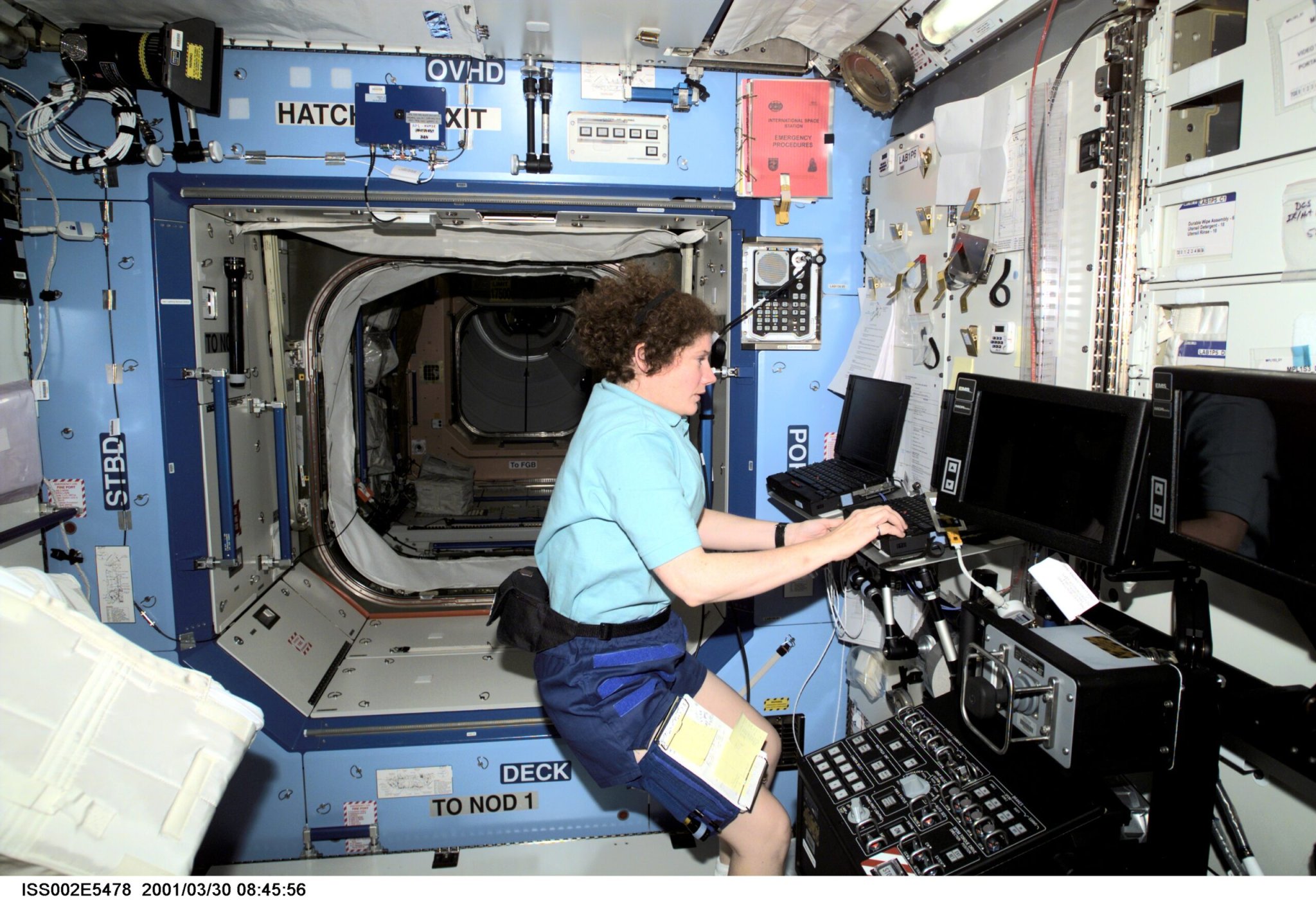
Despite it being in many ways a marvel of modern technology, the International Space Station can't keep up with even the simplest modern cellphone in terms of data communication with Earth. Disruption-Tolerant Networking, a new protocol for transmitting data in space being developed jointly by NASA, Google's "Chief Internet Evangelist" and others, hopes to change that.
Now, spacecraft like the ISS communicate with Earth over a single point-to-point connection using a transmitter that is essentially a souped-up walkie-talkie. Data transmissions must be carefully scheduled to coincide with periods where both the ISS and a receiving station are in range for long enough to complete the exchange.
Disruption-Tolerant Networking (DTN), however, would link spaceships and ground facilities in a mesh network of sorts, sending information in bundles which can be transmitted intermittently. That way, rather than maintain a constant connection, packets of info can be beamed down, or up, and stored for use later. This allows for the bundles to be transmitted partially when connections are tenuous, and then easily resumed by another node in the network. The bundles can be relayed along satellites, future habitats set up on the moon or other planets, or even astronauts own personal communcations gear.
The Internet is currently not set up in a way to would be feasible for space-based environments, where interrupted connections are common and communcations distance are measured by the hundreds of millions of miles. DTN's packet-based system could solve the problem of communication over such interstellar spaces. I can’t wait for my first article comment from Mars.

[PhysOrg]
Stay up to date on the latest news of the future of science and technology from your iPhone with full articles, images and offline viewing
Featuring every article from the magazine and website, plus links from around the Web. Also see our PopSci DIY feed
Share links with friends, comment on stories and more
In our December issue, Popular Science names the 100 best innovations of the year: bombproof wallpaper, self-parking cars, the fastest helicopter, and 97 more. Plus inventor profiles and videos.
Check out the best of what's new here.
from Winnipeg, Manitoba
Can't you Just relay information of the thousands of Satellites? Or is that Illegal?
We need Civilization to Get Into Space before "Some Government" Takes Control of The Celestial Wide Web with Ridiculous Laws like Disobeying FCC Rules. YOU CANT OWN SPACE, Ill Send out Protocols of Whatever Information I want In Whatever Efficient Engineering Language. Also, I may Decode any Waves of Information sent my way.
Ever think of Super Conducting Information? Or mabye its the Opposite i am thinking. Rather then Propel the Packets of Data, Have them Attracted to the source.
Lets hope an internet for space remains open as it is here on Earth instead of Government controlled.
Legality has something to do with the satellites, since you would have to either purchase bandwicth from the owners or coopt it in some way.
Mostly it's technology. The satellites are usually dirctional or semi-directional transmitters. Take DirecWay, the DirecTV satellite internet service. The transmitter on the satellite broadcasts it towards the ground, so as to avoid wasting radiated signal into space. It also listens for signals only from the segment of earth it's designated to cover. I'm not sure of the intended spread of the transmitter or receiver; it's conceivable that they could be able to be accessed from any viable line of sight from lower orbits or the earth's surface.
Since the satellites are geosynchronous, and the ISS is somewhere between LEO and a geosynchronous orbit, you could conceivably transmit/receive to a given satellite. You run into the same problem, however, as you do with the ground stations. The lower orbit moves you in and out of coverage from the satellite, same as you would for a ground station, albeit you could probably get a little more that half an orbit's view of one satellite.
The solution is probably something similar to the cell phone network, with satellites in geosynchronous orbit acting like a cell tower and executing handoffs without the specific knowledge of the spacecraft. The satellites would communicate with ground stations and maintain a constant link, and then communicate with the spacecraft whenever it's in range. The spacecraft would need an omnidirectional antennae in the simplest configuration, or a directional, self steering antenna that would automatically redirect to the next satellite as the handoff takes place.
Conceivably, you could use one or two ground stations and have the satellites relay signal to each other, but you'd get better bandwidth with more ground stations, since the satellites could draw from their local groundstation and not need to pipe it through one portal.
I could see how to build this, but it won't be cheap...