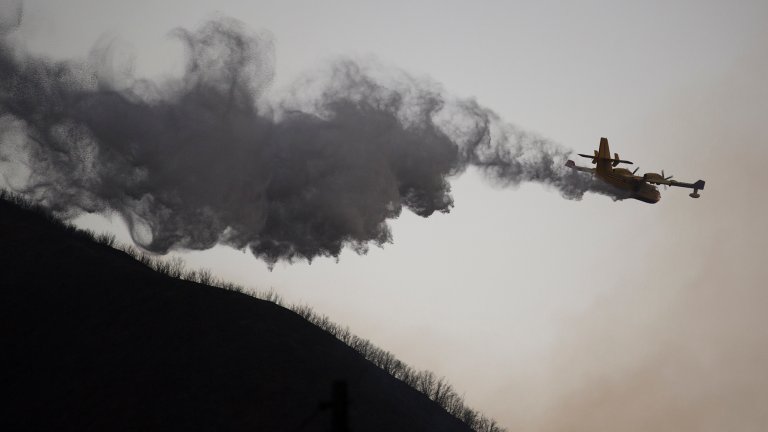
Wildfires Cost California $642 Million in Damages Last Year Gene Blevins/Reuters

As firemen prepare for wildfire season this summer, they will reach for their trusty Pulaski ax, the century-old tool used to hack ditches between flames and the rest of the forest. But they will have some new, high-tech help as well. Mini tree-mounted weather stations and airborne infrared sensors will provide the clearest picture yet of where fires are and where they're headed.

Traditionally, when trying to identify a blaze early and predict its next move, firefighters must wait for dial-up modems that deliver hours-old information. But wildfires feed off hot, dry air, and billowing winds generated within the fire can shift its direction in an instant. And with no way to monitor these conditions in real time, firefighters end up reacting to raging fires rather than putting them out before they spread.

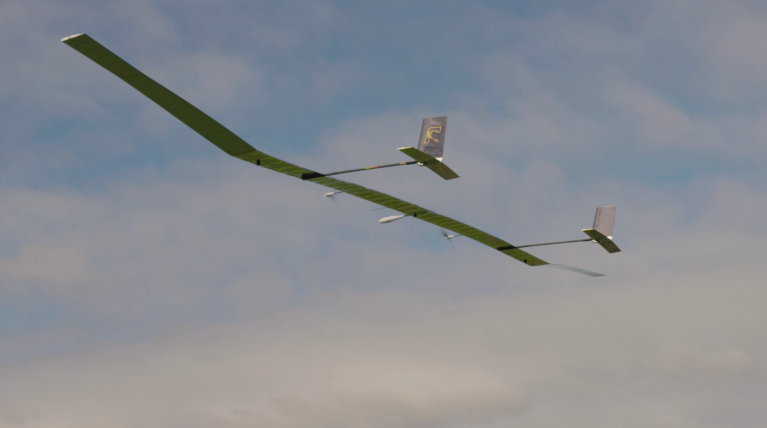
NASA's Unmanned Heat-sensing Aircraft:  NASA
Delayed information is especially dangerous in the Western states, where earlier snowmelt and longer dry seasons have driven a sixfold increase in scorched earth since 1970. Last year, fires wiped out 1.6 million acres in California and ran up $1.3 billion in suppression costs. "In the past, our philosophy was to put a line around every fire," says Tom Zimmerman, the program manager at the National Interagency Fire Center. "We have longer, larger, more intense fires now, and we don't have the resources to do that."

To help identify which spots to attack first, the Forest Service will have NASA's unmanned Ikhana aircraft and its infrared sensor on emergency standby for the first time this summer. Unlike imaging satellites, which can take hours to position and transmit photos, Ikhana can see through smoke and send live data to ground crews. Likewise, the Forest Service's planes, also loaded with infrared sensors, will beam fire managers real-time data and photos over Aircell, the wireless service used by airlines. Historically, pilots printed out bird's-eye images of fires, stuffed them in a tube, and dropped them to firefighters on the ground. Digging through these documents to find the hottest areas in the blaze, which should be put out first, could take up to eight hours. Now command centers can analyze the digital files immediately and send out response crews before things get out of hand.

Tree-mounted Weather Sensor: One of Smokey's new tools for keeping fire at bay  Courtesy of Christopher Huang
Better situational awareness is only the beginning. Knowing precisely which areas are at highest risk of fires could transform how we fight them. Voltree Power in Canton, Massachusetts, has developed a shoebox-size sensor that, planted one per acre, could gather microclimate information, such as spikes in temperature and drops in humidity, that signal a nascent fire. In April the Forest Service began field-testing the device, which can run for a decade on voltage generated from the pH imbalance between a tree and soil.

To help deal with the flood of new information, Zimmerman's team launched the Wildland Fire Decision Support System, an online tool that crunches data in real time, using fire behavior models and weather forecasts. The Forest Service and the National Park Service will use the program to determine whether to attack flames on foot or call in planes to dump fire-suppressant gel.

Even with technological advances in firefighting, perhaps the best way to minimize damage is to recognize that fires play a necessary role in restoring certain ecosystems, and so we should stop building in at-risk areas and use fire-retardant materials, says fire ecologist Max Mortiz of the University of California at Berkeley. Mortiz recently published data predicting that climate change will increase wildfire activity across much of the U.S. "We don't fight earthquakes and floods — we coexist with them," he says. "We need to learn to do the same with wildfires."

Want to learn more about breakthroughs in electronics, medicine, nanotech, and more?
Subscribe to Popular Science and enter to win $5,000!

2 Comments

Gizmag recently reported on a revolutionary modular fire fighting system. Called Precision Container Air Delivery System (PCADS), it's basically a way of packaging giant water balloons into cardboard containers. There are two main advantages: First, the modular nature of the system allows any military lifting vehicle (such as C130s) to fight fires, and second, the individual containers can be precision guided through GPS. The ability to use multiple planes all delivering fire suppressants accurately has the potential to vastly improve fire fighting world-wide.

A system similar to PCADS was tried many years ago. It is NOT revolutionary. It is rehashing a concept that did not work once and will not work again.
It does not work PERIOD
Unfortunately those in charge are a new generation with NO knowledge of the past and how we derived the methods in use today. PCADS is a waste of time and money.
We HAD the ability to use multiple planes delivering fire suppressants accurately. Unfortunately, Tony Kern shut us down in favor of using the miltary, at ten times the costs and 1/10 of the accuracy.
A private industry was sidelined whilst pie in the sky concepts such as the DC-10 and 747 were developed. Mark my words, Tanker 10 is a smoking hole in the ground looking for a place to happen.
As a current wildland fire pilot. I WILL NOT share the airspace over a fire with an unmaned aerial vehicle. It is already hazardous enough, add a UAV and once again, an accident looking for a place to happen.
Why not bring back the Douglasses? The DC-4's,6's & 7's were and still are one of the best retardent delivery systems available.
There is no substitute for getting one's hands dirty.


Download Our iPhone App

Stay up to date on the latest news of the future of science and technology from your iPhone with full articles, images and offline viewing


Follow Us On Twitter

Featuring every article from the magazine and website, plus links from around the Web. Also see our PopSci DIY feed


Become a Fan On Facebook

Share links with friends, comment on stories and more


December 2009: Best of What's New

In our December issue, Popular Science names the 100 best innovations of the year: bombproof wallpaper, self-parking cars, the fastest helicopter, and 97 more. Plus inventor profiles and videos.

Check out the best of what's new here.

Popular Science Photo Pool


Share your photos in the Pop Sci pool at www.flickr.com!
tags_sprite.png
POP_embeddedForm_cover_May09.jpg