Wind, solar, tidal—all are battling for the renewable-energy crown, but what about the six billion highly efficient short-stroke engines in our midst? What about us?

Whenever James is explaining his idea to people and he notices them scouting for the exits, he points out that human-powered rapid transit isn’t just some idea he thought up while waiting for the macaroni to boil. It actually has a long history, beginning a century ago when the bicycle “fad” produced various prototypes of suspended “bicycle railroad systems” that people could tool around on, mostly for fun. The thing about most of these human-power schemes is that they aren’t purely about human power. They depend on some kind of a leg up—be it from gravity, wind or electric power. When you start talking about mass adoption of human power, you have to face some hard truths about human psychology.

“I have a metric that I use,” says Mitchell Joachim, a professor at the Columbia Graduate School of Architecture and inventor of the still-in-progress Soft Car, a stackable supercompact urban vehicle powered by small electric motors in the wheels. “It’s the Homer Simpson metric. Homer is not going to use his body for anything. That’s the American value system in a nutshell. And that’s what we who are trying to design alternative transportation are fighting against. We’ve got to make something that’s clean, cheap and mechanically efficient without the individual feeling the physical consequences. That’s tough.”

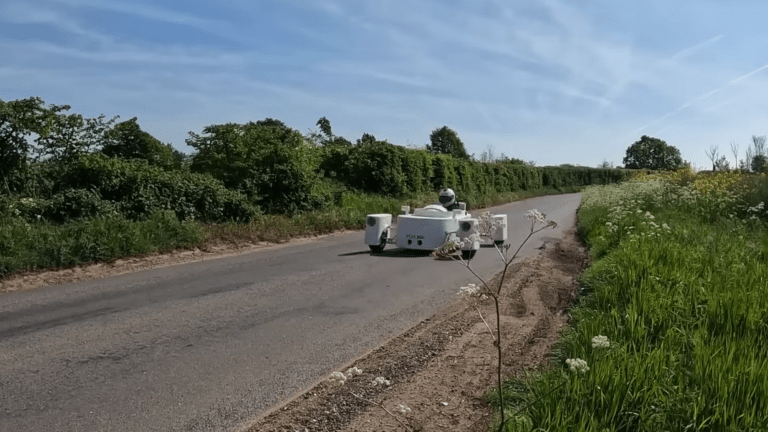
Even Whittingham, the world’s fastest man on two wheels, who has a heavy investment both professionally and psychologically in pure human power, sees the difficulty of getting people to choose it so long as there’s an option not to. “I notice the problem even in myself,” he says. “I’m pretty fit. I ride my bike a lot. I like riding my bike. And yet I still jump in the car. And as I get older, it happens more and more.”

MacCready so believed in his hybrid-electric bike the Charger that he sank into its development part of the small fortune he had made selling solar-powered surveillance drones to the U.S. military. “Paul lent me one for a race,” Chester Kyle recalls. “It was beautiful. The only problem was that nobody bought ’em. Why not? Because you can’t take 200 million people and sell them on the idea of using their bodies when they don’t strictly have to.”

Want to learn more about breakthroughs in electronics, medicine, nanotech, and more?
Subscribe to Popular Science and enter to win $5,000!

7 Comments

1) No multi-personal vehicle will ever be practicle, because we all have to travel alone from time to time. Even in a carpool, I have to make it to peddler #2's house alone.

2) People need to cary stuff. Groceries, babies, and work all need real cargo space. No "bike only" design will fit that need unless it has cargo space and the means to carry the extra weight.

3) It must be weather proof. People are not going to use anything if they must freeze, fry, or be soaked to do so.

4) People often want/need to go faster than 30mph. This requires extra power.

5) People are not that coordinated. Note the number of accidents on motorcycles. It needs to be very stable to be safe and easy to maneuver. Otherwise you are leaving more up to human error, and humans already make mistakes when all they have to do is steer.

If you want a human powered vehicle to be practicle for truely mass consumption, it would need to be enclose-able, fast, powered, and able to carry a passive passanger (the baby, grandma, this week's groceries, etc). Obviously, such a vehicle cannot be human powered alone.

More likely, an electric vehicle, with electric drive, augmented for range/recharging by consistant peddling (as well as solar trickle), where peddle-charging is augmented by passangers peddling as well, consistant (in no ways tied to speed which reduces overall work), and able to be plugged in (making it useful even for those without the time or athleticism for consistant charging).

OR

Something like an electric chargable moped. At slower speeds, human powered. At higher, electric. A switch to convert peddling to charging during electric run or to harness extra force (downhill charging).

If carbon is your goal, however, electric only vehicles and renewable sources are your only path. Leave human generation to things where the mass does so much that they do not realize that they are generating electricity (like the dancefloors and turntable doors).

The multi person powered car is kind of silly. The vellomobile doesn't have that problem.

I don't think these sorts of things can replace powered cars for the reasons oakspar mentioned, but they sure as heck can make a dent. Many of us don't need to go long distances or fast on daily commutes. A vehicle like these could fill this niche. It doesn't have to replace your car to be economical and save wear and tear on the powered vehicle and gas. As the article already noted, a huge dent could be taken out of our gas usage if people only used these vehicles once a week, and if people had brains, they'd realize, as the current economy demonstrates, that it's not just the difference from the cost saved from the current price at the gas station, but savings are realized from the lower gas prices that lower demand yeilds.

If these vehicles could carry a medium sized suitcase or a few bags of groceries, I'd say they have all the storage necessary for a commuter vehicle that supplements our normal powered cars.

The only argument I see against these kinds of vehicles is the saftey issue. Last I saw, riding a bike 10 miles has the same mortality rate as driving a car 300 miles. But that's not an unsolvable problem if we were willing to train drivers more rigorously like they do in some European countries and we were willing to take reasonable measures against drunk drivers... like tatooing their wrists so they couldn't buy drinks without a designated driver... or at all. (and yes, given the cost of their abused freedom, I'd say that is very reasonable and not cruel and unusual).

jamie1962a

from Front Royal, Virginia

Okay, I get that you're trying to make a point- but...

Are you really going to don all that gear, hop on a stationary bicycle, and start pedaling, while cranking a generator with one hand, and holding a solar-panel umbrella in the other (who needs handlebars, anyway?), just to run a desktop (which, I'm guessing is voice operated) or watch a 32" HD TV?

Not a sermon, just a thought...

The way I see it,one major obstacle to using pedal-powered vehicles for commuting is the sweat factor.Several people in my office commute to work on bikes,and as soon as they get to work,they head for the shower in the gym in the company basement.

Well, for Oakspar:

1) tandems already are practical and usable by one person. Human powered vehicles of 3 or more need some work yet.

2) velomobiles can "carry stuff". Lots of stuff. If you buy $200 worth of groceries, then no, human powered vehicles(HPVs) aren't going to work for you. A HPV can easily carry enough groceries for a couple days. If you own a HPV and use it for shopping, then you adjust your shopping habits and there is no problem.

3) velomobiles are water and weather proof and people ride them all over the world, in the winter time. They also have vents for the summer.

4) while people might want to go faster than 30mph all the time, it's often the case that they can't. In many cities, bicycles are faster from point to point than cars ever will be anymore, regardless of the speed limit. You don't need extra power either. Any rider can manage 30 mph with a velomobile too, it just takes areodynamics, not other power sources.

5) the average person has more than enough coordination to safely manage a velomobile. Stability is not an issue. Three wheels.

HPVs already are practical. They're safe, functional and effective. People don't want them because everything is push button, HPVs require effort. People don't want to expend effort unless they absolutely have to. HPVs don't need any other power than the human pedalling it. People functionally use HPVs for a daily vehicle all over the world. If you want to do it, you'll do it. If you don't want to do it, there are a million excuses not to.

The point is, it's about human powered vehicles, like the title of the article says. If you want to talk about electric, that is an entirely different set of criteria. The HPV solution is here and it's been here for over 100 years. The problem is between people's ears not the design of teh "bike".

TheBangTail

from Bay City, MI

I would love to know how I can get my hands such a wonderful bicycle. I ride my bicycle to work (6.7 miles) about three times a week in the summer months. During uncooperative weather, I ride my motorcycle or car (both cost me one grand).

With the bicycle my fastest trip was 25 minutes. My bike costs just under 300 dollars, the motorvehicles cost at most 1,000.

Can I get this wonderful bicycle anywhere for the price I bought my car and motorcycle for? The asking prices are absolutely ridiculous.

This looks cool - as a novelty only.

http://classicmusclecars.wordpress.com/classic-car-parts/


Download Our iPhone App

Stay up to date on the latest news of the future of science and technology from your iPhone with full articles, images and offline viewing


Follow Us On Twitter

Featuring every article from the magazine and website, plus links from around the Web. Also see our PopSci DIY feed


Become a Fan On Facebook

Share links with friends, comment on stories and more


December 2009: Best of What's New

In our December issue, Popular Science names the 100 best innovations of the year: bombproof wallpaper, self-parking cars, the fastest helicopter, and 97 more. Plus inventor profiles and videos.

Check out the best of what's new here.

Popular Science Photo Pool


Share your photos in the Pop Sci pool at www.flickr.com!
tags_sprite.png
POP_embeddedForm_cover_May09.jpg