Wind, solar, tidal—all are battling for the renewable-energy crown, but what about the six billion highly efficient short-stroke engines in our midst? What about us?

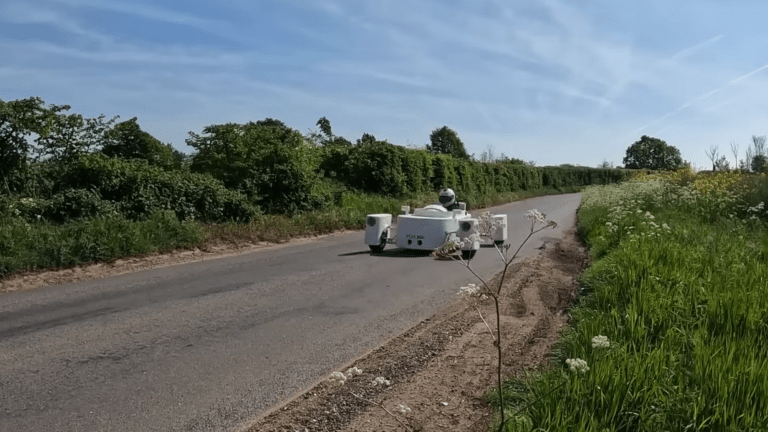
ROW YOUR CAR Charley Greenwood (right) and his son, Chuck, power-monkey the FM-4 HumanCar up to 40 mph on a hill near Cave Junction, Oregon. John B. Carnett

Cave Junction, Oregon, was once, long ago, the center of a gold rush boom that, like so many booms, ultimately consumed its host. Prospectors mined the land around the towns in an ever-tightening circle, until the only gold left was below the saloons, assayers and burlesque halls. Those fell next. The towns were mined right out from under themselves—with no trace left of the old frontier burgs but scars in the earth.

The people who trickled back, decades later, came to satisfy a different urge: not to pursue something but to escape it. Certain hardy members of the hippie diaspora of the ’60s realized that you could live out here entirely under the radar and off the grid. With no one to badger you, you could pursue your own idiosyncratic dreams. You could, in fact, quietly build your better mousetrap and wait until the right time to spring it on the world—the very moment when the world needed saving.

On a lonely stretch of blue highway near the treehouse he lives in and the workshop where he’s been refining that mousetrap, Charley Greenwood slips into the driver’s seat of the FM-4 HumanCar. Or rather, the seat the driver would occupy in a regular car. You don’t “drive” the HumanCar; you row it. It’s the pulling and pushing of the four passengers, converted by a four-gear transmission into rotational thrust, that powers the car at 25 or 30 mph easily, and up to 60 or so on a good downslope. (Where you go in the HumanCar is your business. But rest assured, it won’t be to the gym.)

Charley and I sit up front, his son (and HumanCar, Inc.’s CEO) Chuck in back—none of us so much in the car as on it, for the FM-4 is all bones, with no roof or sides or even fairings. It feels like a cross between a railway push car and a hospital bed. How do you steer a car that every passenger is busy rowing? By leaning in the direction of the turn, or “body steering,” which turns the front wheels. The riders in back don’t steer. They are simply, as Charley puts it, “power monkeys.” Charley grasps the handles the way you would ski poles. A mechanical engineer, he has the looks and manner of a professor but the hands of a laborer. Machine oil has turned his fingertips into blackened kielbasas.

A tiny part has gone missing from the car, preventing it from using all its gears, so we set it in third, which creates an inertia bear at the outset as we get the 300-pound vehicle moving. A kind of automated firing order distributes the torque like an engine as we heave on the oars in sequence—pop pop pop pop. The car picks up speed. And then it starts drifting lazily in the lane: my fault. The brute pull through the power zone and the finesse of the steering are too much for my brain. “There’s a learning curve, for sure,” Chuck says. “That’s why it’s not going to be something anyone can just buy and drive away in. People are going to have to get training, and you’re probably going to have to be licensed.”

single page
Want to learn more about breakthroughs in electronics, medicine, nanotech, and more?
Subscribe to Popular Science today, for less than $1 per issue!

9 Comments

1) No multi-personal vehicle will ever be practicle, because we all have to travel alone from time to time. Even in a carpool, I have to make it to peddler #2's house alone.

2) People need to cary stuff. Groceries, babies, and work all need real cargo space. No "bike only" design will fit that need unless it has cargo space and the means to carry the extra weight.

3) It must be weather proof. People are not going to use anything if they must freeze, fry, or be soaked to do so.

4) People often want/need to go faster than 30mph. This requires extra power.

5) People are not that coordinated. Note the number of accidents on motorcycles. It needs to be very stable to be safe and easy to maneuver. Otherwise you are leaving more up to human error, and humans already make mistakes when all they have to do is steer.

If you want a human powered vehicle to be practicle for truely mass consumption, it would need to be enclose-able, fast, powered, and able to carry a passive passanger (the baby, grandma, this week's groceries, etc). Obviously, such a vehicle cannot be human powered alone.

More likely, an electric vehicle, with electric drive, augmented for range/recharging by consistant peddling (as well as solar trickle), where peddle-charging is augmented by passangers peddling as well, consistant (in no ways tied to speed which reduces overall work), and able to be plugged in (making it useful even for those without the time or athleticism for consistant charging).

OR

Something like an electric chargable moped. At slower speeds, human powered. At higher, electric. A switch to convert peddling to charging during electric run or to harness extra force (downhill charging).

If carbon is your goal, however, electric only vehicles and renewable sources are your only path. Leave human generation to things where the mass does so much that they do not realize that they are generating electricity (like the dancefloors and turntable doors).

The multi person powered car is kind of silly. The vellomobile doesn't have that problem.

I don't think these sorts of things can replace powered cars for the reasons oakspar mentioned, but they sure as heck can make a dent. Many of us don't need to go long distances or fast on daily commutes. A vehicle like these could fill this niche. It doesn't have to replace your car to be economical and save wear and tear on the powered vehicle and gas. As the article already noted, a huge dent could be taken out of our gas usage if people only used these vehicles once a week, and if people had brains, they'd realize, as the current economy demonstrates, that it's not just the difference from the cost saved from the current price at the gas station, but savings are realized from the lower gas prices that lower demand yeilds.

If these vehicles could carry a medium sized suitcase or a few bags of groceries, I'd say they have all the storage necessary for a commuter vehicle that supplements our normal powered cars.

The only argument I see against these kinds of vehicles is the saftey issue. Last I saw, riding a bike 10 miles has the same mortality rate as driving a car 300 miles. But that's not an unsolvable problem if we were willing to train drivers more rigorously like they do in some European countries and we were willing to take reasonable measures against drunk drivers... like tatooing their wrists so they couldn't buy drinks without a designated driver... or at all. (and yes, given the cost of their abused freedom, I'd say that is very reasonable and not cruel and unusual).

Okay, I get that you're trying to make a point- but...

Are you really going to don all that gear, hop on a stationary bicycle, and start pedaling, while cranking a generator with one hand, and holding a solar-panel umbrella in the other (who needs handlebars, anyway?), just to run a desktop (which, I'm guessing is voice operated) or watch a 32" HD TV?

Not a sermon, just a thought...

The way I see it,one major obstacle to using pedal-powered vehicles for commuting is the sweat factor.Several people in my office commute to work on bikes,and as soon as they get to work,they head for the shower in the gym in the company basement.

Well, for Oakspar:

1) tandems already are practical and usable by one person. Human powered vehicles of 3 or more need some work yet.

2) velomobiles can "carry stuff". Lots of stuff. If you buy $200 worth of groceries, then no, human powered vehicles(HPVs) aren't going to work for you. A HPV can easily carry enough groceries for a couple days. If you own a HPV and use it for shopping, then you adjust your shopping habits and there is no problem.

3) velomobiles are water and weather proof and people ride them all over the world, in the winter time. They also have vents for the summer.

4) while people might want to go faster than 30mph all the time, it's often the case that they can't. In many cities, bicycles are faster from point to point than cars ever will be anymore, regardless of the speed limit. You don't need extra power either. Any rider can manage 30 mph with a velomobile too, it just takes areodynamics, not other power sources.

5) the average person has more than enough coordination to safely manage a velomobile. Stability is not an issue. Three wheels.

HPVs already are practical. They're safe, functional and effective. People don't want them because everything is push button, HPVs require effort. People don't want to expend effort unless they absolutely have to. HPVs don't need any other power than the human pedalling it. People functionally use HPVs for a daily vehicle all over the world. If you want to do it, you'll do it. If you don't want to do it, there are a million excuses not to.

The point is, it's about human powered vehicles, like the title of the article says. If you want to talk about electric, that is an entirely different set of criteria. The HPV solution is here and it's been here for over 100 years. The problem is between people's ears not the design of teh "bike".

I would love to know how I can get my hands such a wonderful bicycle. I ride my bicycle to work (6.7 miles) about three times a week in the summer months. During uncooperative weather, I ride my motorcycle or car (both cost me one grand).

With the bicycle my fastest trip was 25 minutes. My bike costs just under 300 dollars, the motorvehicles cost at most 1,000.

Can I get this wonderful bicycle anywhere for the price I bought my car and motorcycle for? The asking prices are absolutely ridiculous.

This looks cool - as a novelty only.

http://classicmusclecars.wordpress.com/classic-car-parts/

If you are living in an area that has strong winds, then you should consider to build your own wind turbine to harness the strong winds and use it for your home. It would be waste if you decide not to do it. A wind turbine will collect the kinetic energy from the wind and converts it to electricity that is compatible to use to power your house’s appliances. But keep it as reminder, the wind speeds must travel at least 10 mph above for your wind generator to work. Anything below 10 mph isn’t doable. Basically, if your wind generator produces enough energy to support half of your house appliances, you are literally save at least 30% to 50% of your total energy consumption which result a cheaper power bills.Just imagine that if your wind turbine continue generate those free energy for your house for a years, you would be saving at least thousands of dollars, provided if you succeed to cut down your power bills by $80 to $100 per month.So before you try to build your own wind generator, you should do some research about the average wind speed travels in your areas.The reason why you should build your own wind turbine instead of hiring a professional contractors to do it for you, it is because the price difference. Most of the commercial installations fee can easily cost up to $5000 to $10000. It is obviously that not every house owner or you can afford that kind of fees.So learn how to build your own wind turbine is the wisest available option if you are seriously looking for home energy solution. You only need at least $300 or fewer budgets to attempt this Do It Yourself (DIY) project. First of all, you need to get yourself wind power manuals to build your very first foundation about the wind energy. It is not good if you don’t have basic knowledge about how the wind energy work as it will only left you with more confusion and frustration during your DIY project.Regardless of what other wind power manuals you have, a wind turbine always consists of the primary parts and these are rotor blades, shaft and generator. You don’t have to worry about the part allocated because reliable manual kits will show you where and how you can get those required parts for your project with best deals. It also has the price list of those parts for your reference so that you won’t buy any overpriced parts.

www.nobledrugstore.com
www.buylasixonline.info


June 2013: American Energy Independence

Five amazing, clean technologies that will set us free, in this month's energy-focused issue. Also: how to build a better bomb detector, the robotic toys that are raising your children, a human catapult, the world's smallest arcade, and much more.


Online Content Director: Suzanne LaBarre | Email
Senior Editor: Paul Adams | Email
Associate Editor: Dan Nosowitz | Email
Assistant Editor: Colin Lecher | Email
Assistant Editor: Rose Pastore | Email

Contributing Writers:
Rebecca Boyle | Email
Kelsey D. Atherton | Email
Francie Diep | Email
Shaunacy Ferro | Email

circ-top-header.gif
circ-cover.gif