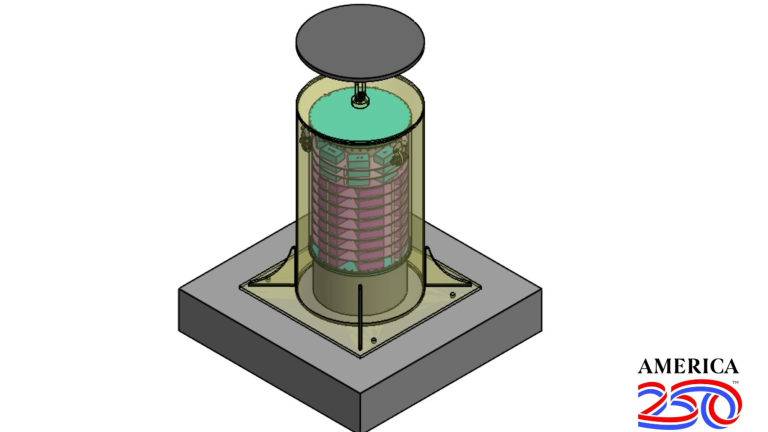
Inside the Viper is a disk [right] with a series of dampeners that cancel out soundwaves that could cause an explosion.
John B. CarnettViper
Cost to Develop: $250,000
Time: 2 years
Prototype | | | | | Product
If we’re ever going to see a true era of commercial space travel—a day when Virgin Galactic is just another spaceline—Tim Bendel believes we need a better rocket engine. Specifically, something that is to the space industry what the internal combustion engine was to the nascent car industry a century ago: a standard, off-the-shelf option that can power any manner of vehicle, from tourist ship to lunar lander. And it has to be affordable to companies not owned by billionaire Richard Branson.
Bendel’s solution is a 50-pound prototype rocket engine called the Viper that sits in a decommissioned nuclear-missile silo hidden in the High Plains ranchland outside Chugwater, Wyoming (pop. 244). Bendel, a former Lockheed Martin propulsion engineer, says that the Viper’s simplified design—which, for example, handles cooling with a disposable liner instead of complex tubing—will make it cost a fraction of what today’s engines do. And it will be more versatile because it will give pilots a greater range of thrust.

The problem is that as you reduce a rocket’s thrust, you reduce the pressure in the engine chamber, and that alters the sound waves bouncing around inside. If those sound waves resonate, it can increase heat and pressure in parts of the engine so greatly that the engine could explode. The Viper is designed to absorb these sound waves before they cause problems. It uses a combination of acoustic dampeners—a series of holes tuned to different frequencies—as well as a cylinder that pushes sound waves out of phase. “Basically what we’re trying to do,” Bendel says, “is make a flute that can’t hold any notes.” Most rocket engines are designed to cancel out only a narrow field of sound waves; the Viper’s sound-dampening system gives it a much wider throttle range.
And whereas other space-tourism rockets are being built for one specific ship, the Viper’s design is so versatile, Bendel is building it on spec. “It’s up to the market whether people are going to buy it or not,” says Bob Steinke, president of SpeedUp, a start-up that’s using one of Bendel’s earlier engines to power its Lunar Lander Challenge entry.
Bill Stone, president of Stone Aerospace, an Austin, Texas, company that makes robots, space suits and other space-exploration equipment, thinks the Viper could become “a tool for smart, nimble, small aerospace companies. Rather than going to Lockheed, we just go to Tim and say, ‘I want a Viper’ or ‘10 Vipers.’ ” A company that wants to enter the space-tourism market could build a craft around the Viper instead of designing its own engine. Similarly, a lunar-lander mission could use a few Vipers to handle the variety of tasks—leaving orbit, landing, taking off again—that now require 10 engines.
Bendel’s company, Frontier Astronautics, is even applying for an FAA permit to turn the Wyoming missile complex into a spaceport. “It’s kind of a gold rush,” Bendel says of the current era. “Everyone’s trying to get their stake in the market. And we’re selling shovels.”


Comments
power i wonder what kind Yılan yağı
1 out of 1 people found this comment helpfulnot only is this just cool but all the amputies coming from war will now(soon) have a normal life. Kargo 1 out of 1 people found this comment helpful Cargo second is Lida power i wonder what kind of battery pack it requires to run one of those Lida
power i wonder what kind Yılan yağı
estetik not only is this just cool but all the amputies coming from war will now(soon) have a normal life. Kargo 1 out of 1 people found this comment helpful Cargo second is Lida power Tatil i wonder what kind of battery pack it requires to run one of those Lida
0 out of 0 people found this comment helpfulthank you !
0 out of 0 people found this comment helpfultrhank tyou very nice.
Team
0 out of 0 people found this comment helpfulTatil
thank you..
gw0
0 out of 0 people found this comment helpfulaussepom
an air breathing rocket engine has all ready been designed,
0 out of 1 people found this comment helpfulthe heart of the development is the Oz Injector, it has many other uses, retrofit into the gas turbine.
some parts have already been made others are to be made as funds become available.
the OZ Jet, can work in the atmosphere at low or high altitude, or space, this last requires closing the air intake.
the main object at the moment is to test and retro fit into a gas turbine.
some details
from 2,046Mj per hour smallest unit
to 94,625Mj per hour
the output is a flame temperature possible 2,800deg C
funding is my main problem.
another use is in the
power generation this is used in the combustion chamber of a Suzer type boiler, instead of COAL.
ome details
0 out of 0 people found this comment helpfulfrom 2,046Mj per hour smallest unit
to 94,625Mj per hour
the output is a flame temperature possible 2,800deg C
funding is my main problem.