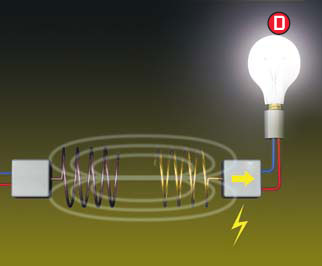
Scientists have known for nearly two centuries how to transmit electricity without wires, and the phenomenon has been demonstrated several times before. But it wasn't until the rise of personal electronic devices that the demand for wireless power materialized. In the past few years, at least three companies have debuted prototypes of wireless power devices, though their distance range is relatively limited [see "Power Brokers," next page]. Then last year, a team at the Massachusetts Institute of Technology set the stage for wireless power that works from across a room.
The key to wireless power is resonance. Think of a wineglass that shatters when an opera singer hits just the right note. When the voice matches the glass's resonant frequency—the tone you hear when you tap the glass—the glass efficiently absorbs the singer's energy and cracks. Using magnetic induction and two identical copper coils that resonate at the same frequency, the MIT scientists successfully powered a 60-watt lightbulb from a power source seven feet away. The team called their invention WiTricity, short for "wireless electricity." Next up: sending the juice even farther and more efficiently.
Stay up to date on the latest news of the future of science and technology from your iPhone with full articles, images and offline viewing
Featuring every article from the magazine and website, plus links from around the Web. Also see our PopSci DIY feed
Share links with friends, comment on stories and more
In our December issue, Popular Science names the 100 best innovations of the year: bombproof wallpaper, self-parking cars, the fastest helicopter, and 97 more. Plus inventor profiles and videos.
Check out the best of what's new here.
The new site is excellent. It's so much easier to navigate and the design is fantastic. Congrats. I work in pharmaceuticals so I've seen what the future looks like. Pop Sci is on its way.
test
there are recent newscasts stating how wireless ANYTHING is harmful to humans and while i have a difficult time swallowing that, i somehow think that once this witricity technology becomes popular, there'll be newscasts on how it's harmful to us.
seems to me that it's probably more harmful than simple radio waves though....
Wouldn't this put off similar magnetic forces that the high voltage overhead powerlines were suspected to casue cancer and birth defects to those that work or live near the high power lines?
The concept of wireless power is interesting but (and I mean a big BUT) given our current concerns about conserving resources this is not a good idea. It doesn’t make sense when we are switching to CFL’s and LED for lighting that we would employ a technology that cast energy off into the “ether” for the sake of connivance. This technology should only be employed where there is no viable alternative such as electronic implants. Wireless power will never be as efficient as good old copper wire.
I would have to say that I feel this technology is a must, and now. Remember the sticky metal screens for cell phones they use to sell on t.v. that "filters out bad" waves before they enter your ear and give you cancer? I feel that kraylus has a valid point but needs to keep in mind the fact that technology grows exponentially. Meaning that sure give us some time and we can make electricity wireless, but at the same time there is progress being made in human research as well. We are able to detect things that harm us much faster, and more accurately. Why would we ever back track and come out with a new technology (especially wireless electricity) without testing it?
Folks, you need to understand the difference between electric and magnetic fields. There is no evidence whatsoever that magnetic fields cause us any harm (Think, MRI machines?). Electric fields on the other hand, cause us harm based on the strength of the waves hitting you and the duration of exposure and, of course, the frequency band in question. Each molecule in your body contains electrons, 'static' (not in your casual definition, but stationary) electric charges, that are or can be adversely affected/energized improperly due to Electric Fields; there do not exist 'static' magnetic charges, therefore magnetic fields are not known to adversely affect us. The researchers at MIT use only magnetic fields at the correct resonance to transmit the power wirelessly. I recommend you read up on the advances in magnetic field research and their effect on the human body; particularly, look at studies of the after effects of MRIs ( of various types ), of which the conclusions are harmless. There are several studies with regard to very high gauss magnetic fields (even for uses including levitation), many of which are ongoing. Good luck.
Might have been a good idea when Tesla was alive but it would take extreme amounts of input power to light a lamp etc. This is not an idea for our times when we have global warming etc. to worry about.
For low power applications it sure would be nice to eliminate all the wires. Maybe this would drive inventors even harder to find more efficient devices to utilize this tech.
However, if they ever try to transmit voltage long distances it would be interesting to see how they plan to keep people from stealing electricity.
I think this technology, if it could be used for greater amounts of power would solve many of the problems with electric cars.
Imagine building grid wires into the lanes of major arterials, or along the guard rails and highways. Cars would have a simple plate on the bottom to be powered by witricity.
Most battery cars have a range of 40 miles. That could be used when going "off grid" into side streets and all.
other sources and ways to transmit power wirelessly
http://youtube.com/watch?v=1yyIpD_sMFs&feature=related
One very interesting application of this concept is the placing of solar cells in orbit, and the transmission of that power to a reciever on Earth. In time, such a project would pay for itself. To be on the safe side, untill we know more about biological effects and how strong the beam needs to be, we need to keep people out of the reciever area if located on land.
Good article
العاب-العاب بنات-العاب فلاش-العاب اطفال-العاب تلبيس
العاب طبخ-العاب ذكاء-العاب بنات فقط-صور حب-صور بنات
Thanks
The effect of radiation on humans is still not completely understood. Take the radiation effects on humans that do not show cancer for 12 - 15 years. Magnetism can induce radiation. Therefore, it is possible that much of the magnetism that we feel is harmless, may be found to cause radiation in our cells that is absorbed by our cells before it is even detected, and then causes a new heretofore unknown cancer or genetic defect.
I want the witricity to be safe, but it may not be possible to ascertain its safety in our lifetime. Mankind is usually found to be killing his or herself for a very long time before realization of this fact.
I disagree with those whom saying system has to be inefficient. Because in close range using the method of induction the efficiency of power transfer was already around 95%.
Making a research about improving the distance 15-20 times (7 feet), MIT can sure improve the efficieny with further researching.
from Union City, Tennessee
I think that this will call for more power to be used. It is good to see that someone else had this idea. I have been trying to find a way to do this since the 6th grade science fair. I havent been able to yet but I will one day :)
from Midland, MI
familyman1962 - Space is our only option
Jabailo, I totally agree with your take on this. I have been considering this for about 6 months. As the country considers a new smart electric grid, I would suggest we route this grid over the current highway system. We then build an elevated roadway above the current highway solely for electric powered vehicles that have the proper inductive device to power their vehicle while traveling on this new highway. They can be billed monthly for using this system. Eventually, the electric cars can be placed on autopilot while on this road and accelerated to much higher speeds than on current highways, allowing "trains" of cars the ability to travel across the country in half the time currently required. It would be a significant cost, but when you consider the number of jobs it would create, it would be much better than the current waste of money the government is squandering. Glad to see someone else on the right track.