
Despite all the trendy concept drawings you may have seen, trees actually hate living on top of buildings.

Vertical Forests
Vertical Forests Concept for the Bosco Verticale, or "Vertical Forest," high-rises. These buildings are now under construction in Milan. Picture by Boeri Studio (Stefano Boeri, Gianandrea Barreca, Giovanni La Varra)

You've seen them. Those artists' renditions of futuristic skyscrapers, with trees growing in rooftop gardens or mid-building parks. City living is hard on the human psyche, so architects imagine that in the future, we'll have soothing green spaces built right into our high-rises.

Not so fast, environmental researcher-turned-journalist Tim de Chant writes on his blog. Trees often don't grow well on top of skyscrapers, De Chant explains, for a few crucial reasons.

First, it's much windier up there, which strips the tiny protective layer of air every leaf maintains. Some plants evolved to live in hot and windy climates and have adaptations to deal with this, but they aren't the tall, straight-trunked trees most often seen in drawings of green architecture.

Also, the weather really sucks. Temperatures are more extreme, and the velocity of rain, hail, snow and sleet is greater.

De Chant advocates spending time and money to preserve ground-level green spaces instead, which is a great idea. But what if, at the same time, we just ended up with skyscrapers growing the kinds of trees evolved for mountaintops and sea cliffs? That could be pretty cool:
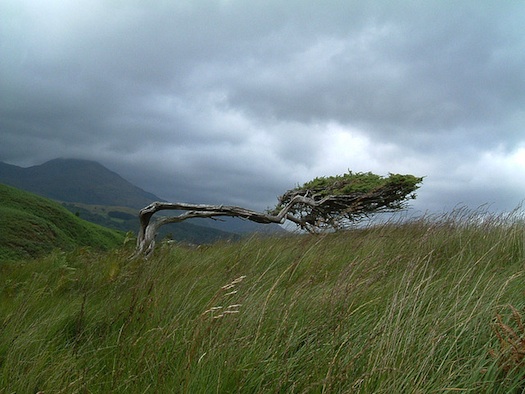

Mountaintop Tree
Mountaintop Tree:  Photo by Alan, CC BY-NC-SA 2.0

[Per Square Mile]

10 Comments

I feel like the problems that de Chant brings up are about as important as the problems with using a blue pen instead of a black pen. Common sense would dictate that you use plants on the buildings that are best suited to the climate and conditions. Besides that, after a very short distance, rain, sleet and snow will reach a maximum velocity anyway. I'm really surprised this actually made the 'news'.

Ditto @ thepriebe

Isnt this just the problem for science....?

When was the last time you heard science tackling a problem by saying "Well I guess it cant be done, onto the next thing!"

Excelsior!

Oh, so you mean all those trees that are on buildings right now are not happy?
Well sorry Mr De Chant, we will apologize to the trees at once and remove them from the buildings.
After all you are an expert at theoretical researcher-turned-journalism.

I would love an explanation of why, "the velocity of rain, hail, snow and sleet is greater". I can't think of why this would be the case. I think precipitation hits terminal velocity pretty quickly after falling from a cloud and after that it is pretty steady. Maybe this is related to more wind (as a sideways velocity) rather than falling downward faster, as seemed to be implied?

All sorts of trees and plants live on mountains. They'd do just fine on a tall building too.

I don't think this author knows just how windy it can be on top of Colorado mountains where trees still grow fine up to 12,000 feet. Last I heard the highest building going up soon will be 3500 feet so altitude sure isn't going to be a problem.

And wind isn't either.

Up in the mountains the winds routinely top 100 mph and often up to 150 to 175 mph so the person who wrote this article is just a media sensationalist without any scientific credibility.

If governments and society are not willing to plant more trees horizontally, I see the likely hood of making tall buildings and growing them vertically unlikely.

Second, if this also an apartment complex, I trees also come with wildlife and bugs, which is not good for people or the structure of the building.

If a person walking on the street is hit in the head by a falling branch, can I make a law suit against the owner of this building?

I see this working just fine with Artifical trees. SO YES ARCHITECTS, YOU CAN PLANT TREES ON SKYCRAPERS.

More and more of these posts sound "Troll-y". Like the work of Trolls that is. Better suited for the Gizmodo crowd.

You know PopSci, instead of writing this crap a more scientific approach would have been to call up the Architects and invite them to do a piece/interview with PopSci on their design, the challenges they encountered, what engineering solutions they came up with and how they implemented them. Did they conduct any field testing of the concepts? What were the results??

I would have found this much more fascinating than some uneducated rant about trees and wind from and 'Armchair Architect' (if there ever was one).

Hail, rain etc would go faster higher up because the air is thinner. This equals less resistance which equals a higher terminal velocity, since terminal velocity is determined by how much air friction their is. less air means less friction..... however as someone pointed out, and I agree since I live in Denver at 5280 feet. Trees grow just fine up here!


June 2013: American Energy Independence

Five amazing, clean technologies that will set us free, in this month's energy-focused issue. Also: how to build a better bomb detector, the robotic toys that are raising your children, a human catapult, the world's smallest arcade, and much more.


Online Content Director: Suzanne LaBarre | Email
Senior Editor: Paul Adams | Email
Associate Editor: Dan Nosowitz | Email
Assistant Editor: Colin Lecher | Email
Assistant Editor: Rose Pastore | Email

Contributing Writers:

Kelsey D. Atherton | Email
Francie Diep | Email
Shaunacy Ferro | Email

circ-top-header.gif
circ-cover.gif