
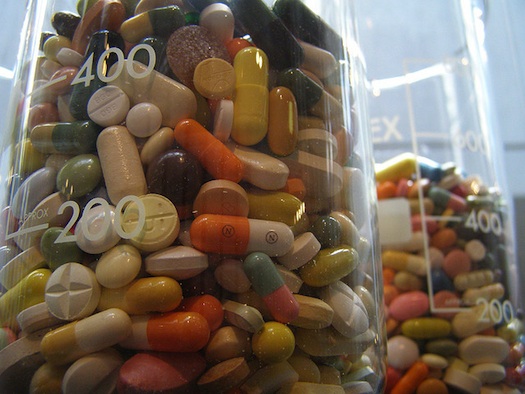
Think of the children! Or at least the medical students—and their future patients.

Pharmaceutical companies start talking with doctors early in their careers
Pharmaceutical companies start talking with doctors early in their careers Photo by Erich Ferdinand, CC BY 2.0

In spite of medical schools' efforts to shield budding doctors from the dark forces of the medical-industrial complex, more than half of medical students end up receiving gifts from pharmaceutical representatives by the end of their fourth year, according to an upcoming study.

The study's lead scientist, a physician and researcher at Brigham and Women's Hospital in Boston named Aaron Kesselheim, explained the problem for the hospital:

In medical school and residency, as trainees are learning the fundamentals of their profession, there is a need to ensure the education they receive is as unbiased as possible," said Dr. Kesselheim. "However, it is well known that promotional information and gifts from pharmaceutical companies can encourage non-evidence-based prescribing.* Though many institutions have tried to insulate trainees from these effects, trainees' exposure to industry promotion is still quite high.

Kesselheim and a fourth-year Harvard medical student, Kirsten Austad, surveyed more than 2,000 medical school students and residents from every school in the United States. They asked students how often they interacted with pharmaceutical company reps, what kind of gifts they received and what they thought of their interactions.

Kesselheim and Austad found that even tender first-year students often interacted with pharma reps, and one-third of first-years reported getting gifts. The majority of students said they thought the pharmaceutical industry gave them "valuable education," but also opened them up to bias. The majority supported reducing how often industry members can talk with students.

The study will be published this week in the Journal of General Internal Medicine. And for an overview of how often the pharmaceutical industry talks with doctors, and how that affects what doctors choose to prescribe, check out this 2000 review.

[Brigham and Women's Hospital]

5 Comments

I knew that a medical student had to be involved in this. I am a fourth year medical student and the funny thing is the most that pharma reps can give is a pen or pad and allow us to eat at lunches that are for the docs that we are rotating with. I bet this is how they posed the question. Which is why 50 percent would say yes because we as students love to get free food. Most of us zone out and dip early on these meetings. Many of these drugs are so specific to specialities that it would be a waste of time and money to focus on all medical students. These types of studies are an insult to us students. In regards to what gifts physicians can be given from pharma reps, there is strict legislation a that regulates what we can accept. It's stricter than the legislation that politicians have for themselves. As a fourth year student we still have 3 to 7 years before we practice by which time the patents run out and they go generic so it is quite pointless to give us anything. Interacting with pharma reps I can tell you they don't care about is students in terms of earning our business or trust.

Seeker - so nice to hear a report from someone who actually knows what's going on.

Certainly they want you to associate their company names with a positive experience -- but that sounds like the most that they'll get.

Sounds like you have been bought seekerofthetree. Most of the drugs bigpharma sells have far more harm then benefit. I suppose you are taught to prescribe up to 12 pills to counteract side effects. Perhaps you should review your notes on the liver.

This study is not an insult to students. It shows how an industry that is so corrupt that it puts profit before healing people operates. The drug companies fund the studies that show their drugs are safe, while hiding the side effects that kill people.

As for the legislation, it is rarely if ever enforced. Big pharma reps regularily drop off samples to every clinic in the developed world. Perhaps once you get of school you can see the reality.

Strange how both posts above mine , i have never seen their names before. Perhaps they arent even what they say they are? Its pretty easy to be anonymous, especially for cheap PR reasons.

Yeah you definitely have better info than seeker. What do you do? I bet your not a student in med school. I've seen a few of your posts as well and the are always inflamatory.

Makes one wonder if your just a troll trying to start a flame war?

I have to agree with Dkella, Big Pharma is just too profitable. Whatever benefit these drugs can have is slipping away to shorter testing times and underhanded bribes to get people to look the other way. Having talked to a number of my friends they are either convinced these prescription drugs are not what they were advertised to be or grateful for them but slipping into greater and greater mental ills that yet another drug prescription is made out for. Something is very wrong here.


June 2013: American Energy Independence

Five amazing, clean technologies that will set us free, in this month's energy-focused issue. Also: how to build a better bomb detector, the robotic toys that are raising your children, a human catapult, the world's smallest arcade, and much more.


Online Content Director: Suzanne LaBarre | Email
Senior Editor: Paul Adams | Email
Associate Editor: Dan Nosowitz | Email
Assistant Editor: Colin Lecher | Email
Assistant Editor: Rose Pastore | Email

Contributing Writers:
Rebecca Boyle | Email
Kelsey D. Atherton | Email
Francie Diep | Email
Shaunacy Ferro | Email

circ-top-header.gif
circ-cover.gif