
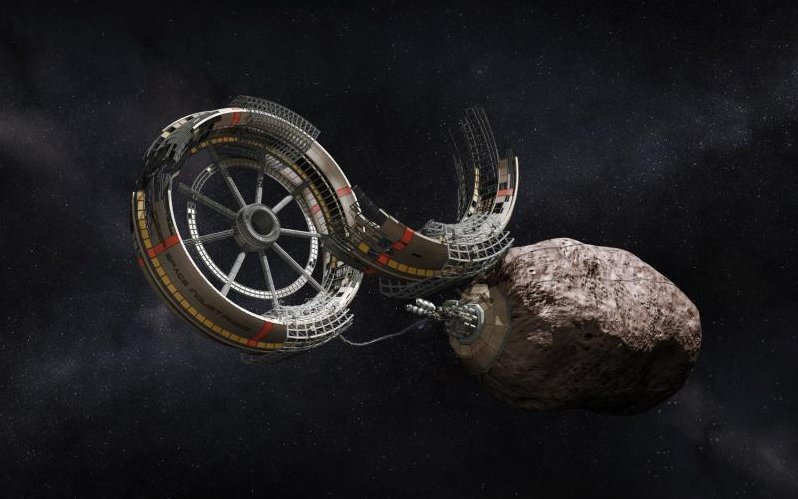
Another new asteroid mining venture plans to send fleets of small spacecraft to rendezvous with space rocks, aiming to harvest their contents. That makes two startups now in the asteroid-rush of the early 21st-century teens. This one also plans to use asteroid materials right where they’re found, as feedstock for spaceborne 3-D printers.
Deep Space Industries will unveil its plans later today at the Santa Monica Museum of Flying, but here’s a sneak peek.
“They can be like the Iron Range of Minnesota was for the Detroit car industry last century--a key resource located near where it was needed,” said CEO David Gump, previously of Astrobotic, a competitor for the Google Lunar X Prize. “In this case, metals and fuel from asteroids can expand the in-space industries of this century.”
Competing asteroid mining venture Planetary Resources aims to use robotic spacecraft to exploit near-Earth objects. The company plans to harvest asteroid ice for rocket fuel, and for platinum-group metals like palladium, iridium and platinum itself. In announcing its foundry plans, Deep Space seemed to scoff at rare-metals as an ultimate goal: “Mining asteroids for rare metals alone isn’t economical, but makes senses if you already are processing them for volatiles and bulk metals for in-space uses,” said Mark Sonter, a member of the DSI board of directors.
The company’s leadership has some space credentials--chairman Rick Tumlinson signed up the world’s first space tourist, Dennis Tito, and is a founding trustee of the X Prize. But there’s one major difference between DSI and Planetary Resources, and that’s funding. PRI’s high-profile backers include Eric Schmidt and Larry Page from Google, filmmaker James Cameron, Ross Perot Jr. (son of the former presidential candidate), space tourism pioneer Eric Anderson, and X-Prize founder Peter Diamandis, among others. DSI is looking for sponsors.

140 years of Popular Science at your fingertips.
Each issue has been completely reimagined for your iPad. See our amazing new vision for magazines that goes far beyond the printed page
Stay up to date on the latest news of the future of science and technology from your iPhone or Android phone with full articles, images and offline viewing
Featuring every article from the magazine and website, plus links from around the Web. Also see our PopSci DIY feed
Engineers are racing to build robots that can take the place of rescuers. That story, plus a city that storms can't break and how having fun could lead to breakthrough science.
Also! A leech detective, the solution to America's train-crash problems, the world's fastest baby carriage, and more.


Online Content Director: Suzanne LaBarre | Email
Senior Editor: Paul Adams | Email
Associate Editor: Dan Nosowitz | Email
Contributing Writers:
Clay Dillow | Email
Rebecca Boyle | Email
Colin Lecher | Email
Emily Elert | Email
Intern:
Shaunacy Ferro | Email
from Northfield, Vt
Does anyone know how they plan on refining the material? Or any of the processes of creating metals and materials. I know that the current processes require gravity. Links are appreciated.
Once a profit making scheme happens to be in\about\through space, then humanity will move there.
Until there, humanity and business will keep their feet on the ground.
I am for being in outer space; I just believe better planning of how to make profit of some action in space must be established first.
Until then, we are just explorers! Which is nice too!
I wonder if the name FireFly came from the TV series of the same name.
lanredneck - I imagine some kind of chemical extraction process + centrifuge and/or a pulverization screw to grind everything down to grit then again some kind a centrifuge separator.
Or they could just not process in space at all, just simply pack it into "freight" containers and drop them from orbit to a designated drop site, aka a "Space Harbor"
Alternately, the moon could be used as a refining base as it may have enough gravity to use traditional refining processes AND it's gravity is low enough to allow for easier launching of the processed ore; its lack of atmosphere will make "Dropping" freight containers on its surface an easier task as well since there would be no risk of them burning up in the atmosphere.
Plenty of options available.
I suppose capturing a comet and selling water to the miners on an asteroid, planet or moon, could be profitable.
So how does one caputure a comet anyways?
The above picture reminds me of a cosmic motorcycle for Monty Python, lol
This will be interesting to watch unfold over the next couple years.
It's about time people quit looking for ET and start putting money towards useful things like resource prospecting. If it shows promise we can stop chopping up earth and use the resources from cold dead space.
@ robot-
The way suggested by Zubrin is to use a Nerva-type nuclear thermal rocket that uses the ice of the comet as fuel. The rocket would be installed at a point in the comet's orbit at which it is not out-gassing.
@Bagpipes100
don't hold yer breath! Nothing will happen in the next couple of years. That they have suggested so tells you how legit they are. Apparently they don't even have the financial resources needed although that would be by far the easiest of the steps.
The whole idea of space factories in this day and age seems foolish. Such a set up would require significant maintenance making it highly impractical. There is nothing even remotely related on Earth! Maybe 50 years from now but no sooner unless there are some significant scientific discoveries before then that can be utilized.
A 50 or 75 pound piggy-back microsat could not be designed to have anywhere near enough propellant and payload to travel from the launch trajectory path of a commercial satellite, rendezvous with a passing asteroid, and then return to earth with a payload.
Not to mention the fact that most asteroids which will pass close to earth are not detected until they are only within a few weeks away from our planet.
Nasa has already mapped nearly a million near-earth asteroids. They know where they are, and they know their orbital paths. We can detect objects coming to our planet far sooner than a couple of weeks. You underestimate our technology. Our telescopes are far more advanced than you think.
A start up company that hasn't done anything in space is going to develop a series of space craft and space manufacturing technologies, with no funding. At best they will dump billions of dollars for the next 5 to 10 years with no return on the investment. At the end of the development period the will have develop a transportation system to move the manufactured products to the point of use, another few billion dollars. Don't think so.
hollycow,
BINGO!
I ain't buying it because I just can't see the international community putting up with mining asteroids until we can model the mass relationship effects of doing so. The more valuable the asteroid, the more it's mining will affect it's neighbors, and theirs, and so on.
So just how many asteroids accidentally or negligently sent into the inner system is acceptable for these people who have no more idea what they are doing than anyone else, including NASA? Ping! Didja see that vidclip of that heavy matter coming off that sucker? How fast you think it was goin? I dunno. Is it gonna hit anything? I dunno. Oh crap! The whole asteroid just cracked apart! Think these twenty thousand or so asteroids nearby are gonna send any chunks at anything? I dunno.
As of today, that would be the scenario at risk.